An SEO proposal for link building has one job: let the client sign off on exactly what they are buying before you spend a dollar with a publisher. A good link building proposal sets a count of links per month, the standard every link has to meet, how paid links are tagged, what you will report, what it costs per unit and what is not included, all on a few pages the client can approve in one sitting.
Most SEO proposal templates are written for audit and content retainers, where the agency sells hours. A link building proposal sells units, and every unit carries a cost you pay out before the client sees a result. Below are the seven sections that cover it, a template you can copy, a worked pricing example, the fees to spell out so nothing surprises the client, and a cover email to send it with.
What a link building proposal has to settle
Write the proposal around the four questions a link client will ask later, usually when something goes wrong:
- What counts as a delivered link? A placement on a site you picked, or a placement on a site that meets written criteria and was live when you checked it.
- Who decided the site was good enough? You, the client, or both, and on what record.
- What happens when a link disappears? A replacement window, written down, or nothing.
- Why did this month cost what it did? A per-link price and a fixed fee that tie straight to the invoice.
Answer those four in the proposal and the contract, the brief, the reports and the invoices all follow from it. Leave them vague and each one becomes a negotiation after you have already paid the vendor.
What winning proposals look like
One of the larger public datasets on proposals comes from proposal software, not from SEO. Proposify's State of Proposals 2026 covers 742,137 proposals across 30 industries, sent in 2025. It is not specific to agencies, but the patterns carry over to any service sold on a signed document.
| Finding | Number | What to do with it |
|---|---|---|
| Length of winning vs losing proposals | 11 pages vs 13 pages | Cut the SEO education section. The client already decided they need links. |
| Sections in a winning proposal | 7 on average | Use the seven sections below and stop there. |
| Time spent reading winning vs losing proposals | 25.3 vs 15.8 minutes | Put the price and the link standard where a skimmer will find them. |
| Views of winning vs losing proposals | 12 vs 8 | Expect the proposal to be forwarded. Write it for a finance reader too. |
| Several stakeholders viewing | 20% higher close rate | Ask who else signs off and send it to them directly. |
| Interactive pricing | 21% more likely to close | Let the client pick the monthly link count from two or three options. |
| Client input forms | 41% close rate, against a 34% average | Collect target pages and competitor domains inside the proposal. |
| E-signature | 15% higher close rate, closes 60% faster | Never send a PDF that has to be printed and scanned. |
The same report found that proposals with recurring fees carried an 18 times higher deal value, which is the case for selling links as a monthly plan rather than a one-off batch. It also tracked revisions: proposals that went through one, two or three rounds of changes closed more often than those signed as first sent.
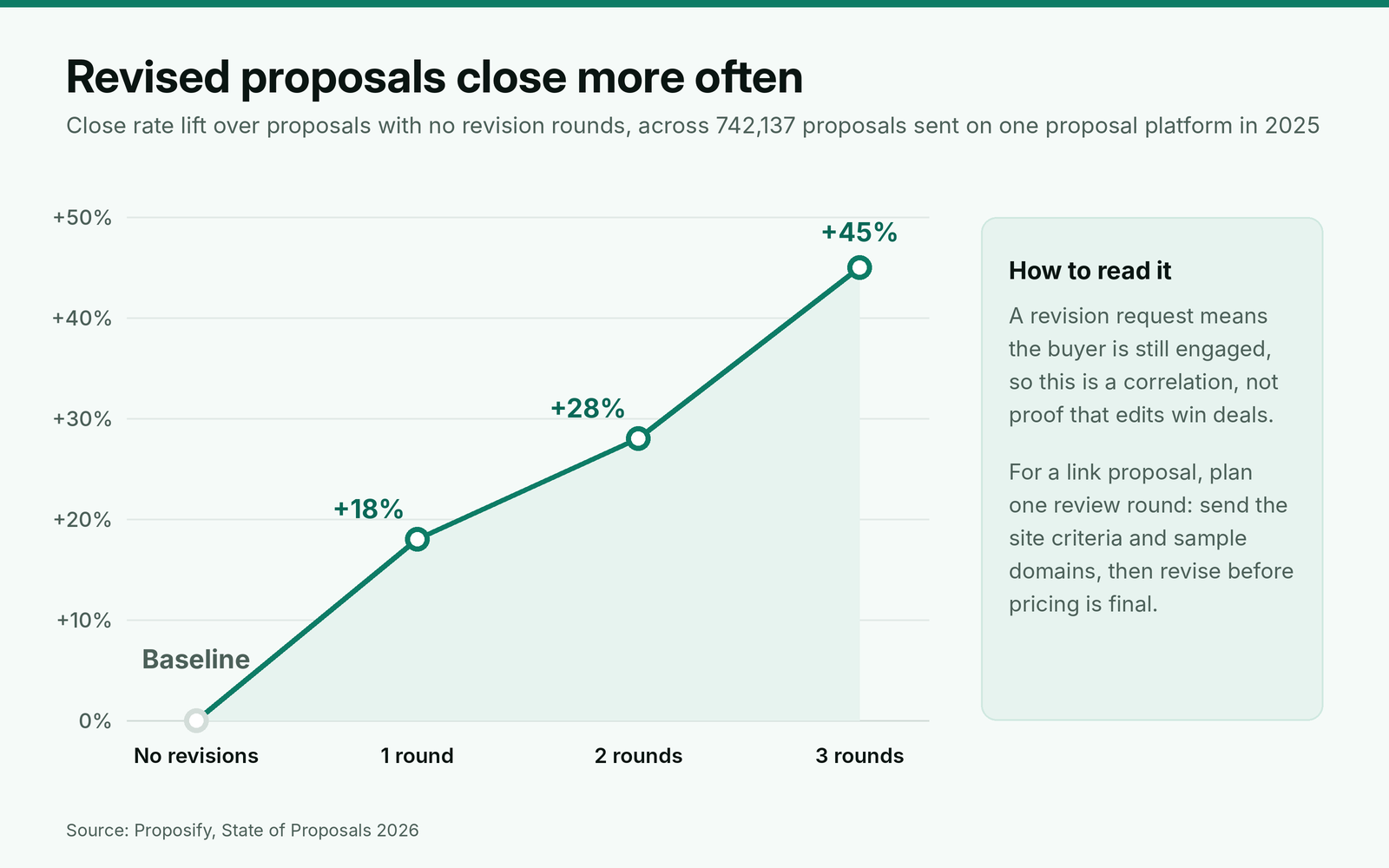
Read that as a signal, not a tactic. Nobody wins by adding deliberate errors. In a link building proposal, the natural revision point is the site criteria: send a sample of five domains that meet your standard, let the client react, and fix the criteria before the price is locked.
The seven sections of an SEO proposal for link building
Each section below says what goes in it and what to leave out. The full template follows.
1. The goal, in one paragraph
Name the pages that need links, the searches they should rank for and the business reason. "Move the three pricing comparison pages from page two to page one for their main terms" is a goal. "Increase domain authority" is not, and it is the kind of promise a client can hold you to with a free tool.
2. Where the site stands now
Give a baseline the client can check: referring domains to each target page, the same count for the two or three competitors ranking above them, and current clicks and positions from Search Console. Keep it to one table. This is the number you will compare against at the quarterly review, so take it from a source you will still have access to in 90 days.
3. The link plan
State the monthly link count per target page, the link types (guest posts, niche edits or both) and the anchor approach. Link counts should come from the gap in section 2, not from a package size. If one page needs 12 more referring domains than its competitors and another needs 3, the plan should say so. Agree the anchor rules here too, set page by page rather than as one keyword list for the whole site. If the client asks why guest posts are in the mix at all, point them to when a guest post is worth buying rather than earning.
4. What counts as a delivered link
This is the section most SEO proposal templates skip, and the one that matters most to a link client. Write down the minimum standard for a site: real organic traffic in the client's main country, a relevance threshold, no outbound links to casino, loan or essay sites in recent posts, and a live, indexable page. Then say who approves each domain before purchase, the step that sits between the brief and payment in a backlink buying process that runs from brief to live link. The checks themselves are the website vetting steps that sit behind a written quality floor. Give the indexable page a date too, such as indexed within 30 days of going live, and set out an indexing deadline for each placement page the same way in your vendor terms.
Add the paid link policy in the same section. Google's guidance on qualifying outbound links says paid placements should carry rel="sponsored", with rel="nofollow" still acceptable. Some clients accept untagged paid links and the risk that comes with them; some do not. Either way, the client chooses in writing, and the proposal records a written rel policy the client can sign. If a vendor sells untagged placements as editorial, the questions that test a placement sold as editorial belong in that conversation too.
5. Timeline and reporting
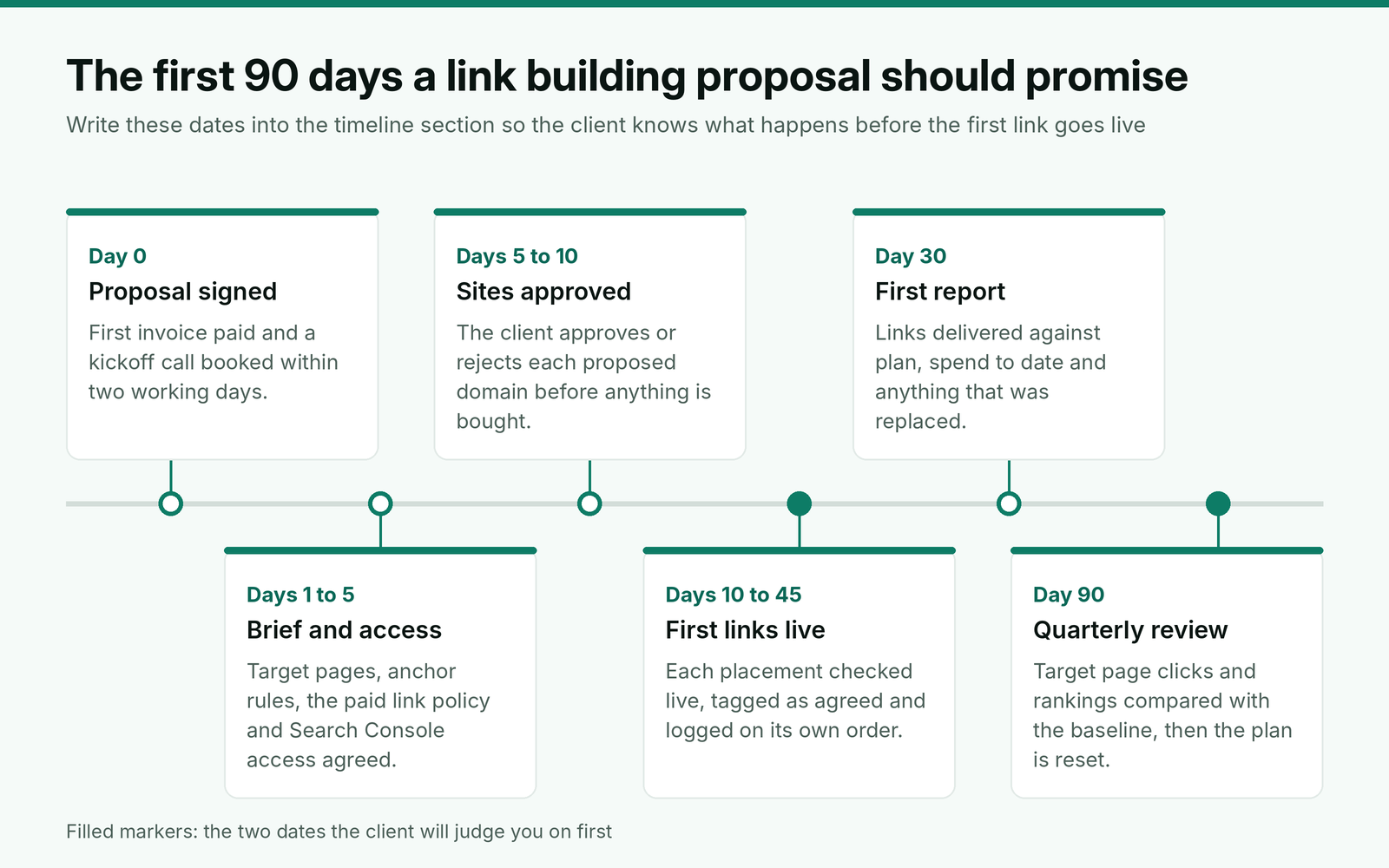
Give dates, not "results in three to six months". The client cannot judge rankings in month one, so they will judge you on what they can see: whether the brief was agreed, whether they approved sites, whether links went live on schedule and whether the first report matched the invoice.
Promise a monthly report and say what it contains. Ours lists every placement with its live URL, anchor and tag, spend against plan and any replacements; the layout follows a monthly link building report template. Name the delivery numbers it will show, such as live rate and time to live, using KPI definitions with formulas and working targets, so the client signs off on how each one is counted. Rankings and clicks belong in the quarterly review, measured against the section 2 baseline.
Avoid ranking guarantees. Google's own advice to site owners on hiring an SEO says plainly that no one can guarantee a number one ranking and tells them to find someone else if an SEO does. A client who has read that page will trust a proposal that guarantees placements and process far more than one that guarantees positions.
6. Price and terms
Price per link, plus a fixed monthly fee for strategy, vetting and reporting. That split makes the invoice explain itself: six links at the per-link price, plus the fee. The per-link figure should come from your cost and target margin, set when pricing link building services before you quote. Then list the terms that protect both sides: payment timing, minimum term, a replacement window for links that go missing and what happens to links already placed if the client cancels. An SEO contract template turns those terms into signed clauses for link building clients.
7. Acceptance and next step
One page: the plan the client chose, the monthly total, the start date and a signature field. Add a short intake form for target pages, competitor domains and Search Console access, since filled-in forms correlated with a higher close rate in the data above. Ask for a restricted Search Console user, which is enough for reporting, and set up what link clients see once they sign in your client management software. What happens in the two weeks after the signature belongs in an onboarding plan that turns the signed proposal into a first order.
SEO proposal template for link building
Copy this into your proposal tool and replace the brackets. It is written for a monthly plan with a per-link price.
Proposal: Link building for [client name], [month year] start
1. Goal
Earn links to [target page 1], [target page 2] and [target page 3] so they rank on page one for [main term 1], [main term 2] and [main term 3], which drive [demo requests, sales or sign-ups].
2. Where you stand
[Target page 1]: [x] referring domains. The top three results for [main term 1] average [y].
Search Console, last 90 days: [clicks] clicks, average position [z].
We will compare against these numbers at the day 90 review.
3. Link plan
[n] links a month: [a] to page 1, [b] to page 2, [c] to page 3.
Link types: [guest posts, niche edits or both].
Anchors: [share] branded or plain URL, [share] partial match, no more than [share] exact match per page.
4. What counts as a delivered link
Every site has [minimum] monthly organic visits from [country], covers [topic] in its recent posts, and links to no gambling, loan or essay sites in its last five posts.
You approve every domain before we buy it.
Paid placements are tagged [rel="sponsored" / as agreed in writing].
A link counts as delivered when it is live in the body of the article, on an indexable page, with the agreed anchor, target URL and tag.
5. Timeline and reporting
Brief and access agreed by day 5. First site list for approval by day 10. First links live by day 45.
Monthly report on the [date] of each month: every link with its live URL, anchor and tag, spend against plan and any replacements.
Quarterly review on day 90 against the numbers in section 2.
6. Price and terms
Option A: [n] links a month at $[price] each, plus $[fee] for strategy, vetting and reporting = $[total] a month.
Option B: [m] links a month at $[price] each, plus $[fee] = $[total] a month.
Invoiced [monthly in advance / on delivery]. Minimum term [three] months, then [30] days' notice.
Links lost within [six] months of going live are replaced at no charge.
Links placed before cancellation stay live and remain yours.
Not included: [see the list of extras and their prices].
7. Next step
Choose an option, fill in the intake form (target pages, competitor domains, Search Console access) and sign below. We start on [date].
[Your name]
[Title, agency, URL]
Keep the template short on purpose. If you need a case study, put one link to it in section 1 instead of three pages of results from other clients.
Pricing the proposal: a worked example
Two outside reference points help when you set the numbers. In a 2025 survey of 518 SEO professionals, reported by Search Engine Land, the average acceptable price for one high-quality link was $508.95, agencies put 32.1% of their SEO budget into links, and 80.9% expected link building costs to keep rising. On the agency side, Clutch's SEO pricing guide puts the average monthly cost of an SEO engagement at $3,199.19, with $100 to $149 an hour the most common agency rate and a typical project running 12 months.
Here is a made-up example. A SaaS client wants links to three comparison pages, and the gap analysis supports six links a month.
| Line | Per link | Six links a month |
|---|---|---|
| Average vendor or publisher cost, article included | $240 | $1,440 |
| Your vetting, approval and live check (about 45 minutes at $75 an hour) | $55 | $330 |
| Your cost | $295 | $1,770 |
| Client price per link | $475 | $2,850 |
| Fixed fee: strategy, monthly report, quarterly review | $450 | |
| Monthly total to the client | $3,300 |
The per-link price of $475 sits below the survey's $508.95 average, and the monthly total lands close to the Clutch average for an SEO engagement, so the client's finance reader will not see an outlier on either measure. Your gross margin on links is $180 each, or $1,080 a month, before the fixed fee.
Two checks before you send it. First, price the replacement window: if your vendors replace lost links for six months but you promise twelve, the extra six months come out of your margin, so agree vendor replacement windows that cover your own promise before you quote. Second, compare the vendor cost line with current guest post prices by traffic and niche. If your average is well below the market, the sites probably will not pass the standard in section 4.
What is not included: the fees to spell out
Most disputes over a signed link building proposal are about money the client did not expect to pay. A short "not included" list with a price next to each item stops them, because the client sees the cost before they ask for the extra.
| Item | What to write | Why it causes trouble when left out |
|---|---|---|
| Links above the plan | Extra links at the same per-link price, approved in writing before ordering | A request in a call becomes an invoice the client does not remember agreeing to |
| Premium sites | Sites above your top price band are quoted one by one | One famous publication can cost several times your average link |
| Rush turnaround | A flat fee per link for delivery inside [x] days | Fast delivery costs you more with vendors, so it should cost the client more too |
| Rewrites after approval | One round of changes per article included; further rounds at [price] | Open-ended rewrites turn a profitable link into a loss |
| Replacements outside the window | Links lost after [six] months are replaced as new orders | Without an end date every lost link looks like your fault |
| Price reviews | Per-link prices reviewed every [six] months with [30] days' notice | Vendor costs rise, and a fixed price with no review clause eats your margin |
| Work outside link building | Technical fixes, content for target pages and audits quoted separately | Clients assume an SEO agency does all of it for the same fee |
Put the list right after the price in section 6, not in an appendix. A finance reader who forwards the proposal should see the monthly total and its limits on the same page.
Sending the proposal: a cover email
The email decides who opens the proposal. Send it to every person who will sign off, not only your main contact, and name the one decision you need from each of them. Keep it short; the proposal does the explaining.
Subject: Link building proposal for [client name]: [n] links a month from [start date]
Hi [first name],
Here is the proposal we discussed: [link]. It covers links to [target page 1] and [target page 2], the standard every site has to meet, and two monthly options at $[total A] and $[total B].
Two things would help before [date]. Could you look at the five sample sites in section 4 and tell us if any miss the mark? And could [finance contact] check the payment terms in section 6?
Once you pick an option and sign, we send the first site list within ten days.
[Your name]
[Title, agency, URL]
Asking for feedback on the sample sites is deliberate. It starts the revision round on the part of the proposal that matters most, before the price becomes the only thing anyone discusses.
Recent changes clients will ask about
Google's September 2026 spam update completed on October 8 after about two weeks and did not target link spam, and the November 2026 core update began rolling out on November 10, with Google expecting about two weeks for the rollout. Prospects who saw traffic move in either window may ask whether bought links were the cause. Section 4 is your answer: a written standard, client approval on every domain and a tag policy the client chose. Put the date of each placement in the monthly report so any later drop can be checked against it, and set the section 2 baseline from a period outside the rollout.
Mistakes that lose link building proposals
- Selling a package size. "10 links a month" with no link to the gap analysis reads as a vendor price list. Tie the count to section 2.
- Promising a metric the client can watch for free. A Domain Rating target moves for reasons you do not control and invites a monthly argument.
- Hiding the site list. If the client cannot approve domains, every lost link or weak site becomes your fault alone.
- No replacement terms. A link that vanishes in month four, with nothing in writing, costs you a free replacement or the client.
- One price for everything. A single monthly number hides your margin and makes every later price change look like a hike.
Where software fits after the client signs
A signed proposal turns into a brief, a stream of orders, a monthly report and an invoice, and each of those needs to show the terms the client agreed to. That is the job we built BuildLinks to do. In BuildLinks, the brief from sections 1 to 4 goes on the client's account as a structured brief with reference links and SOPs, so whoever picks up the next order sees the site standard and tag policy. A new domain needs approval before anyone can quote it, and each link is an order that is rechecked live when it publishes before it is marked Completed.
The per-link price from section 6 becomes the client's price on each order, while your vendor cost stays on your side of the account. Invoices are written when an order completes, and extras such as a rush turnaround go on the same invoice through an add-on catalog with per-client rate overrides, which is where the "not included" list from your proposal ends up. Reports show total spend, average cost and turnaround for any date range. If you are comparing tools for this stage, look at link building management software built for running link orders after a deal closes. BuildLinks does not write proposals or track rankings, so keep your proposal tool and Search Console alongside it.
Conclusion
Write the SEO proposal around what the client will check later: the link count tied to a real gap, a written standard for every site, client approval before purchase, a tag policy they chose, and a per-link price plus a fixed fee that matches the invoice line by line. Keep it to seven sections and about 11 pages, list what is not included with a price next to each extra, send it for e-signature to everyone who signs off, and plan one review round on the sample domains.
Before you send it, test the price against your own cost and the replacement window you are promising. If the margin only works when nothing gets replaced, change the price, not the standard.