Link farms are sites, or groups of sites, that exist to sell or swap outbound links rather than to serve readers. Google treats followed links from them as link spam and now discounts most of them automatically, so a link bought on a farm usually costs full price and passes nothing.
For an agency the question is not what a link farm is but how to keep one out of a vendor list. Below: how link farming started and what it looks like now, how a farm differs from a private blog network, what research and Google have measured, six checks with pass and reject lines, a worked example of scoring one site, and what to do when farms already link to a client.
What link farming means today
The term dates to the late 1990s. SEOs first built link farms in 1999 to exploit Inktomi, a search engine whose index dropped pages with few inbound links every month. Member sites linked to each other in bulk so every page looked popular. When PageRank began weighting links by the strength of the linking page, farms were adapted to push PageRank to their members, and selling those links to outsiders followed.
The version agencies meet today rarely calls itself a farm. It shows up as a "general" or "business" blog on a wholesale list, with a Domain Rating in the 40s or 50s, a write-for-us page with a price list, and a publishing calendar full of posts that each carry a link to someone who paid. Three traits define it:
- It links to anyone who pays. No topic filter, no editor turning buyers away.
- Its outbound links outgrow its inbound links. The site gives far more links than it earns, because giving links is the product.
- It has no audience to protect. Organic traffic is thin or falling, and nobody reads the posts except the buyers checking that their link is live.
A farm can be one site or many. When several farm sites also link to each other, you are looking at a network, and the comparison work is the same as for how we catch private blog networks in a vendor list.
Link farm vs PBN vs a publisher that sells sponsored posts
Agencies often lump every site that sells links into one bucket. That leads to two mistakes: rejecting real publishers that sell labeled sponsored posts, and approving farms because they "are not a PBN". The useful split is on two questions, who the site links to and whether the selling is out in the open.
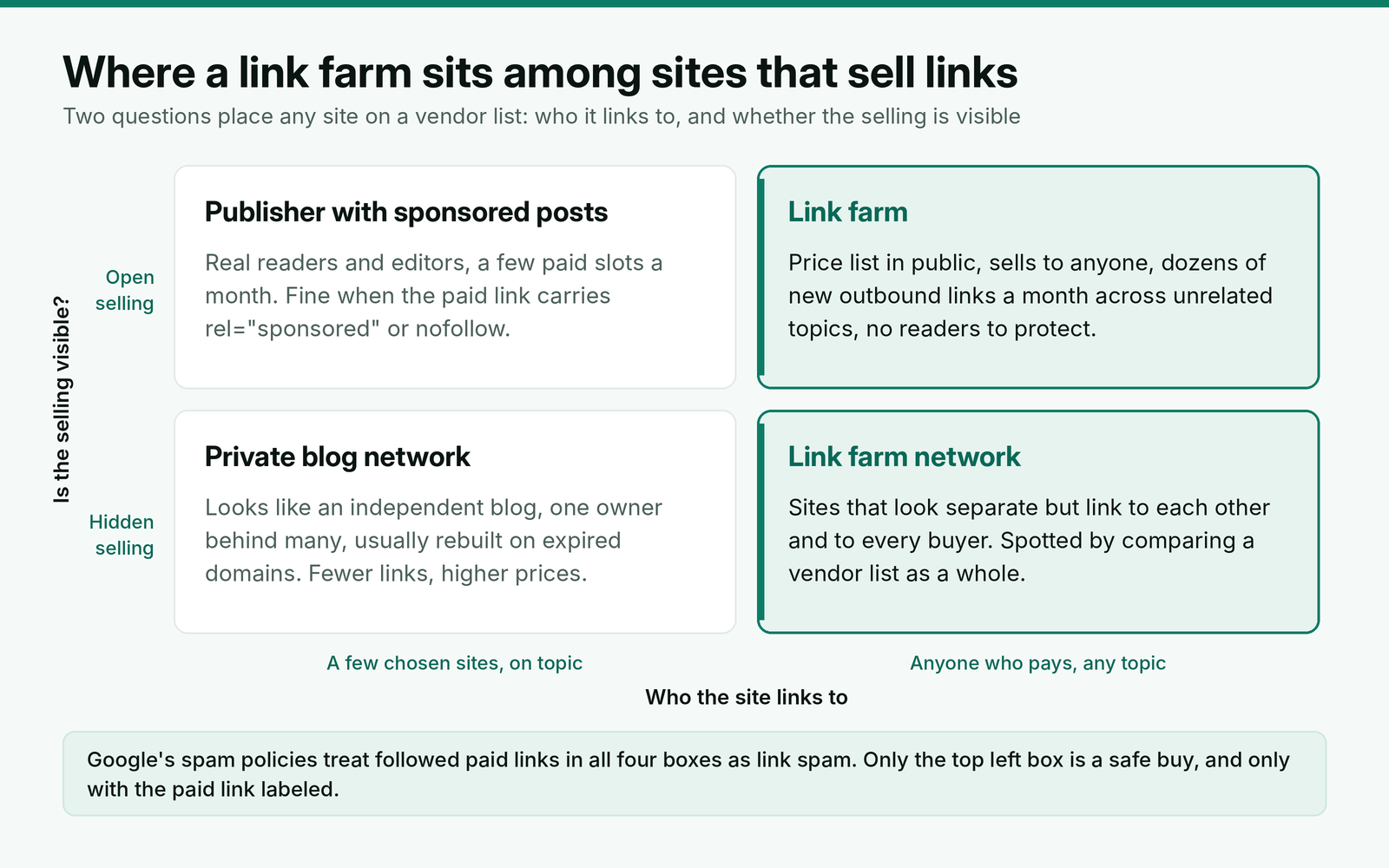
The right-hand column is where most of the volume in cheap vendor lists sits. A farm does not need to hide, because its buyers are not checking. A PBN owner spends money making sites look independent; a farm owner spends it on publishing speed. That difference changes which checks catch them. Footprint comparisons find PBNs. Outbound link patterns and publishing rates find farms.
The top-left box is the one worth buying from. A publisher with editors and readers can sell a sponsored post without being a farm, and Google's own spam policies say buying links for advertising is fine as long as the link is qualified with rel="nofollow" or rel="sponsored". The same page lists what is not fine, including excessive link exchanges, partner pages built only for cross-linking, links created by automated programs, and advertorials where payment buys links that pass ranking credit. A farm usually ticks several of those at once. We cover the line between an editor's choice and a purchase in what separates an editorial link from a paid one.
What research and Google have measured
Farms are one of the most studied forms of web spam, because they are built from links and links are easy to measure at scale. The figures below come from academic crawls and from Google.
| Finding | Figure | What it tells a buyer |
|---|---|---|
| Share of hosts that sat in link farms, Japanese web archive, 2004 to 2006 (about 3 to 4 million hosts a year) | 4.3% to 7.2% each year (Chung, Toyoda and Kitsuregawa, AIRWeb 2009) | A small share of hosts, but enough that any long list of cheap sites is likely to hold some. |
| Large groups of tightly cross-linked hosts (over 100 hosts) near the core of that web that were link farms | 95% | Dense cross-linking among many hosts is almost always manufactured. |
| Topics of spam hosts inside link farms | Adult and Travel made up over 60% (same authors, 2011) | Farms cluster in a few money topics. Travel is still a common "general blog" category on vendor lists. |
| Hand-labeled spam hosts in the WEBSPAM-UK2006 and UK2007 research datasets | 19.8% of 10,660 hosts; 5.3% of 114,529 hosts (Erdélyi et al., Internet Mathematics) | Even in curated research crawls, between 1 in 20 and 1 in 5 hosts were spam. |
| Link spam detected in Google's December 2022 link spam update, compared with the July 2021 update | 50 times more (Google's 2022 webspam report, via Search Engine Roundtable) | Detection of link selling sites took a step change once SpamBrain was applied to links. |
The same 2011 study found that many farms were maintained for years but most did not grow. That matches what buyers see: the same farm domains turn up on vendor lists year after year, kept alive because they keep selling, not because they gain readers.
The reason farms are easy to catch is structural. Research classifiers built nearly 20 years ago could spot most spam hosts from link data alone, without reading a word of the content.
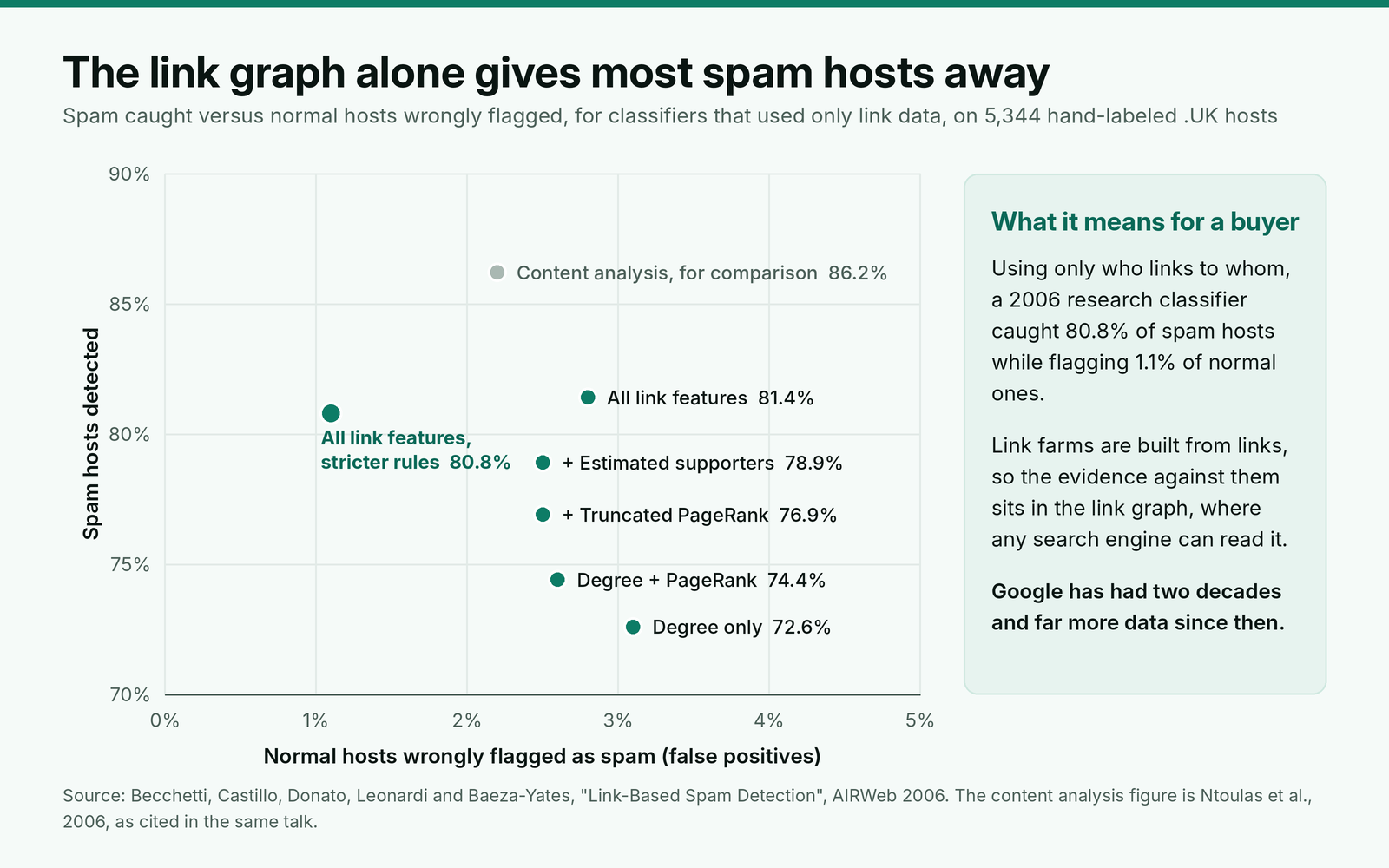
That 2006 link-based spam detection work used signals such as how many sites a host links to, how many link back, and how its PageRank is supported. Every one of them is a pattern a farm cannot avoid, because selling outbound links is its business model. Google has had two decades and far more data since then. Since the December 2022 link spam update, SpamBrain looks for sites used to pass outgoing links as well as sites that buy them, and neutralizes the unnatural links it finds.
Do link farm backlinks still work?
Rarely, and never for long enough to justify the order. The usual outcome is not a penalty. It is a link that passes nothing, reported to a client as a win, on a site that will be cited later in an audit as the reason a profile looks bought.
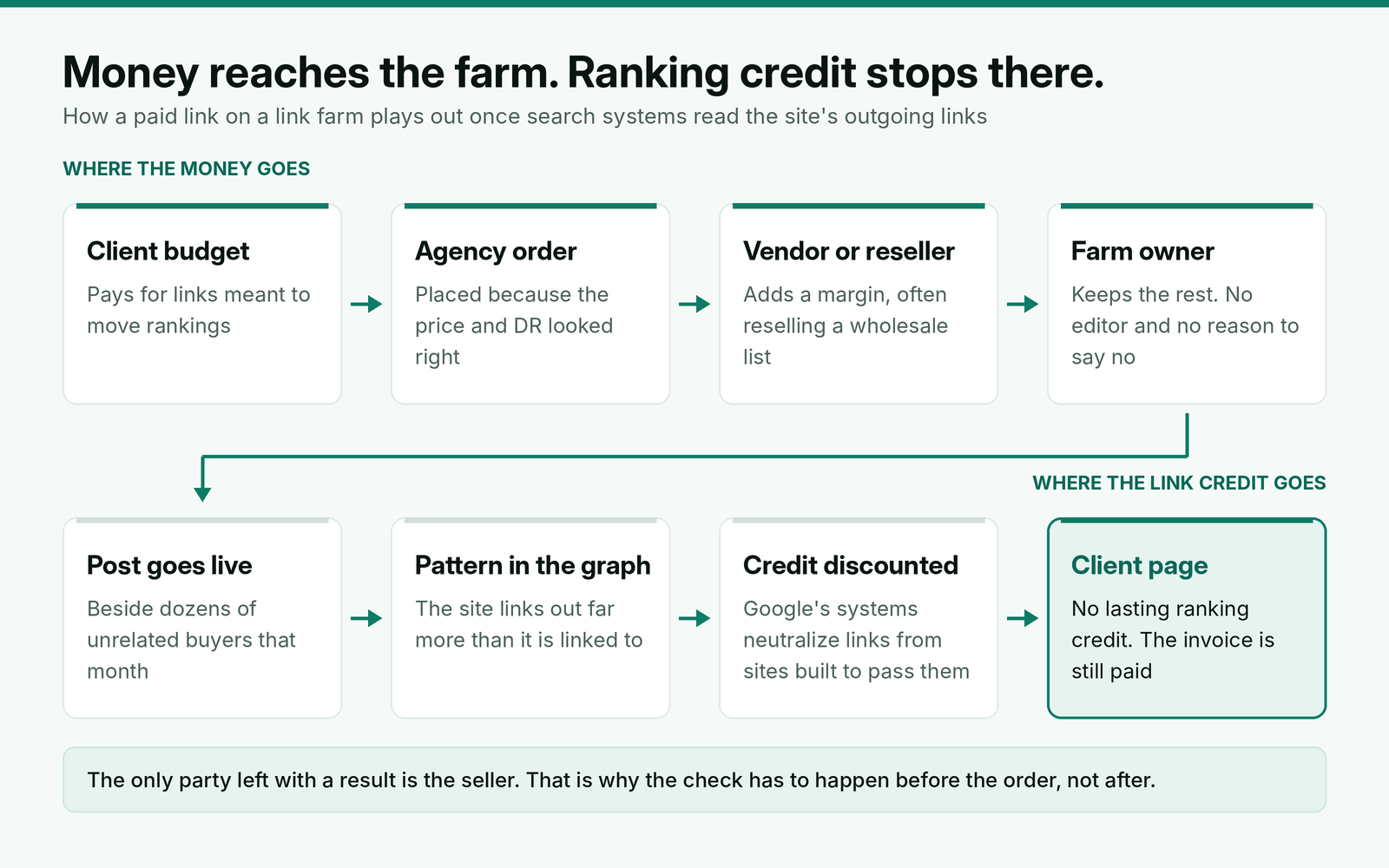
Farm sellers point to short-term ranking bumps as proof their links work. A bump in the same month as a farm order rarely isolates the farm link: the client's content, technical fixes and earned links keep running alongside it. Ask the seller which page moved, for which query, with nothing else changed, and the claim usually goes quiet.
Recent updates have not changed the picture. Google's September 2026 spam update finished rolling out on October 8 after about two weeks, and it did not target link spam. A farm that held its traffic through it has not been cleared; it simply was not the subject of that update.
How to spot a link farm before you buy
Farms fail different checks from PBNs. A PBN is caught by history and footprints. A farm is caught by its outbound links, its publishing rate and its sales pitch. Run these six checks on top of the vetting routine we run on every site before an order. The pass and reject lines are our working rules, not industry standards.
| Check | Where to find it | Pass | Reject |
|---|---|---|---|
| Outbound ratio | Linked domains divided by referring domains, from your SEO tool's outgoing links and backlink reports | Under 1.5 | Above 3, unless it is a directory or news aggregator |
| Publishing rate against audience | Posts in the last 30 days, set against estimated organic visits | A pace the audience explains | More than 30 posts a month with under 1,000 organic visits |
| Topic spread | Categories in the menu and the XML sitemap | One main subject with a few sections | 8 or more unrelated categories, or most posts filed under "General" |
| Who the last 20 posts link to | External links in the body of the 20 newest posts | Fewer than 5 commercial links, each on topic | 10 or more, or any casino, payday loan, CBD or essay site |
| The sales page | Write-for-us, advertise and contact pages | Editorial guidelines, paid posts labeled | A price list promising "dofollow", "permanent" links or "no sponsored tag" |
| Resale spread | The same domain across your vendors' lists | Offered by one seller, or by several within a narrow price band | On 3 or more lists with the highest price more than double the lowest |
Outbound ratio. This is the single fastest farm test, and it maps directly onto the link signals in the research above. A real niche blog with 300 referring domains might link out to a few hundred sites over its life, mostly sources and tools. A farm with 1,200 referring domains often links out to 6,000 or more, because each post adds one or two new buyers. Count domains, not links, so a site's own social profiles and navigation do not skew it.
Publishing rate. Real publishers scale output with readers. A site publishing two or three posts a day with organic traffic in the hundreds is publishing for buyers. Check the dates in the sitemap rather than the blog page, which some farms paginate to hide volume.
Topic spread. Farms add categories to widen the pool of buyers. A site with sections for crypto, home improvement, pets, law and dental care has told you who it writes for. Scored against the client's topic at site level, farms fail almost every time.
The last 20 posts. Open them and note every external link in the body. Twenty posts gives a better read than ten on a site that publishes daily, because farms often alternate sold posts with filler to look natural. One casino or loan link in the sample is enough to reject: a seller who takes those buyers will put your client beside them.
The sales page. Real publishers that sell sponsored posts say so and label them. A farm sells the opposite: "dofollow guaranteed", "no sponsored tag", "permanent", "indexed in 24 hours". Each of those promises is a promise to break Google's policy on the client's behalf.
Resale spread. Farms sell through many resellers at once. When the same domain sits on three vendor lists at $40, $65 and $140, the cheapest price is close to what the farm accepts, and the domain is being sold to everyone. Compare quotes with what real publishers charge for a guest post at each DR tier; a high-DR site far below those prices needs a reason.
Worked example: scoring one site from a vendor list
Here is a made-up example. A vendor's spreadsheet offers a "business and lifestyle" blog for a SaaS client at $55 a post, DR 48, "dofollow, permanent". The account lead runs the six checks before quoting it to anyone.
| Check | What the site showed | Result |
|---|---|---|
| Outbound ratio | 6,800 linked domains against 1,250 referring domains, a ratio of 5.4 | Reject |
| Publishing rate | 74 posts in the last 30 days, about 900 estimated organic visits a month | Reject |
| Topic spread | 19 categories, from crypto to pet care; the client's topic appears in none | Reject |
| Last 20 posts | 18 carry a commercial link; 4 link to casino or loan sites | Reject |
| Sales page | Price list: $45 general, $90 for casino and CBD, "no sponsored tag" | Reject |
| Resale spread | Same domain on two other vendor lists at $38 and $120 | Reject |
Six rejects out of six makes the call easy, but the order of the checks matters for time. The outbound ratio and the sales page took four minutes between them and were already decisive. The full run took about 20 minutes, and most of that was reading the last 20 posts. On a long list, run the ratio on every site first and only open posts on the sites that pass it.
The bigger finding was about the vendor. Two other sites on the same list shared the price list wording and linked to each other in their footers, the pattern behind paid footer and blogroll links that repeat on every page. The account lead removed all three and moved the vendor to a watch status: any further site from them gets the full six checks, not a spot check.
When a client asks why the cheaper list was turned down, send the reasoning in writing:
Subject: Why we did not use three sites from the latest vendor list
Hi [first name],
We reviewed the [number] sites [vendor] offered for [client brand] this month. We approved [number] and rejected [number], including three sites priced at about $[price] a post.
Those three sell links to any buyer on any topic: they publish around [number] posts a month with very little organic traffic, link out to about five times as many sites as link to them, and sell casino and loan placements alongside general ones. Google's systems are built to ignore links from sites like these, so a placement there would be reported as a link without passing any value to [client domain].
The approved sites cost more per post but have real readers and cover [client topic]. The budget for this month stays the same; it goes to fewer, stronger placements.
[Your name]
[Agency, URL]
When link farms already link to a client
Most farm links in a client's profile were not bought by anyone. Scraper and farm sites link to popular pages without being asked, and Google already ignores links like these. Leave them alone.
The ones that need action are farm links someone paid for: a previous agency's order, a cheap package the client bought before hiring you, or a vendor who swapped a promised site for a farm. Those belong in the triage we use in a client link audit. Ask the seller for removal or rel="sponsored", give it 30 days, and disavow only what stays unfixed, at domain level for a farm, because every page on it is for sale. A manual action changes the urgency but not the method.
Record every farm you find, whether it linked to the client or turned up on a vendor list. The same domains come back through different resellers, often renamed in the spreadsheet as a new "premium" list.
Where BuildLinks fits
A farm check only saves money if its result outlives the person who ran it. That is the job we built BuildLinks to do. In BuildLinks, the shared domain inventory holds every new site for approval before anyone on the team can quote it, so a farm rejected on Monday cannot reach a client order on Tuesday through a different account manager. The inventory filters by DR, traffic, service type, turnaround and country, so the traffic half of the publishing rate check becomes a filter rather than a lookup.
The six checks and their pass and reject lines can sit on each client's requirements page as SOPs, next to the brief and any excluded vendors. Every order keeps its domain, target URL, anchor and full history, so if a site is later found to be a farm, the list of clients with links on it already exists. BuildLinks does not calculate outbound ratios or read a site's posts for you; those still come from your SEO tool and the review itself.
Conclusion
Treat any site that links to anyone who pays as a link farm, whatever the vendor calls it and whatever its DR says. Run the outbound ratio first: above 3 is a reject unless the site is a directory or aggregator. Then check the publishing rate against traffic, the topic spread, the last 20 posts, the sales page and the resale spread, and reject on any casino or loan link or any "no sponsored tag" promise.
Buy from publishers with readers and editors, label paid links, and record every farm you reject so it cannot return through another reseller. Leave unpaid farm links in a client's profile alone, and fix only the ones someone paid for.