Guest post pricing in 2026 depends less on the site than on whose data you read: completed marketplace orders average $164 a placement, while marketplace and vendor listings average about $460. Published vendor packages sit in between, at $72 to $456 a link depending on the DR tier you order. This guide sets out what each source measures, what pushes a price up or down, and how to judge a quote on landed cost per visitor instead of price per link.
It is written for people who buy placements for clients and resell them, so the numbers come with their sample and date, and the last half is about using them on an actual quote.
Guest post pricing in 2026: what the data says
Four studies published or updated this year give an average guest post price. They measure different things, which explains most of the spread.
| Source | What it measured | Average guest post price | Date |
|---|---|---|---|
| PressWhizz | 12,297 completed guest post orders on its own marketplace | $164 (median paid link $112) | Published July 22, 2026, checked October 2026 |
| Adsy | Listings from 52,671 sites in its inventory, February 2026 | $459, up from $427 in 2025 | Updated June 23, 2026, checked October 2026 |
| BuzzStream | 257,267 sites with complete DR, traffic and price data in a vendor database | $295 direct from the site, $461 through a vendor | Updated June 15, 2026, checked October 2026 |
| Setproduct | Listings and "30+ direct quotes collected in Q3 2026"; the author sells guest posts | No single average; $150 to $400 direct at DR 26 to 40 | Published September 6, 2026, checked October 2026 |
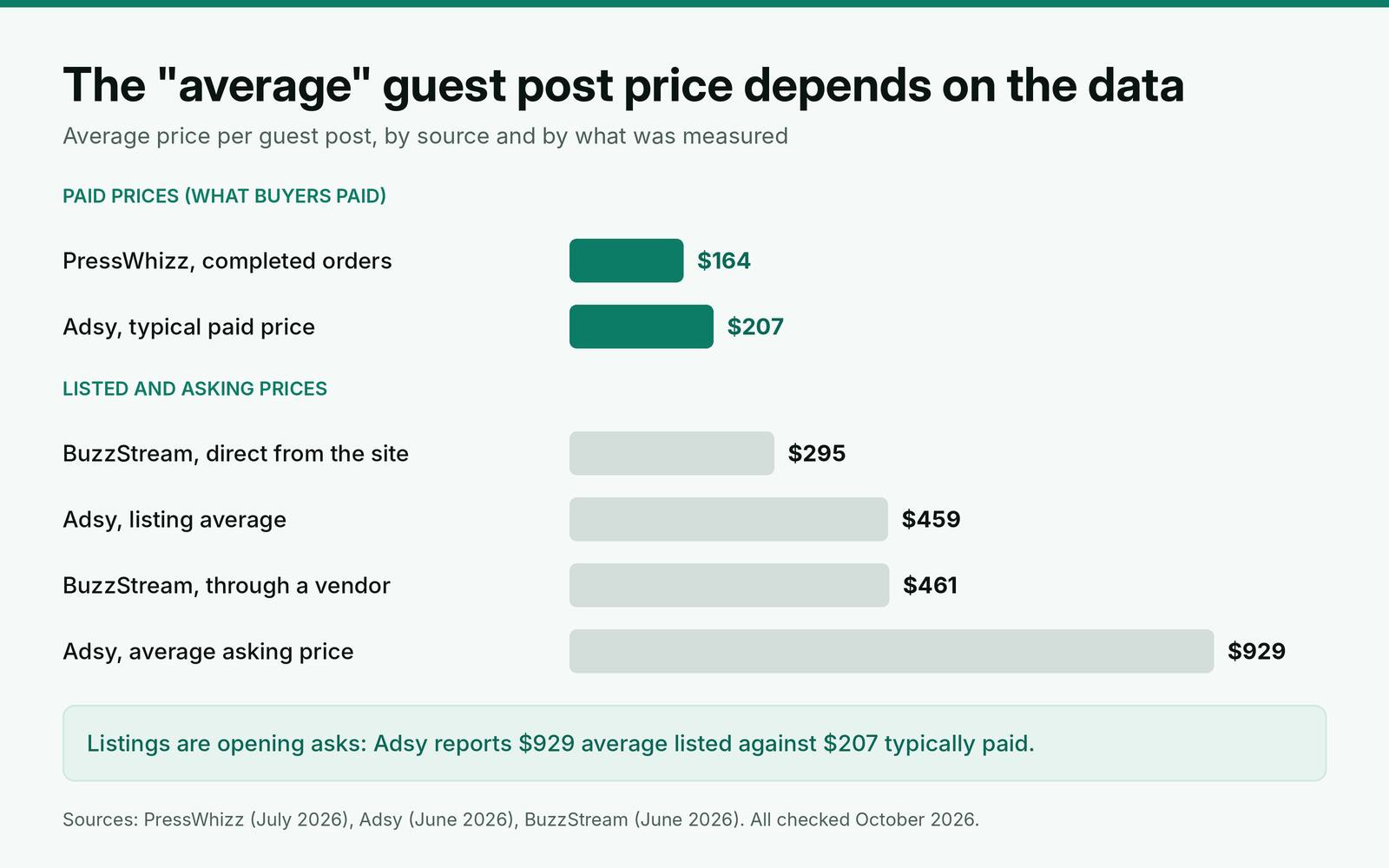
If you need one planning number for a mid-range placement, the listing averages cluster at $459 to $461. If you want to know what buyers end up paying, the order data says much less: $164 on average at PressWhizz, and $207 as the typical paid price in Adsy's own comparison of asking and paid prices.
Why the averages disagree
Three differences in method account for nearly all of it.
- Listed price versus paid price. Adsy reports an average listed price of $929 per backlink against $207 typically paid. A listing is an opening ask. Treat any average built from listings as a ceiling for negotiation, not a market rate.
- Who is in the sample. PressWhizz counts what its own buyers bought, and buyers lean cheap: its order data puts the mid-tier range at $100 to $200. BuzzStream counts every site in a vendor database, including a small number of very expensive news sites that pull the average up (its highest single news placement is over $125,000).
- Who published it. Every study above comes from a company that sells placements or link building tools. That does not make the figures wrong, but it is a reason to read the sample description before quoting the number to a client.
The supply picture matters as much as the averages. In BuzzStream's data, almost 80% of guest posting sites are under DR 40, more than three-quarters get under 1,000 organic visits a month, and only 1.37% qualify as high quality or top tier (DR 71 and up with 50,000 or more monthly visits). The cheap end of the market is cheap because most of it is weak.
What published vendor packages charge by DR tier
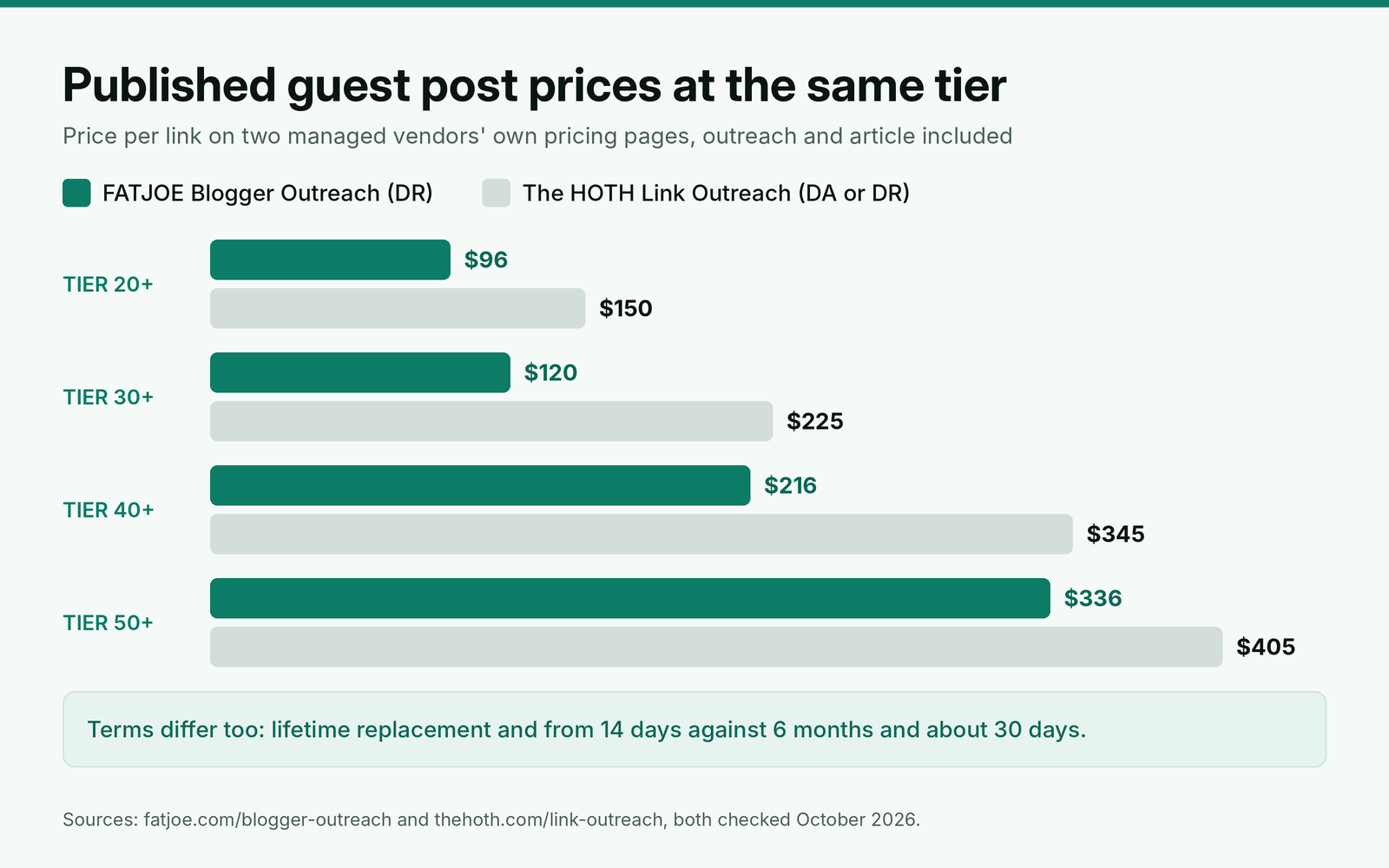
Managed vendors that publish a price list sell by DR tier and include the outreach and the article. These are two of the few that publish tiers, taken from their own pages and checked October 2026.
| Tier | FATJOE Blogger Outreach | The HOTH Link Outreach (DA or DR) |
|---|---|---|
| 10+ | $72 (traffic 0 to 1,000) | Not offered |
| 20+ | $96 (traffic 0 to 5k) | $150 |
| 30+ | $120 (traffic 100 to 10k) | $225 |
| 40+ | $216 (traffic 500 to 20k) | $345 |
| 50+ | $336 (traffic 1k to 30k) | $405 |
| 60+ | $456 (traffic 1k to 60k) | Not offered |
| Turnaround | From 14 days | About 30 days |
| Guarantee | Lifetime replacement; no refund or replacement for DR changes after placement | 6 months on broken links, 1 year on a discount contract or subscription |
| Content | Outreach and writing included; length agreed during outreach | Article of 500 to 2,000 words included; no approval before posting |
At the same nominal tier, The HOTH is $54 to $129 more per link, and the terms differ as much as the prices: one vendor guarantees for life, the other for six months, and one lets the traffic floor rise with the tier while the other publishes no traffic minimum at all. A DR tier on its own does not tell you what you are buying. Compare the whole row.
What moves the price of a guest post
Organic traffic
Traffic is the clearest price driver in all three datasets. BuzzStream's vendor prices run from $229 for sites under 100 monthly organic visits to $3,210 for sites over 100,000. PressWhizz's completed orders show sites above 100,000 visits selling for about 218% more than sites under 1,000. Adsy's effect is smaller: about 21% more for a site with 10,000 monthly visits than one with 1,000.
Domain Rating
Adsy finds each additional 10 DR points adds about 32% to the price, with averages of $332 at DR 1 to 30, $555 at DR 31 to 70 and $2,025 at DR 71 and up. BuzzStream runs from about $200 at DR 0 to 9 to about $3,000 at DR 80 and up. DR is the metric sellers price by because it is the one buyers filter by, which is also why it is the easiest one to inflate. Before you pay a DR premium, read our explainer on what does and does not move Domain Rating.
Niche
Niche premiums are real, but the sources disagree on which niches carry them, because listings and completed orders behave differently.
| Niche | BuzzStream (vendor listings) | Adsy (listings) | PressWhizz (completed orders) |
|---|---|---|---|
| Sports | $572 | $669 | $246 |
| Finance | Not reported | $816 | $221 |
| Health | $352 (Health and Wellness) | $547 | Not reported |
| Gambling or casino | $238 (Adult and Gambling, the cheapest category) | Not reported | $252 (the most expensive niche) |
| All niches | $461 | $459 | $164 |
Sources as in the first table, all checked October 2026. Gambling is the clearest case of why the data source matters: it is the cheapest category in BuzzStream's listings and the most expensive in PressWhizz's orders. A low listing average can hide a thin pool of usable sites: BuzzStream's 108 high quality gambling sites (DR 50+ with 10,000+ monthly visits) average $1,109. Some vendors avoid the question: FATJOE sends iGaming to a separate page and describes adult and other grey niches as tough to fill.
Country
Adsy's location data puts core English-speaking markets about 50% above its $459 global average: United States $670, United Kingdom $729 and Canada $750, against $236 for New Zealand. If a client needs US-based publishers specifically, budget from the US figure, not the global one.
Content, labeling and extras
The placement fee is not always the whole price. Some publishers charge a separate writing fee when they write the article, and vendor packages vary: FATJOE and The HOTH both include writing in the per-link price. Setproduct, which sells placements itself, describes sponsored posts at 30% to 50% above a base guest post price and a second body link at 15% to 30% more. Ask for every extra in the quote, in dollars, before you compare it with anything else.
Direct, marketplace or managed vendor
You pay for the route as well as the site. In BuzzStream's data, the same type of guest post costs $295 on average bought directly and $461 through a vendor, a $166 gap that is the market price of sourcing and handling. Setproduct puts the marketplace markup at 30% to 70% over the publisher's price.
- Managed vendor. Highest price per link, but it includes finding the site, the pitch, the article and a guarantee. Right when your team's hours are the constraint.
- Marketplace. You pick from listings and pay the listed price plus the platform's cut. Right when you want to see the inventory yourself and can vet fast. Expect listed prices to be opening asks.
- Direct from the publisher. Lowest fee, highest time cost, and the way to reach sites that are not on every reseller's list. For the email outreach that direct deals need, we recommend linkOreach, whose AI agent Linkzy builds prospect lists from Ahrefs DR and traffic data, writes personalized pitches, sends them from your own domain and runs follow-ups until a reply comes in.
Most agencies use all three, which is why the next section matters: you need one way to compare, say, a $120 vendor tier, a $350 marketplace listing and a $200 direct quote. If you resell vendor placements under your own brand, our guide to reselling vendor placements under your own brand works through the margin on a ten link order.
How to judge a guest post quote: landed cost per 1,000 visits
Price per link is the wrong unit, because it hides both the extras and what the link is attached to. Two numbers do the job better.
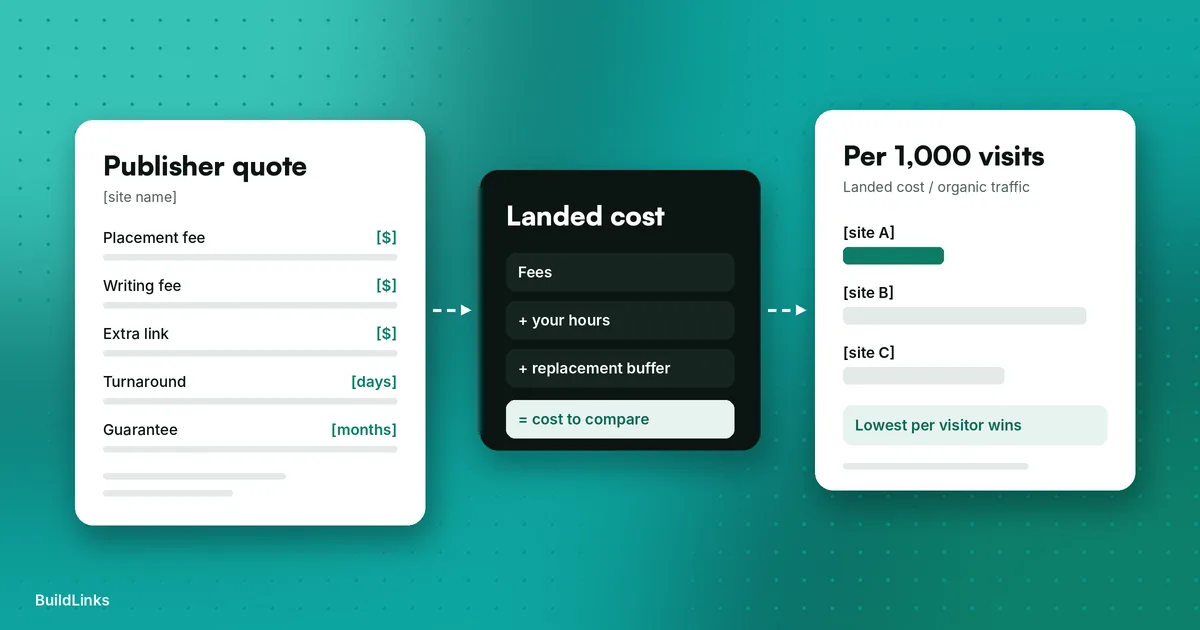
- Landed cost = placement fee + content fee + any labeling or extra link fee + your hours to brief, review and QA multiplied by your loaded hourly rate + a replacement buffer (the fee multiplied by the share of links your own records show you lose outside the guarantee).
- Landed cost per 1,000 visits = landed cost divided by the site's monthly organic traffic in thousands, using traffic you checked yourself on the day of the quote.
Worked example: two quotes for the same client
The two quotes below are illustrative, not real sites. Assume 1.5 hours of your time on either placement at a $60 loaded hourly rate, so $90 each.
| Quote A: [site A] | Quote B: [site B] | |
|---|---|---|
| Placement fee | $300, article included | $180 |
| Writing fee | $0 | $50 |
| Your time | $90 | $90 |
| Landed cost | $390 | $320 |
| Monthly organic traffic (checked) | 4,000 | 800 |
| Landed cost per 1,000 visits | $97.50 | $400 |
| Replacement terms | 12 months | None stated |
Quote B has a placement fee $120 lower and a landed cost $70 lower, and it is about 4.1 times more expensive per visitor, before you price the risk of paying again if the link disappears with no replacement. Per visitor is not the only test (relevance to the client's topic still decides whether either site is worth buying), but it stops a low fee from winning the comparison on its own.
Guest post quote checklist (copy this)
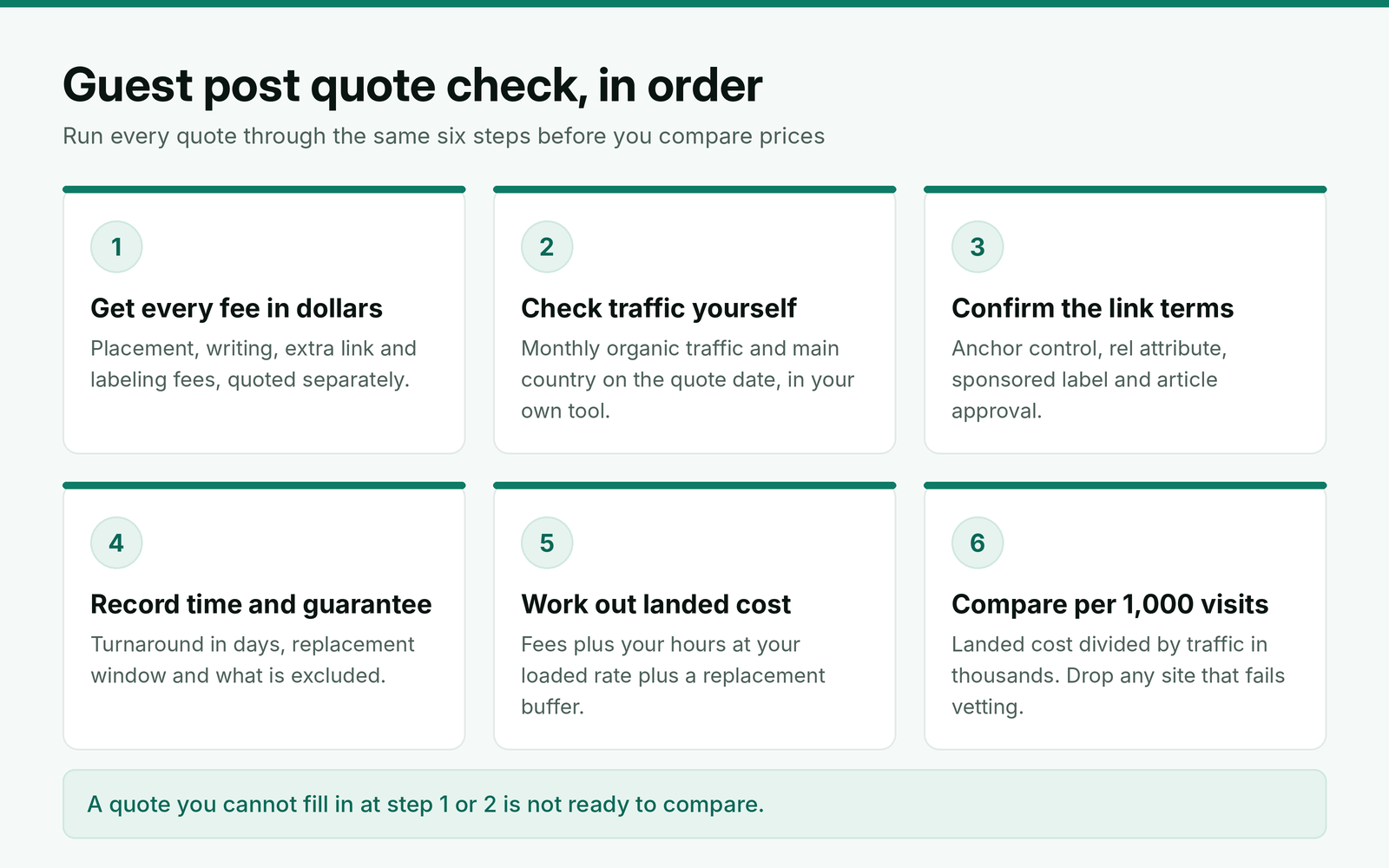
- Placement fee, in dollars, and whether it includes the article.
- Writing fee, extra link fee and any labeling surcharge, in dollars.
- Monthly organic traffic and its main country, checked by you on the quote date, not the figure in the listing.
- DR on the quote date, recorded with the date.
- Link terms: number of links, anchor control, rel attribute, and whether the post is labeled sponsored.
- Whether you approve the article before it goes live.
- Turnaround in days from payment.
- Replacement window and what does not trigger a replacement.
- Indexing terms: what happens if the page is not indexed after a set number of days.
- Landed cost and landed cost per 1,000 visits.
- Pass or fail on vetting, with the reason recorded.
The vetting line is the one that overrides the rest. The checks behind it (traffic trend, outbound link patterns, content quality) are in our full pre-purchase vetting process.
Quote comparison sheet (copy these columns)
One row per quote: date, client, target URL, publishing domain, route (vendor, marketplace or direct), DR, organic traffic, main traffic country, placement fee, content fee, other fees, your hours, landed cost, landed cost per 1,000 visits, article approval (yes or no), rel attribute, turnaround days, replacement window, vetting result, decision. Sort by landed cost per 1,000 visits, then remove every row that failed vetting.
Red flags in guest post pricing
- A price far below the order data. Setproduct treats under $100 for a claimed DR 30+ placement as a reason to walk away. PressWhizz's own budget example is about $40, so cheap placements exist, but cheap plus high claimed metrics is the combination to check hardest.
- One flat price across every tier. Every published price list above rises with the tier. A seller whose price does not move with traffic or DR is not pricing the site.
- Traffic you cannot confirm. If the traffic figure in the listing does not match what you see in your own tool, price the quote on your figure.
- Every post on the site has a link to an unrelated advertiser. That is a site selling links to anyone who pays, which is the pattern Google's link spam policy describes.
- No written replacement terms. A quote without them is a quote for a link that may be gone in six months at your cost.
Pricing guest posts you resell
If you sell placements to clients, the buying data above is your cost side. The selling side has its own rules: a rate card by tier, a markup that covers your hours and replacement buffer, and a price you can explain when a client asks why one guest post costs twice another. Our guide on how to build a link building rate card covers the three pricing models and the markup check. When the cheapest suitable page for a client already exists on a site, the cheaper format may be a link insertion, which averages $225 against $459 for a guest post in Adsy's data; see when a niche edit beats a guest post.
Anchor terms belong in the price conversation too. A seller that lets you choose an exact-match anchor is selling the kind of link Google names in its policy, so decide anchors from an anchor plan for each target URL, not from what the seller allows.
What Google's policy means for the price
Google's spam policies (last updated August 28, 2026, checked October 2026) list buying or selling links for ranking purposes as link spam, and name "links with optimized anchor text in articles, guest posts, or press releases distributed on other sites" as an example. Paid links are acceptable when they carry rel="sponsored" or rel="nofollow". The price you pay does not change that risk. What changes it is the site, the anchor and the rel attribute, which is why all three are on the checklist.
The latest enforcement news is the September 2026 spam update, which started on September 24 and finished on October 8 after about two weeks. Search Engine Roundtable reported that it does not target link spam (October 8, 2026, checked October 2026). Placements bought in late September can now be judged on settled rankings.
Where software fits
The quote check falls apart when quotes live in email threads and costs live in a different sheet from client prices. That is the job we built BuildLinks to do. In BuildLinks, your domain inventory holds every site with your prices, each placement is an order with a status (Pending, In Progress, Completed or Rejected), the live link is checked before an order completes, and the invoice is generated from the completed order. On the agency side, you see each placement's vendor cost next to the price you set for each client, and clients see neither your costs nor other clients' data (see how the agency view separates costs from client prices). BuildLinks manages orders, inventory and invoicing. It does not find publishers or send outreach.
Conclusion
Use $459 to $461 as the listing benchmark for a guest post and $164 to $207 as what buyers typically pay, and read every study's sample before you quote it. At the tier level, published vendor prices run from $72 at DR 10+ to $456 at DR 60+, and the terms differ as much as the prices.
On each quote, get every fee in dollars, check traffic yourself, and compare landed cost per 1,000 visits rather than price per link. Walk away from cheap quotes with high claimed metrics, flat pricing across tiers or no replacement terms, and keep the anchor and rel attribute inside your own plan, whatever the seller allows.