Link building pricing in 2026 runs from about $179 for a niche edit to $295 for a guest post bought directly from a site, $461 for the same guest post through a vendor, and $1,250 to $1,500 for a digital PR link. To price your own service, start from what each link really costs you, including your time, then pick a pricing model that fits the client and check your markup against what vendors already charge.
Many people price backwards. They take a vendor's price, add a number that feels fair, and call it a rate card. That works until a client asks why two very different sites cost the same.
What the market charges per link
Know what buyers compare you against. The figures below come from a link marketplace pricing study covering more than 257,000 guest post sites and 62,916 sites that sell link insertions, plus the published prices of several agencies. Treat them as reference points, not a single market price.
| Link type | Typical price |
|---|---|
| Guest post, bought directly from the site | About $295 |
| Guest post, bought through a vendor | About $461 |
| Niche edit (link added to an existing article) | About $179 |
| Digital PR (links earned through news coverage) | $1,250 to $1,500 |
| Monthly agency retainer | $500 to $1,500 for 2 to 5 links in low-competition niches, up to $10,000 to $15,000 at the top end |
A guest post is an article you write for someone else's site, with a link back to your client. Prices also rise with DR (Domain Rating), a 0 to 100 score of how strong a site's backlinks are. For guest posts alone, guest post prices vary by DR tier, niche and country.
What vendors add on top, by DR
The same study splits guest post prices by the site's DR. For a seller, the gap between buying direct and buying through a vendor is the most useful number in it, because it is the markup the market already accepts.
| Site DR | Direct | Through a vendor | Vendor markup |
|---|---|---|---|
| 0 to 9 | $132 | $196 | 48% |
| 10 to 19 | $175 | $270 | 54% |
| 20 to 29 | $225 | $353 | 57% |
| 30 to 39 | $290 | $458 | 58% |
| 40 to 49 | $384 | $609 | 59% |
| 50 to 59 | $470 | $759 | 61% |
| 60 to 69 | $832 | $1,289 | 55% |
| 70 to 79 | $1,266 | $1,934 | 53% |
| 80 and above | $1,735 | $2,983 | 72% |
Two lessons stand out. First, vendors add about 50% to 60% at almost every tier, or about $166 on an average guest post. That is what the market already pays for someone to find, buy and handle the link, and it is the room you have to work in. Second, prices jump above DR 60, so a flat card that tops out at "DR 50+" either leaves money on the table or loses it on the strongest sites, even though Domain Rating only scores backlinks.
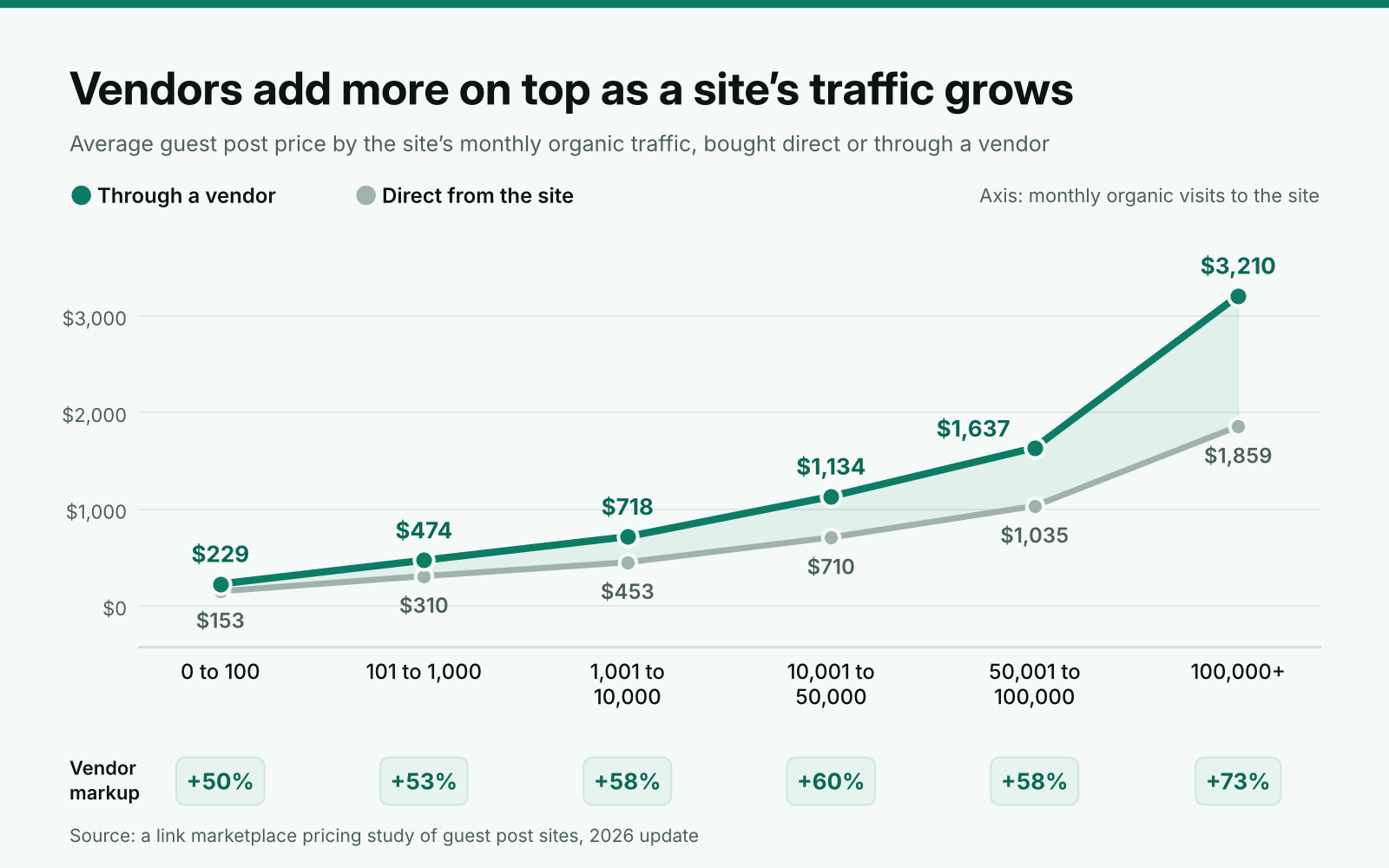
Traffic moves prices even more than DR does. Sorted by the site's monthly organic visits, the vendor price climbs from $229 to $3,210, and the markup widens to 73% on the busiest sites.
Start from your real cost
Your cost is more than the vendor's invoice. It also includes the time you spend checking the site, briefing the content and confirming the link went live. And some links will disappear later, so you need money set aside to replace them.
A simple formula: real cost = vendor price + your time + a bit set aside for replacements. Skip any part and a price that looks fine on the invoice loses money over time. That is why a written process for buying backlinks comes before any price you quote.
If you earn links by emailing site owners instead of buying them, your outreach time and tools replace the vendor price. For guest posts, we work out the break-even between earning and buying at a median writer wage. For the email outreach itself we recommend linkOreach, which lists one plan at $69 a month, or $117 a quarter when billed quarterly, with a 7-day free trial (linkOreach pricing).
Three ways to price link building
1. A flat price per link
One price for a guest post, another for a niche edit, maybe more for stronger sites. It is quick to quote, so it suits freelancers and one-off orders. The downside: two sites with the same DR can be very different in real quality, yet get the same price.
2. A monthly package
You sell a set number of links each month, say ten, for one fee. This suits agencies with ongoing SEO clients, because income is steady and easy to plan. The risk is a slow month: if good sites are scarce, you either lose profit or quality slips. When you quote a package, put the link count, the site standard and the replacement terms in writing, in a link building proposal template that splits a per-link price from a fixed monthly fee. If you resell under your own brand, work out the profit on each white label order.
Build the package from the links inside it. Say a client wants eight guest posts a month, four on DR 30 to 39 sites and four on DR 50 to 59 sites. At the direct prices above, that is 4 x $290 plus 4 x $470, or $3,040 in placement costs. At 1.5 times, the package comes to $4,560 a month, just under the $4,868 the same eight links would cost through a vendor. Add a fixed fee for strategy, vetting and reporting on top, and say in writing what happens in a month when good sites run short.
3. Price bands by site quality
Set bands, such as DR 20 to 40, 40 to 60 and 60 plus, each with its own price. This is the clearest model for clients who care about site numbers. Add a traffic condition to each band, since traffic moves the price more than DR. It only works if you keep an up-to-date list of every site you use and its numbers.
How much to add on top
Markup is what you add on top of your cost. There are two common approaches:
- Cost-plus: multiply your vendor price by a set amount, often 1.5 to 2 times. It is simple and safe.
- Market rate: charge what that kind of link is worth in the market, whatever it cost you. It can earn more, but you need confidence in what you sell.
The DR table above is a useful check for cost-plus. A 1.5 times multiple on the direct price lands within about 8% of the average vendor price at every tier below DR 80, and about 13% under it at DR 80 and above. So a client comparing your quote with a vendor's sees a familiar number. At 2 times you are priced as a premium service, and you need the vetting, reporting and replacement terms to show for it.
There is a ceiling too. In a survey of 518 SEO professionals reported by Search Engine Land, the average price respondents would accept for one high-quality link was $508.95, and agencies put 32.1% of their SEO budget into links. Above about $500 a link, expect the client to ask what makes the site worth it, and have the traffic, relevance and replacement terms ready.
Many freelancers undercharge because they think they are reselling a link. They are not. The client is paying to avoid finding the site, checking it is legitimate, arranging the link and making sure it stays live. That is the service. Price it like one.
A quick example
Take a guest post that costs about $295 direct. At 1.5 times, you charge about $440, just under the $461 vendor average. At 2 times, you charge $590, well above it.
Neither is wrong. But at 1.5 times, you keep about $145 to cover your time and replacements. If those cost more than that, raise your price or find a cheaper vendor.
What a link building package should contain
A package is a monthly price for a set number of links plus the work around them. Build it so the client can divide the placement cost by the link count and still see a fair per-link price, and charge strategy, vetting and reporting as a separate fixed fee. Here are three tiers built from the direct and vendor prices in the DR table above, at 1.5 times your direct cost.
| Tier | Links a month | Site mix | Your placement cost | Client price at 1.5 times | Same links through a vendor |
|---|---|---|---|---|---|
| Starter | 4 | DR 20 to 29 | $900 | $1,350 | $1,412 |
| Growth | 6 | 3 at DR 30 to 39, 3 at DR 40 to 49 | $2,022 | $3,033 | $3,201 |
| Authority | 6 | 4 at DR 60 to 69, 2 at DR 70 to 79 | $5,860 | $8,790 | $9,024 |
Each tier lands a little under the vendor price for the same links, which is where you want to be when a client compares quotes. The Growth tier works out at about $506 a link, right at the $509 ceiling from the survey above, so that client will ask what each site is worth: have the traffic and relevance ready. The Authority tier is where a flat rate card fails. Six links there cost almost three times the Growth tier, so sell it only to clients whose competitors already hold links at that level.
Put five terms in writing for every tier: the link count, the site standard (a DR band plus a traffic floor and topic fit), who writes the content and picks the anchor, how long each link is covered for replacement, and what happens in a month when good sites run short. A package without those terms is a price, not a service.
What "affordable" usually means
Cheap packages give themselves away once you divide. Five links for $500 is $100 a link, below the $132 average direct price of even DR 0 to 9 sites in the pricing study. One agency's logs of 3,499 completed placements put the median price buyers paid at $150 a link, against a median asking price of $178. When a package costs less per link than publishers charge, someone in the chain is not being paid, and the usual reason is that the vendor owns the sites. Set your entry tier from your real costs, not to match the cheapest offer a client found online.
Mistakes that quietly eat your profit
- Pricing by DR alone. DR measures a site's backlinks, not whether real readers in your client's field visit it. A relevant site with real traffic can be worth more than a high-DR site with neither. A cheap site with a high DR is often a rebuilt expired domain, so checking a vendor list for private blog network sites before you price it saves a refund later.
- Undercharging for niche edits. Finding a relevant page that already ranks is real research. Price it as its own service, not a cheap guest post. Weigh guest posts vs niche edits to see when each works best.
- Forgetting replacements. If you promise a link stays live for a year, some will need replacing, and how often paid links disappear tells you how much to set aside. That cost belongs in your price, and the promise belongs in a contract replacement clause that has an end date.
- Treating favors as free. A link from a site owner you know still cost you the time to build that relationship.
The client isn't buying a link. They're buying not having to do everything it takes to get one safely.
Build a price list you can explain
Keep a list of every site you use. For each one, note:
- The site and link type.
- DR and traffic, with the date you checked.
- Your cost and your price.
- How long the link takes, and how long you guarantee it.
This is what link building management software is for. Review the list every quarter, because site numbers change, and review the vendors who supply it at the same time with a weighted scorecard for each link vendor. The checks behind it come from vetting each website before buying a link.
The payoff comes when a client questions a price. You point to a band and a reason you set in advance, instead of making one up on the spot.
Where BuildLinks fits
A spreadsheet only reflects the last day someone updated it. An order pipeline keeps your prices with your orders. BuildLinks keeps your cost and client price on every site in your list and creates invoices from completed orders. Clients see only their own price, which matters when you pick client portal software that keeps vendor costs hidden.
The agency setup gives you a separate price per client. Plans are on the pricing page.
Conclusion
Build each price from your real cost: the vendor or direct price, your time, and money set aside for replacements. Use a flat price per link for quick quotes, a monthly package built from the links inside it for ongoing clients, or price bands by DR and traffic if you keep site numbers current. Give DR 60+ and high-traffic sites their own bands, because that is where costs jump.
Then check your markup against the market. Vendors add about 50% to 60% at most tiers, so 1.5 times your direct cost keeps you close to what clients see elsewhere, while 2 times needs extra service to justify it. Expect questions above about $500 a link, put the site standard and replacement terms in every package, and treat any package priced below what publishers charge as a warning sign.