An SEO contract for link building has to settle five things a general SEO agreement skips: what counts as a delivered link, who approves each site, who decides whether paid links are tagged, how long a lost link is replaced, and what happens to orders already paid to a vendor when the client cancels. Get those five in writing and most disputes never start. Leave them out and you will negotiate each one after the money is spent.
Most SEO contract templates are written for retainers that sell hours: audits, content and technical fixes. A link building contract sells units, and every unit carries a cost you pay out before the client sees a result. Below are the numbers that should shape the main terms, the clauses a link client signs, a template you can copy and a worked cancellation example.
SEO contract vs SEO proposal: what each document does
The proposal sells the plan. The contract makes it binding. In the link building proposal, which sets the price and link standard before anything is signed, the client picks a monthly link count, sees the site standard and approves a price. The SEO agreement then turns those choices into obligations: payment dates, the minimum term, replacements, cancellation, ownership and liability.
The cleanest structure for an agency with several link clients is two layers. A master services agreement holds the terms that never change between clients: payment rules, liability, confidentiality, governing law. A statement of work holds what changes: target pages, monthly link count, site standard, prices. When a client moves from six links a month to ten, you sign a new statement of work, not a new contract.
Write the proposal so its terms can be copied into the statement of work unchanged. If the proposal says a link counts as delivered when it is live in the body of an indexable page with the agreed anchor, the contract should use the same sentence. Two versions of the same promise are where arguments start.
The numbers behind the main terms
A few outside figures help you set terms a client will see as normal rather than aggressive.
| Term | Figure | What it means for the contract |
|---|---|---|
| Length of an SEO engagement | Typical project runs 12 months; average project cost $37,158.66 (Clutch SEO pricing guide) | A 12-month expectation is normal, but a three-month minimum with monthly renewal is easier to sign. |
| Monthly fee | Average monthly SEO cost $3,199.19 (Clutch) | A link plan in this range will not look like an outlier to the client's finance team. |
| Price of one link | $508.95 average acceptable price for one high-quality link; agencies put 32.1% of SEO budget into links (survey of 518 SEO professionals) | Each link is a large, separate cost. Price and bill it per unit, not as a blended retainer. |
| Ranking promises | "No one can guarantee a #1 ranking on Google" (Google's advice on hiring an SEO) | Guarantee placements and process, never positions. |
| Signing | Proposals with e-signature close 60% faster, with a 15% higher close rate, across 742,137 proposals (State of Proposals 2026) | Send the contract for e-signature the day the proposal is accepted. |
E-signatures are not only faster. Under the federal E-SIGN Act, a contract in interstate commerce cannot be denied legal effect solely because an electronic signature was used, so there is no reason to send a PDF that has to be printed and scanned.
The clauses a link building contract needs
Every clause below either protects money you have already spent with a vendor or settles a question the client will ask later. The template in the next section puts them in order.
Scope: link count, link types and target pages
State the monthly link count per target page, the link types (guest posts, niche edits or both) and the anchor rules. Then state what is out of scope: content for the client's own site, technical fixes, digital PR campaigns and rank tracking. A client who thinks the fee covers "SEO" will ask for all of them by month three.
Put the numbers in the statement of work, not the master agreement. Link counts change more often than anything else in the relationship.
What counts as a delivered link
This is the clause general SEO agreement templates leave out, and the one that decides most disputes. Define delivery in terms the client can check on the live page: the link sits in the body of the article, on a page that is indexable, with the agreed anchor, target URL and rel value. Then define the site standard every domain must meet, such as minimum organic traffic in the client's main country, recent posts on the client's topic, and no outbound links to gambling, loan or essay sites in recent articles.
Add an approval step with a deadline. The client approves each domain before you buy it, and a domain counts as approved if the client has not objected within three business days. Without the deadline, one slow approver can stall a month of orders while your vendor quotes expire.
Paid link policy and who carries the risk
Google's spam policies treat buying links that pass ranking credit as link spam, and accept paid links that carry rel="sponsored" or rel="nofollow". Some clients want every paid placement tagged. Others accept untagged links and the risk that comes with them. The contract should record which one the client chose, in writing, before the first order.
The reason is in the same Google page that warns about ranking guarantees: "Ultimately, you are responsible for the actions of any companies you hire." Your client carries the search risk of the links you place, so the client has to make the call. Copy the client's choice into every vendor order; a rel sponsored tag clause is a ready-made version. If an old placement later needs fixing, decide whether that toxic backlink gets tagged, removed or disavowed.
Payment terms
Link building has a cash problem that hourly SEO does not: you pay the vendor when the order is placed, and the client often pays 30 days after the invoice. Late payment is common in B2B selling, so plan for it rather than hoping it will not happen. In the Atradius Payment Practices Barometer for North America, published in September 2026 from a survey of more than 600 businesses, overdue invoices made up 23% of B2B receivables by value.
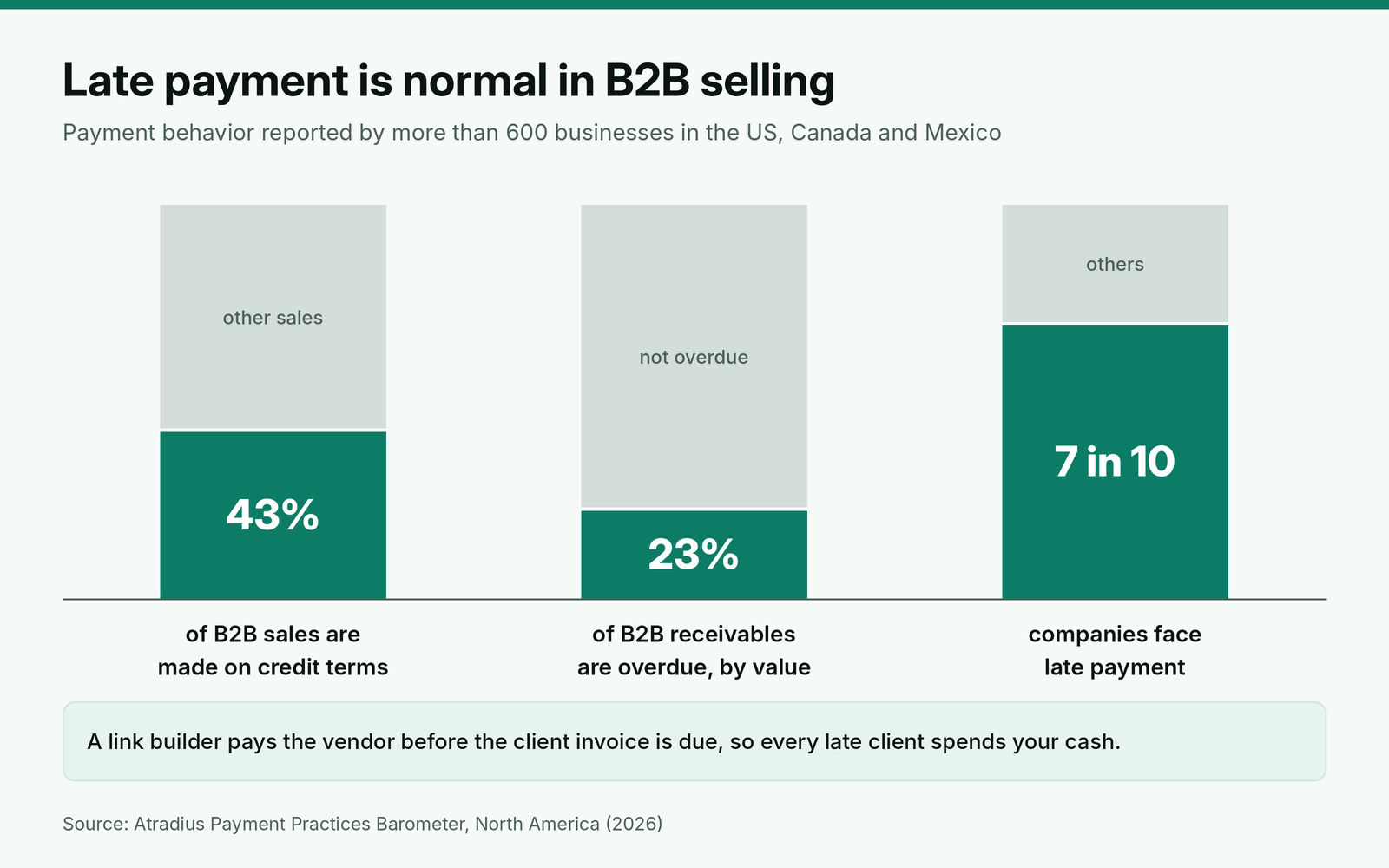
Three terms fix most of it. Bill the monthly fee and the link budget in advance, or have the client fund a balance that each completed order draws down. Pause new orders, not live links, when an invoice is 15 days overdue. And make replacements conditional on the account being paid up, so a client cannot withhold payment and still claim free replacements.
Replacement window and refunds
Links disappear. Publishers redesign, delete old posts, sell the domain or let it lapse. Pew Research Center tested pages collected between 2013 and 2023 and found that a quarter of them were no longer accessible, and the older the page, the higher the share.
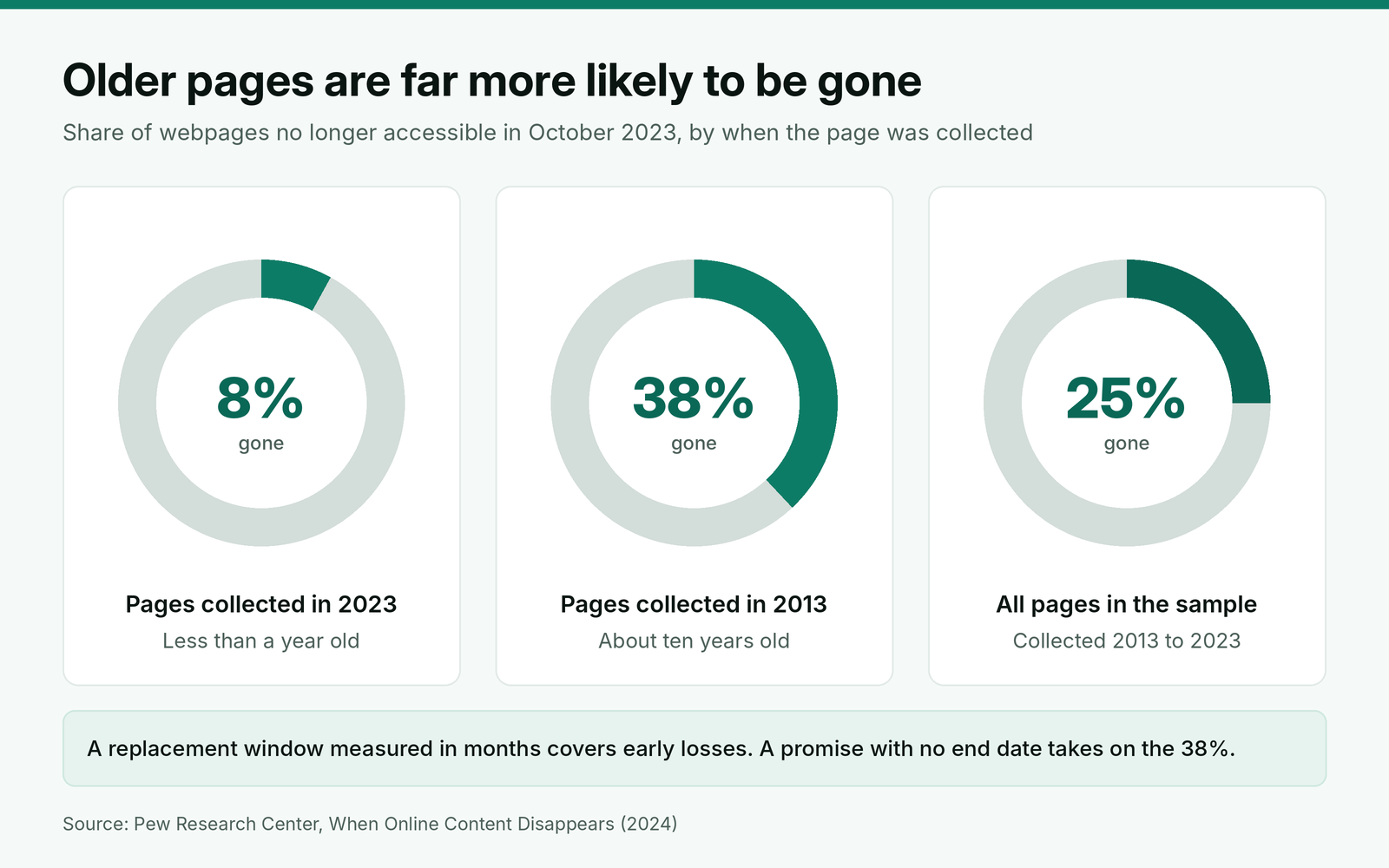
Promise a replacement window with an end date, usually six or twelve months from go-live, and only offer what your vendors will cover. If your vendors replace lost links for six months and you promise twelve, you pay for months seven to twelve yourself. Write the exclusions too: no replacement when the client changes or redirects the target URL, when the client's own page returns an error, or when the client asks for the link to be removed. One replacement per lost link is enough; a refund is the fallback only when no replacement site meets the standard within 30 days.
Ownership of content and links
Two assets need an ownership line. The first is the articles your writers produce. A freelance writer's article is not automatically a work made for hire: the Copyright Office lists four conditions that must all be met, including a signed written agreement, and a guest post rarely fits them. The practical fix is a written assignment of copyright from your writers to you, and from you to the client once the article is paid for.
The second is the links themselves. A placement lives on the publisher's site, so neither you nor the client owns it. What the contract can promise is that you will not ask publishers to remove links when the client leaves. Some providers rent links that come down when payments stop; if you do not, say so in the contract, because it is a point in your favor.
No ranking guarantee, and what happens after updates
Guarantee what you control: the number of links, the site standard, client approval of each domain and the replacement window. Disclaim rankings, traffic and the effect of search engine updates. Then add a review clause rather than an exit clause: if rankings fall after a Google update, both sides meet within 10 business days to compare placement dates with the drop. Google's September 2026 spam update, which finished rolling out on October 8 and did not target link spam, is the kind of event that prompts that call. A dated placement record answers it quickly.
Confidentiality, vendors and white label delivery
Your vendor list and buy prices are the core of your margin. The contract should keep them confidential and stop the client from contacting your publishers directly to buy placements for 12 months after the contract ends. If you resell under your own brand to other agencies, the confidentiality runs the other way as well, as in any white label link building setup.
Term, renewal and termination
A three-month minimum term with monthly renewal after that suits most link clients. It is long enough for the first links to go live and short enough to sign without a legal review that takes weeks. Set 30 days' written notice to cancel after the minimum term.
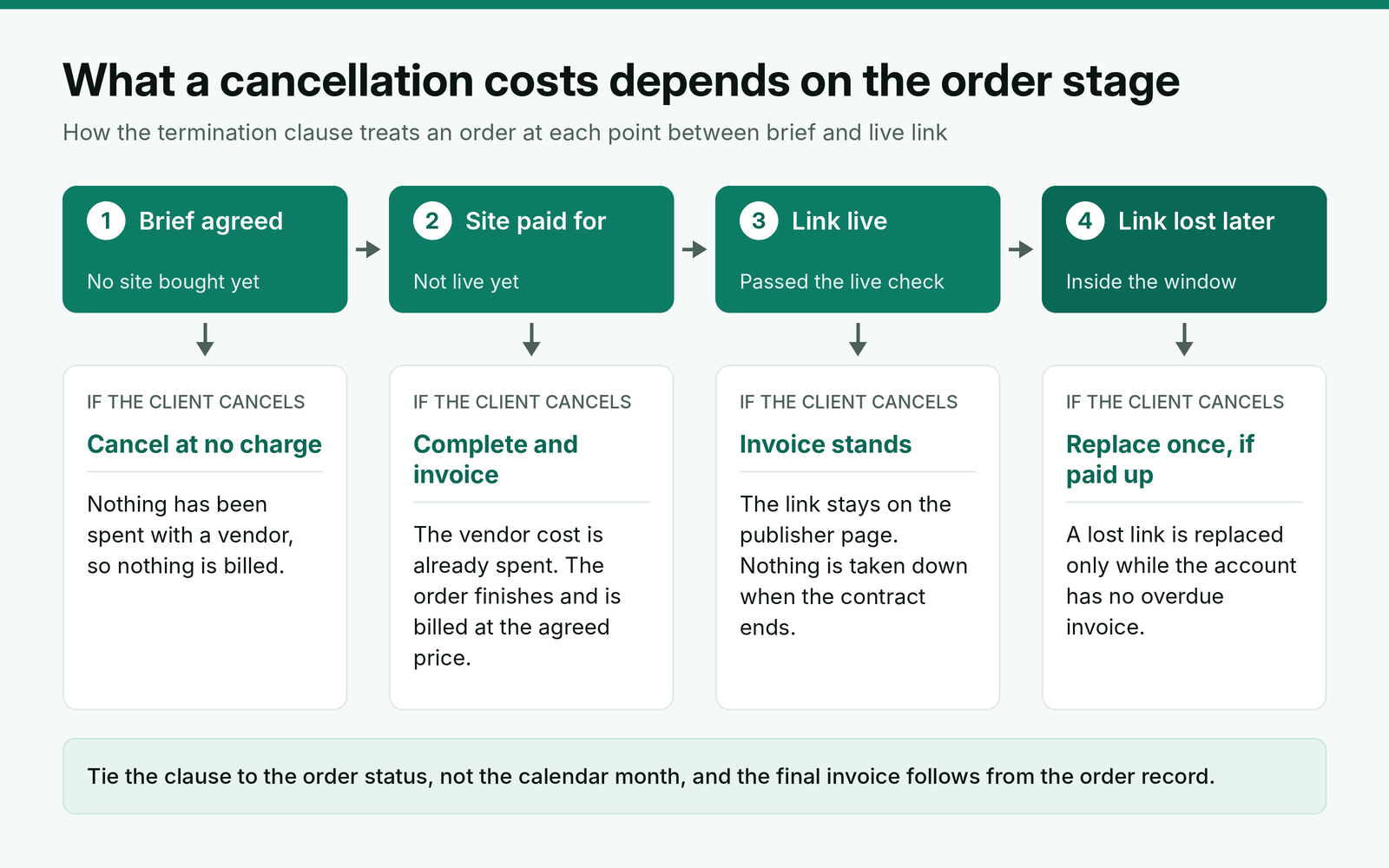
Then tie termination to the order stage rather than the calendar. An order with no vendor payment is cancelled. An order the vendor has already been paid for is completed and invoiced. A live link keeps its invoice and stays live.
Close the contract with a liability cap equal to the fees paid in the previous three months, the governing law, and a line that electronic signatures and counterparts are valid.
SEO contract template for link building
Copy this into your contract tool and replace the brackets. It is written as one document for a monthly plan with a per-link price; split sections 1 to 3 into a statement of work if you run a master agreement. This is not legal advice. Have a lawyer licensed in your state review the final version before you use it.
Link Building Services Agreement
Between [agency legal name], [address] ("Agency") and [client legal name], [address] ("Client"). Effective [date].
1. Services
Agency will place [n] links a month to the target pages listed in Schedule A, using [guest posts, niche edits or both]. Anchors follow the rules in Schedule A. Content for Client's own site, technical SEO, digital PR and rank tracking are not included.
2. Site standard and approval
Every site will have at least [minimum] monthly organic visits from [country], cover [topic] in its recent posts, and link to no gambling, loan or essay sites in its last five posts. Agency will send each domain for approval before purchase. A domain not rejected within three business days is approved.
3. Delivered link
A link is delivered when it is live in the body of an article on an indexable page, with the agreed anchor, target URL and rel value. Agency checks each link when it goes live and lists it in the monthly report.
4. Paid link policy
Client has chosen: [every paid placement carries rel="sponsored" or rel="nofollow" / untagged placements are accepted]. Client confirms it understands the search engine risk of its choice. Agency will include this policy in every order it places with publishers.
5. Fees and payment
$[price] per delivered link plus a fixed fee of $[fee] a month for strategy, vetting and reporting. Fees are invoiced [monthly in advance / drawn from a prepaid balance as orders complete]. Invoices are due within [7] days. If an invoice is 15 days overdue, Agency may pause new orders. Live links are not removed for non-payment.
6. Replacements
A link lost within [six] months of going live is replaced once at no charge with a link of equal standard, provided Client has no overdue invoice. No replacement is due if Client changes or redirects the target URL, the target page returns an error, or Client asks for the link to be removed. If no replacement site meets the standard within 30 days, Agency will refund the price of that link.
7. Ownership
On full payment, Agency assigns to Client the copyright in articles written for Client's links. Agency will not ask publishers to remove links placed for Client when this agreement ends.
8. No guarantee of rankings
Agency does not guarantee rankings, traffic or the effect of search engine updates. If rankings for a target page fall after a confirmed search engine update, the parties will review placement dates within 10 business days.
9. Confidentiality and non-solicitation
Each party keeps the other's confidential information private, including Agency's vendor list and buy prices. For 12 months after this agreement ends, Client will not buy placements directly from publishers introduced by Agency.
10. Term and termination
Minimum term of [three] months, then month to month. Either party may end the agreement with 30 days' written notice after the minimum term. On termination, orders not yet paid to a publisher are cancelled; orders already paid to a publisher are completed and invoiced; live links remain live.
11. General
Each party's total liability is capped at the fees paid in the three months before the claim. This agreement is governed by the laws of [state]. Electronic signatures are valid and binding.
[Agency signatory name, title, date]
[Client signatory name, title, date]
Keep Schedule A to one page: target pages, monthly link count per page, anchor rules and the price. That page is what changes when the client upgrades, and it is the page your team needs open when placing orders.
Example: a client cancels in month four
Here is a made-up example. A SaaS client signed for six links a month at $475 each, plus a $450 monthly fee, with a three-month minimum. Ten days into month four, the client gives 30 days' notice. The agency's average vendor cost is $240 per link.
| Order status at notice | Orders | Under the clause | Billed to client |
|---|---|---|---|
| Live and checked | 2 | Invoice stands, links stay live | $950 |
| Paid to vendor, not yet live | 3 | Completed and invoiced | $1,425 |
| Brief agreed, no site bought | 1 | Cancelled, no charge | $0 |
| Fixed fee for the final month | Due under the notice period | $450 | |
| Final invoice | $2,825 |
Without the order-stage clause, a client who says "stop everything" leaves the agency holding three vendor payments of $240, or $720, with no invoice to match them, plus the argument about whether the two live links were "finished". With the clause, the final invoice is a filter on order status. The replacement window still runs for the five links that went live, but only while the final invoice is paid.
Where BuildLinks fits
A contract only protects you if the work matches it order by order, and if you can show the record when the client asks. That is the job we built BuildLinks to do. In BuildLinks, the statement of work lives on a requirements page on each client account, so the site standard, anchor rules and tag policy are in front of whoever places the next order. Each link is an order with its own status, the target URL and anchor are locked once placed, and guest posts and niche edits are rechecked against the live link before the order is marked Completed. That status is exactly what the termination clause above reads from.
Payment terms map onto the same orders. Invoices are written when each order completes, with the client's own due-date rule, and a client can fund a prepaid wallet that settles each completed order, which is the prepaid balance from clause 5. Clients log in to see their own orders and invoices, never your vendor costs.
If you are comparing tools for this part of the job, look for link building management software that tracks each order from brief to invoice. BuildLinks does not draft or sign contracts, so keep your contract and e-signature tool alongside it, and set a per-link price for link building that covers vendor cost and margin to fill in clause 5.
Conclusion
Write the SEO contract around what a link client will dispute: a delivered link defined on the live page, a site standard with a three-day approval deadline, a paid link policy the client chose in writing, and a replacement window with an end date your vendors will cover. Bill the link budget before you pay vendors, and make replacements depend on a paid-up account.
Set a three-month minimum with 30 days' notice, and tie cancellation to order status so paid vendor orders are completed and invoiced. Guarantee placements, never rankings. Then have a lawyer review the template once and reuse it for every client.