Link building vendors are the publishers, brokers, marketplaces and agencies you buy placements from. The agencies that manage them well keep three to five vendors active, cap any one at 40% of a month's orders, and score every vendor each quarter on the same six numbers, so a weak one is replaced before a client notices.
This guide is for agencies and freelancers who buy links for clients. It covers the four kinds of vendor, what the data says about the inventory they sell, how to qualify a new one, the weighted scorecard we use with a worked example, how to split orders so one failure does not stall an account, and when a vendor relationship should end.
The four kinds of link building vendor
"Vendor" covers very different businesses, and each one puts a different distance between you and the person who controls the site. That distance decides how much you can verify and who can fix a problem when a link goes missing.
| Vendor type | Who you deal with | What you can verify | Main risk | Best use |
|---|---|---|---|---|
| Direct publisher | The site owner or editor | The site, its editorial rules and the exact page before you pay | Small inventory, slow replies, one niche | Core placements in a client's own niche |
| Broker or reseller | A middleman selling sites it does not own | The live URL, rarely who owns the site | Hidden markups and lists nobody rechecks | Filling niches you have no publishers in |
| Marketplace | A platform listing many sellers | Listing metrics and seller ratings | Metrics that lag the site's real state, seller churn | Price discovery and one-off orders |
| Managed or white label agency | A team that sources, writes and places for you | Its reports and the live links | You inherit its site choices and its mistakes | Volume you cannot staff in house |
Most agencies end up with a mix: two or three direct publishers for each main client niche, one broker or agency for volume, and a marketplace for gaps. The mix matters less than knowing which kind each vendor is. A broker's replacement guarantee is only as strong as its hold over sites it does not control, so price that risk in. If you resell an agency's work under your own brand, testing a white label vendor with a paid trial adds checks this guide does not repeat.
What the data says about vendor inventory
Buying through vendors is normal. A 2025 survey of 518 SEO professionals, covered by Search Engine Land, shows how much the industry relies on them and how much it worries about what comes back. The survey was run by a company that sells link building and the article flags self-selection, so read it as a picture of active link buyers rather than of every SEO.
| Finding | Respondents |
|---|---|
| Outsource at least part of their link building | 56% |
| Open to sites that sell links if the quality is right | 63.1% |
| Avoid sites with spammy outbound links | 89% |
| Treat low-quality content as a dealbreaker | 86.3% |
| Struggle to scale without losing quality | 67.2% |
| Say premium links are too expensive | 75.1% |
| Average acceptable cost for one high-quality link | $508.95 |
The scaling number explains most vendor trouble. When an agency needs more links than its trusted vendors can supply, it adds a vendor whose list nobody has checked, and quality drops with the volume. The second problem is age. One link building agency tracked 44,276 sites that sold links and checked them again about ten months later, in a sponsored study published on Search Engine Land.
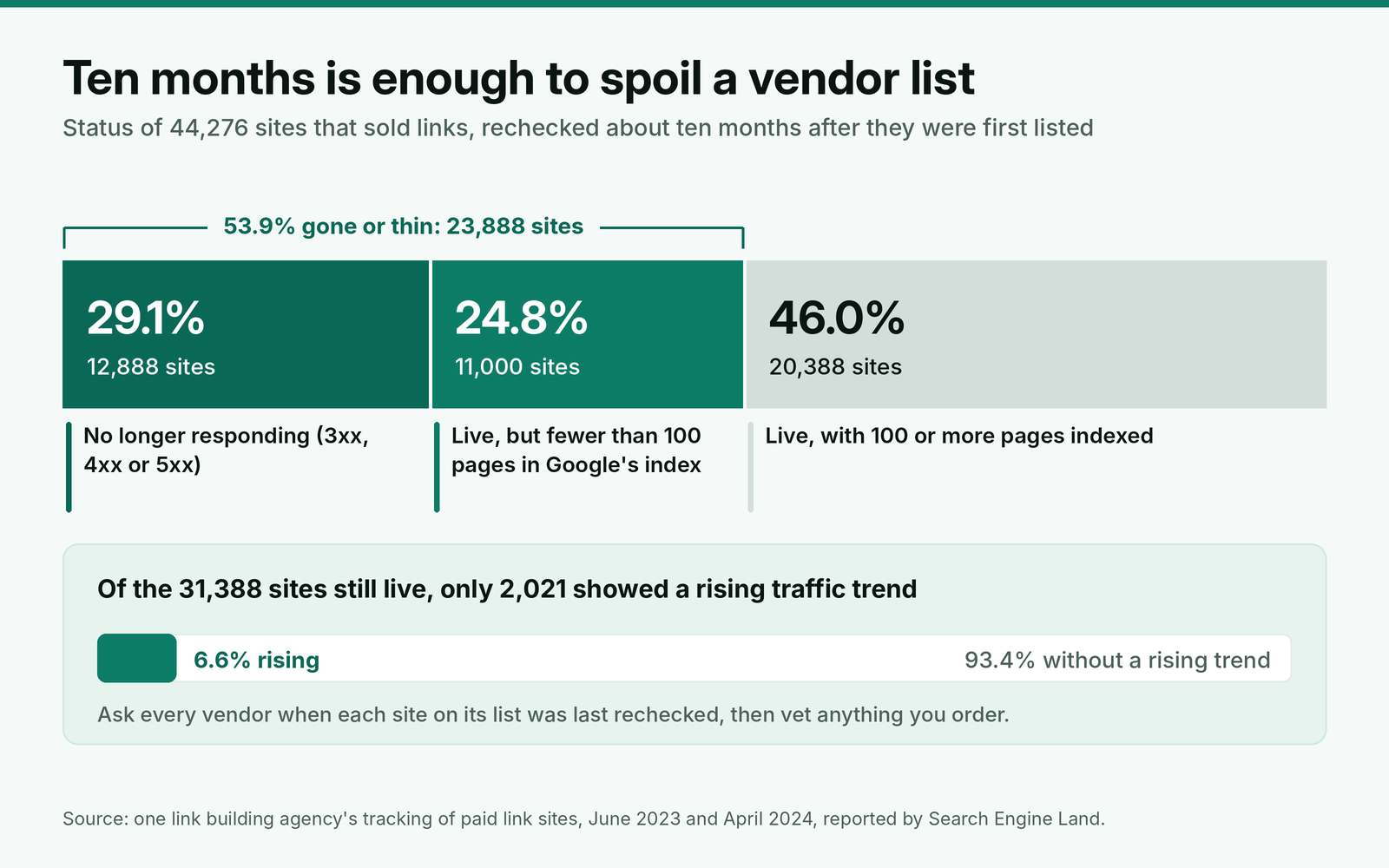
A vendor list that was built a year ago and never rechecked is mostly risk. Ask every vendor when each site on its list was last checked, and run the checks we run on each site a vendor offers before any order, whatever the list says. Thin sites that sell to anyone are common enough in these lists that telling a link farm apart from a real blog is a skill every buyer needs.
How to choose a link building vendor
Shortlisting is cheap and a bad vendor is not. We qualify every new vendor in three steps, and it gets no regular orders until it passes all three.
1. Ask six questions in writing
Send the same message to every candidate so the answers can be compared side by side. Vague answers to the first two questions usually mean a reseller presenting itself as a publisher.
Subject: Questions before we place orders with [vendor]
Hi [first name],
Before we send regular orders we ask every vendor the same six questions:
1. Do you own or directly manage the sites you sell, or do you place through other people?
2. When was each site on your current list last checked for traffic and indexing?
3. Which rel value do your placements carry, and can we set it per order?
4. Do any placements go into a separate sponsored, partner or contributor section?
5. What is your replacement window, and what counts as a lost link: removal, a changed URL, a rel change, a page dropped from the index?
6. How do you report status, and how long after publishing do we get the live URL?
If the answers fit, we will start with a small paid trial.
[Your name]
[Agency, URL]
Questions three and four come from Google's spam policies. Buying links for ranking purposes is listed as link spam, and paid links are within the rules only when they carry rel="nofollow" or rel="sponsored". The same page's site reputation policy names white-label services and freelancers as third-party content, and treats it as a problem when it is published mainly to borrow the host site's ranking signals. A vendor that cannot say how its placements are tagged, or that puts everything in a walled-off partner section, is passing that risk to you.
2. Run a small paid trial
Order five to ten links across the price bands you expect to use, for one client with a clear brief, and judge them at day 30. A batch that small proves little about quality, but it shows what does not change with volume: how the vendor reads a brief, how fast it answers, whether live URLs match what was promised, and how it reacts to a problem. If nothing goes wrong, query one placement anyway and watch the response.
3. Write the pass lines down first
Decide before the first order what failure looks like. Our default for a trial is 9 of 10 links live within the agreed turnaround, every placement on brief and every page indexed by day 30. Setting the bar after the results arrive is how a vendor with a good sales call gets a pass it did not earn.
The vendor scorecard: six numbers every quarter
Once a vendor is in rotation, score it on the same six numbers as every other vendor, from your own order records rather than its reports. The formulas behind each vendor metric are in our KPI guide; the table below shows how we weight them into one score out of 100.
| Metric | How to calculate it | Weight | Our pass line |
|---|---|---|---|
| Live rate | Links live within the agreed turnaround divided by links ordered | 20 | 90% |
| On-brief rate | Live links matching the agreed page, anchor, rel value and site, divided by live links | 15 | 95% |
| Indexed at day 30 | Placement pages indexed at day 30 divided by live links | 20 | 85% |
| Survival at day 90 | Links still live and unchanged at day 90 divided by live links | 20 | 95% |
| Cost per live link | Total spend divided by live links, against your price band for that DR range | 15 | At or under band |
| Claim response | Median days from your claim to a fix or a replacement | 10 | 7 days |
Each metric earns its full weight at or past the pass line, half its weight when it misses by up to 5 points (up to 10% over band for cost, up to 14 days for claims), and nothing beyond that. The price bands come from your own rate card, which is how we turn a vendor's cost into a client price. Indexing and survival carry the most weight because they decide whether a link counts at all; indexing checks at day 7, 30 and 90 give you the inputs.
Score on what you can measure. Rankings move for reasons no vendor controls, and Google's November 2026 core update began rolling out on November 10 with about two weeks expected for the rollout. Ranking swings inside a window like that say almost nothing about one vendor's links.
Worked example: three vendors, one quarter
Here is a made-up quarter for an agency placing 120 links, split 35% to vendor A, 35% to vendor B and 30% to vendor C.
| Metric | Vendor A | Vendor B | Vendor C |
|---|---|---|---|
| Live rate | 96% (20) | 92% (20) | 88% (10) |
| On-brief rate | 97% (15) | 93% (7.5) | 96% (15) |
| Indexed at day 30 | 88% (20) | 81% (10) | 62% (0) |
| Survival at day 90 | 97% (20) | 96% (20) | 89% (0) |
| Cost per live link | $240, at band (15) | $225, 6% over band (7.5) | $180, under band (15) |
| Claim response | 4 days (10) | 9 days (5) | 21 days (0) |
| Score | 100 | 70 | 40 |
Vendor C looks cheapest and is the most expensive. Divide its cost per live link by the share of links that are both indexed and still there at day 90, and $180 becomes roughly $326 per link that counts (180 divided by 0.62 times 0.89). The same sum gives about $281 for A and $289 for B. Sticker price ranks the three C, B, A; cost per counting link ranks them A, B, C.
The review then follows one path for every vendor, so the decision does not depend on who had the better relationship with the account manager.
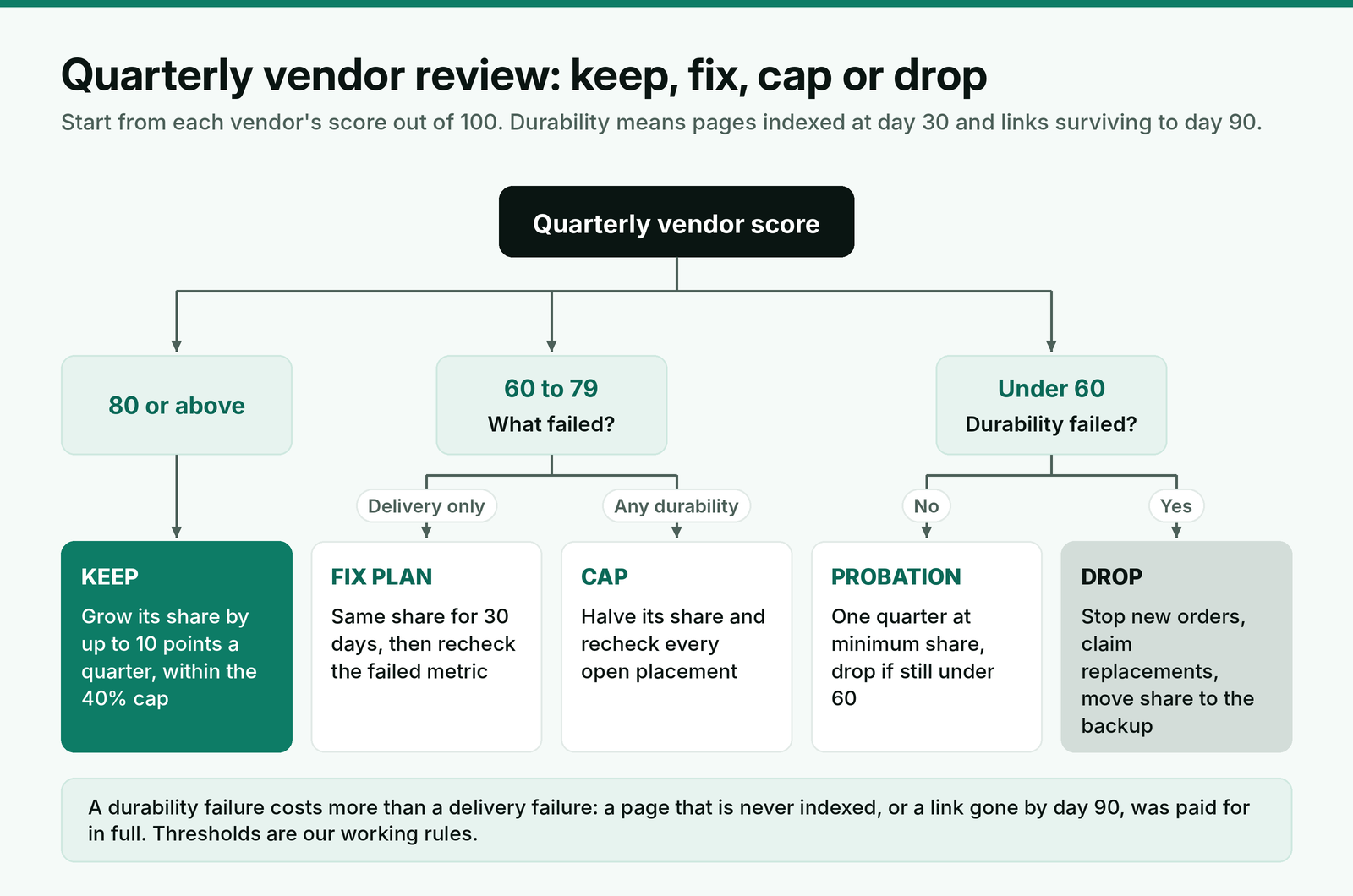
In the example, A rises from 35% to the 40% cap. B scored 70 but missed the indexing line, so its share is halved to about 18% and its open placements are rechecked. C scored 40 with both durability metrics failing, so it gets no new orders, its missing links go in as replacement claims, and its share moves to the backup vendors already qualified for its price band.
How many vendors to run and how to split orders
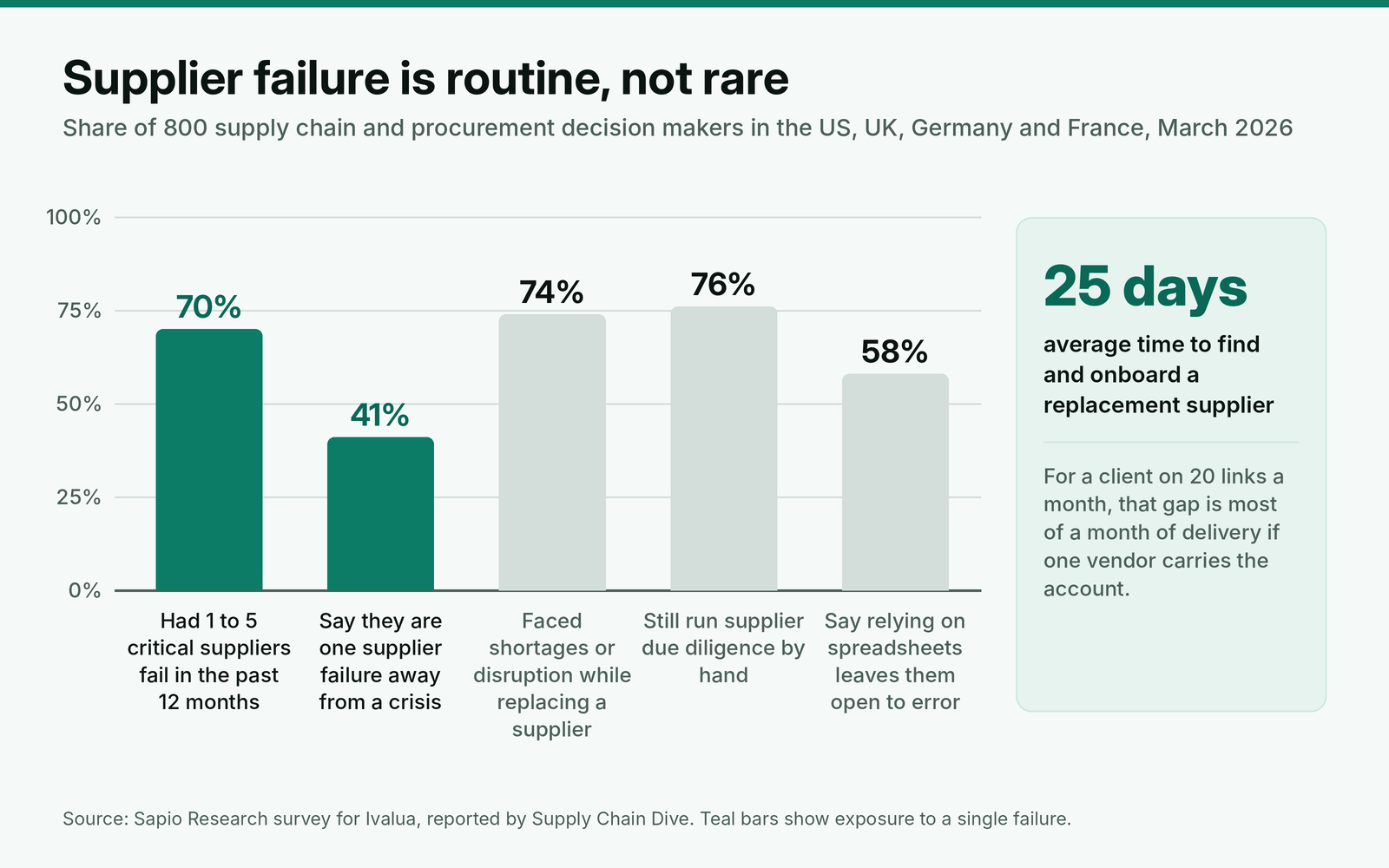
Run at least three active vendors and no more than you can score properly; for a small team that is about five. Cap any single vendor at 40% of a month's orders and keep a qualified backup for each price band you sell. The cap is our working rule, not an industry standard, and it exists because supplier failure is ordinary.
Procurement research outside SEO shows how ordinary. In a survey of 800 supply chain and procurement decision makers, 70% had between one and five critical suppliers fail in the past 12 months, and replacing one took 25 days on average. Those are physical supply chains, but the gap carries over: a client on 20 links a month whose only vendor folds loses most of a month's delivery while you qualify a new one.
Split orders by price band and niche, not evenly. Each band needs one primary vendor and one qualified backup that has passed a trial and receives a few orders every month, so its turnaround and quality are known before you need it. A backup that has not had an order in six months is a new vendor again.
Shares then move with the score. A vendor at 80 or above can grow by up to 10 points a quarter, which stops a strong quarter from turning into dependence. Anything below 80 holds or shrinks, as the decision tree shows.
Put the working terms in writing
Your client agreement and your vendor terms should define delivery the same way, or you carry the gap. Before the first regular order, send each vendor one message that sets the terms and keep its written reply on file.
Subject: Working terms for [agency] orders
Hi [first name],
Thanks for the trial. Before we move to regular orders, here is how we define delivery, so there are no surprises on either side.
Delivered means live on the agreed page, with the agreed anchor and rel value, on a page that is indexable (no noindex tag, a self-referencing canonical, linked from at least one other page on the site) within [number] days of the order.
Any link that is removed, moved, changed to a different rel value or dropped from Google's index within [90] days of going live is replaced at no cost within 14 days of our claim.
Please send the live URL within 24 hours of publishing. We pay monthly for links that pass our live check. Please do not contact our clients directly.
Reply to confirm and we will send the first batch.
[Your name]
[Agency, URL]
Set the replacement window at least as long as the one you promise clients. If you give clients 90 days and the vendor gives you 30, every loss between day 31 and day 90 comes out of your margin.
When to drop a vendor at once
The scorecard handles slow decline. Some events end a relationship whatever the score:
- A site sold as an independent publisher turns out to belong to the vendor, alongside others in the same list.
- The vendor contacts your client directly.
- Links are removed or switched to a different rel value in batches, without notice.
- An invoice includes links that are not live, or a live URL that was never ordered.
- The vendor refuses to say which section of a site a placement will sit in.
When you drop a vendor, file replacement claims for every link inside its window on the same day, and move its share to the backups for each band before the next order cycle.
Where BuildLinks fits
A scorecard is only as good as its inputs: what was ordered, from whom, at what cost and when it went live. Keeping that record is the job we built BuildLinks to do, and our comparison of link building management tools covers the other options. In BuildLinks, the sites from every vendor sit in one domain inventory with your own prices, filterable by DA, DR, traffic, service type, turnaround and country. A new domain is held for approval before anyone can quote it, so a vendor's fresh list goes through vetting before it reaches a client, and rate cards load in bulk through CSV import and export.
Each order moves through Pending, In Progress, Completed or Rejected, and guest posts and niche edits are rechecked automatically when the link publishes, so the live date that your day 30 and day 90 checks count from is already on the order. Reports show total spend, average cost and average turnaround for any date range. On the agency side, an Inventory Manager keeps domains current without seeing any money, and vendor costs never reach the client's view; clients see only the price you set. The weighting and the keep or drop decision stay with you.
Conclusion
Treat vendors as a portfolio you manage, not a list you order from. Run three to five, cap each at 40% of monthly orders, and keep a qualified backup that gets a few orders every month in each price band. Qualify a new vendor with six written questions and a trial of five to ten links judged at day 30 against pass lines you set in advance.
Every quarter, score each vendor on live rate, on-brief rate, indexing at day 30, survival at day 90, cost against band and claim response, and compare cost per link that still counts rather than sticker price. Keep anything at 80 or above, fix or cap 60 to 79, and stop ordering from anything under 60 that is losing links.