rel="sponsored" is the link attribute Google asks sites to put on any link that was paid for: ads, paid guest posts, link insertions, affiliate links and gifted reviews. It tells Google not to treat the link as an editorial vote. If you buy placements for clients, the important part is that you never add the tag yourself. The publisher does, so whether a paid link is tagged comes down to what you agreed before the order and what you check once it is live.
This guide covers what rel sponsored does and does not do, which links need it, how rarely publishers use it, the tag clause we put in every brief, and a quick way to check the attribute on every live placement.
What rel sponsored tells Google
The value goes inside the link's own anchor tag: <a href="https://example.com/" rel="sponsored">. Google introduced it in September 2019, alongside rel="ugc", and at the same time changed how it reads nofollow. All three values became hints rather than commands. Google may still look at a hinted link to understand anchor text and spot unnatural patterns, and it said it would generally treat these links as it treated nofollow before and not count them for ranking.
Three details from that announcement settle most arguments with publishers:
- nofollow still works for paid links. Google prefers sponsored, but treats either one the same for the purpose of avoiding a link scheme action. A publisher who already nofollows paid posts does not need to change anything.
- Values can be combined. rel="sponsored nofollow" is valid, and some publishers use it to stay compatible with tools that only read nofollow.
- The only wrong attribute is a missing one on a paid link. Marking an unpaid link as sponsored costs the target, at most, the ranking credit of that link. Leaving a paid link unmarked is the case Google cares about.
The hint model also explains why tagged links are not worthless to a client. A sponsored link can still send referral visits and put the brand in front of the publisher's readers. What it should not do is pass ranking credit, and Google's John Mueller has said there is no practical difference in SEO value between nofollow, ugc and sponsored for the site being linked to.
Google's rules on paid links, by date
The guidance on paid links has been built up over several announcements. These are the ones that matter to anyone buying placements.
| Date | What Google said | What it means for a link buyer |
|---|---|---|
| May 25, 2017 | Guest posts built mainly to earn links at scale break its guidelines, and publishers should ask whether links of questionable intent carry nofollow (large-scale article campaigns) | The guest post itself is fine. A pattern of keyword-rich links across many sites is the problem. |
| September 10, 2019 | rel="sponsored" and rel="ugc" launched. All three values became hints for ranking. | Ask publishers for sponsored, accept nofollow. |
| March 1, 2020 | nofollow also became a hint for crawling and indexing. | A tagged link can still lead Google to the client's page. |
| July 26, 2021 | Sites failing to tag affiliate links, or publishing or acquiring excessive sponsored and guest posts without tags, may face manual and algorithmic actions (link tagging and link spam update) | The risk sits on both sides of the order: the buyer and the publisher. |
| December 14, 2022 | SpamBrain can detect both sites buying links and sites used to pass outgoing links (December 2022 link spam update) | An untagged paid link is more likely to be neutralized than penalized, but the money is still spent. |
The current wording sits in Google's spam policies. They list exchanging money, goods or services for links as link spam, along with sending someone a product in exchange for a write-up with a link, and advertorials where payment is received for articles with links that pass ranking credit. The same page says links bought for advertising or sponsorship are not a violation as long as they carry rel="nofollow" or rel="sponsored".
Which links need rel sponsored
The test is compensation, not the word "sponsored" on the page. If the publisher received anything of value because the link exists, the link needs a qualifier. That covers more than cash for a guest post.
A link insertion into an existing article is paid even when the vendor calls the fee an "editing charge". A product sent free for review counts, because the spam policies name it directly. Affiliate links count: Google asks sites in affiliate programs to tag them whether they were added by hand or by a script. A link given in return for a link is compensation too, and excessive link exchanges have their own line in the spam policies. A sponsorship of an event or a podcast that comes with a logo link on the sponsor page counts as advertising.
Two cases do not need it. A link a journalist or blogger adds because they chose to cite the client is editorial, even if the client's PR team sent the pitch. And links on a site to its own pages are internal: Google's guide to qualifying outbound links recommends robots.txt rather than a rel value if a site wants to keep Google from fetching one of its own pages. When a vendor uses the word "editorial" for a placement you are paying for, our guide to checking whether a placement sold as editorial really is one covers how to tell.
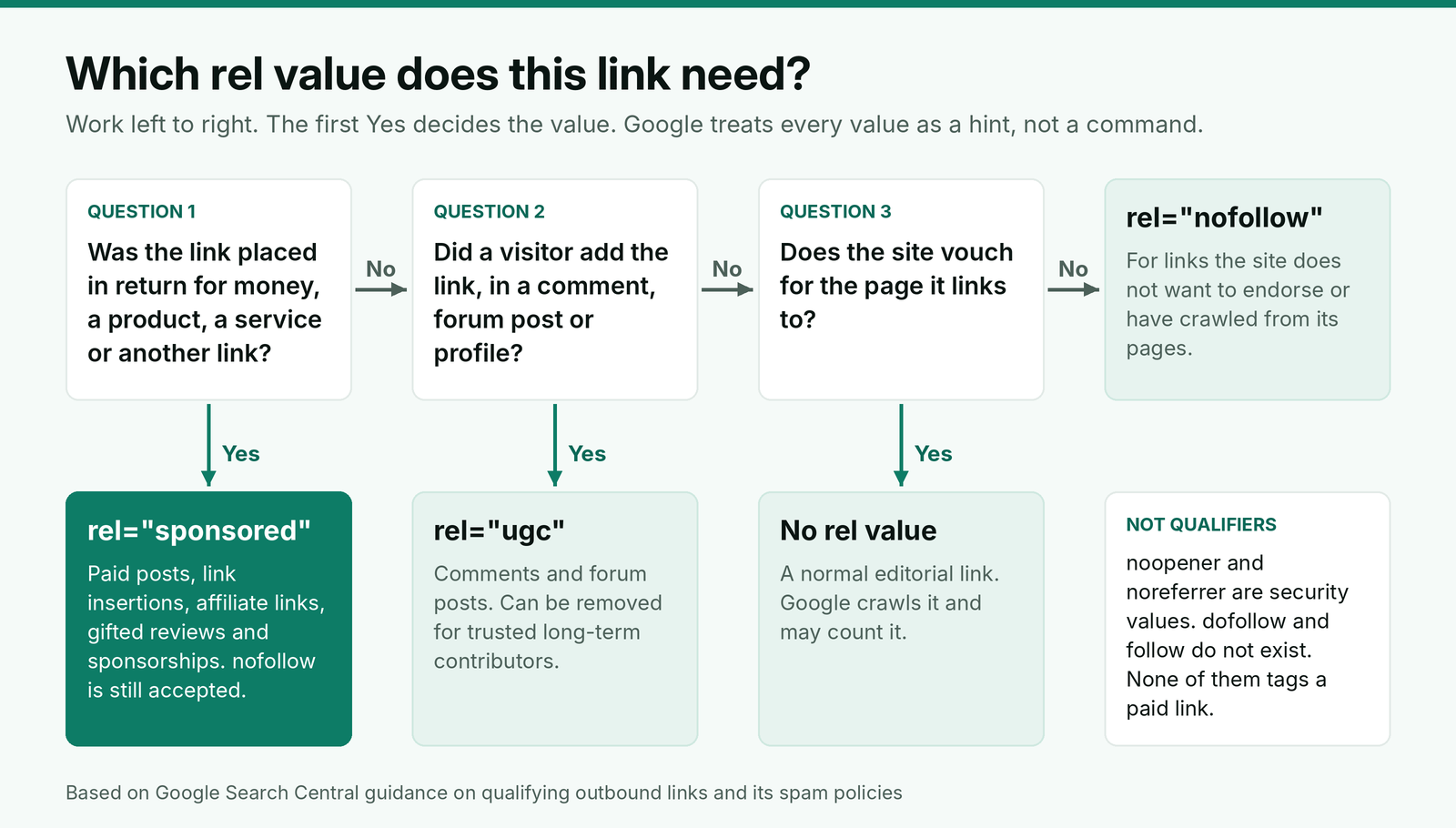
Run the first question on the vendor's whole menu, not just guest posts. Homepage links, sidebar links and "featured partner" listings are paid placements, and they tend to be sitewide placements that repeat on every page, which is a second item on the spam policy list.
How rarely publishers use it
Six years after launch, rel="sponsored" is still rare. The HTTP Archive Web Almanac 2025 found sponsored and ugc on 0.5% of mobile pages each, against 32.3% for nofollow. The authors read that as site owners still seeing little value beyond the plain split between nofollow and a normal link.
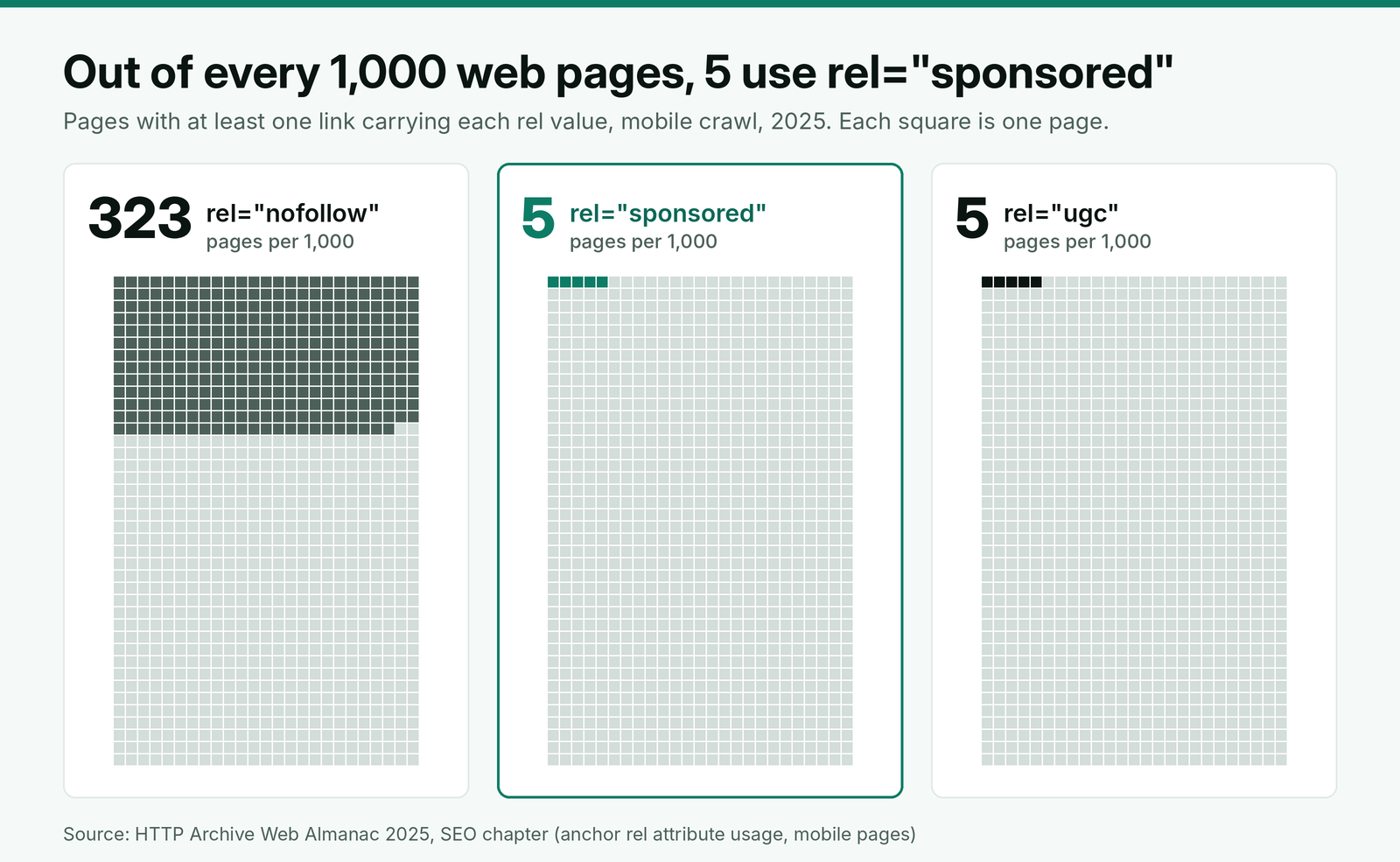
For a link buyer, that has two consequences. First, when a publisher says it tags paid posts, expect nofollow, and accept it: Google treats the two the same for paid links. Second, a publisher that writes "sponsored" on its media kit but has no rel values anywhere on its sponsored articles is telling you how its other paid links look too.
The same data shows how often publishers get the markup wrong. In the 2022 edition, rel="dofollow" appeared on more mobile pages than sponsored. Google ignores both dofollow and follow, because neither is a real value.
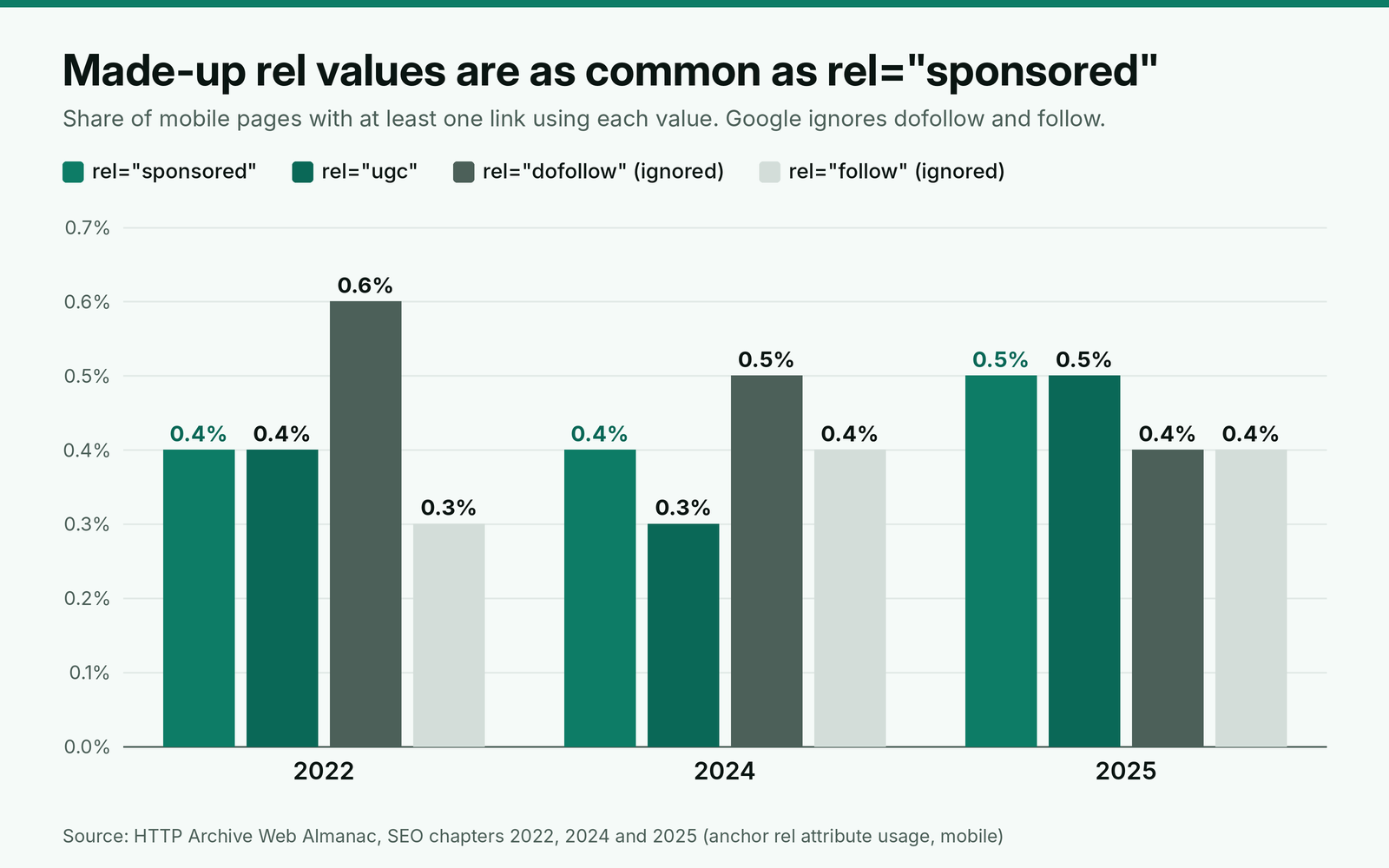
A vendor listing that promises "dofollow links" is describing a plain link with no qualifier. That is a choice the client should make knowingly, not a feature.
Who decides whether a paid link is tagged
The client decides, in writing, before the first order. We ask for that decision in the first two weeks of onboarding a link building client, before any vendor sees the brief. Some clients want every paid placement tagged and accept that the value is referral traffic, brand reach and a diverse profile. Others accept untagged paid links and the risk that comes with them. Your job is to make sure the choice is explicit, recorded and passed to every vendor, because the person who pays for the link carries the consequences of a missing tag.
We set this in the brief, next to the anchor rules, and repeat it in the order note each vendor sees. The client's side of the same rule belongs in the paid link clause of the client agreement. The policy section of a link building proposal is where the client first signs off on a written paid link policy. The tag rule then goes into the brief before any money moves, as one step in a process for buying backlinks. This is the clause we use for clients who want every paid link tagged:
Tag policy: [client name], all paid placements
Every link we pay for, whether a guest post, link insertion, sponsored listing or gifted review, must carry rel="sponsored" on the link to [client domain]. rel="nofollow" or rel="sponsored nofollow" is accepted where the publisher's system adds nofollow by default. rel="dofollow", rel="follow", noopener or noreferrer on their own do not meet this policy.
The tag must be in the HTML of the live page, on the anchor tag itself, and must stay in place for as long as the link is live. A placement without the agreed tag is not delivered and is not invoiced until it is fixed.
We recheck the tag when the link goes live and again 90 days later.
The last line matters more than it looks. Publishers change themes, switch SEO plugins and edit old posts. A tag that was there on day one can disappear in a redesign, and nobody tells the buyer. Our recheck routine for lost or edited placements covers when to look again and the claim to send when a placement has changed.
How to check rel sponsored on a live placement
Checking one link takes a minute. Checking forty takes a method, because the obvious checks miss things.
Read the rendered page, not only the source
View source shows the HTML the server sent. Many sites add or strip rel values with JavaScript after the page loads, so the source and what Google renders can differ. Check the rendered DOM in your browser's developer tools, and if they disagree, treat the rendered version as the one that counts and ask the publisher to fix the source too.
Check the right anchor
Articles often link to the client twice, once in the body and once in an author box. The tag has to be on each link to the client. A rel value on a wrapping element, or on the image inside the link, does nothing.
Use a script for more than a handful
Paste this into the browser console on a live placement, with the client's domain in the first line. It lists every link to that domain with its rel value and anchor text:
const domain = 'clientdomain.com';
[...document.querySelectorAll('a[href]')]
  .filter(a => new URL(a.href, location.href).hostname.endsWith(domain))
  .forEach(a => console.log(a.getAttribute('rel') || 'NO REL', '|', a.textContent.trim(), '|', a.href));
"NO REL" on a placement where the client chose tagging is a failed delivery. A value such as "noopener noreferrer" with no sponsored or nofollow is also a fail. Those two values are about security and referrer data, and the Web Almanac authors note they do not affect positioning.
Do not rely on Search Console for this
The Links report does not show whether a link is nofollow, so it cannot tell you which paid placements are tagged. Your own records, rechecked on the live page, are the only reliable list. We add a rel column to the placement table in the monthly client report so the client sees the status of every link they paid for.
Tag mistakes we see on live placements
- rel="dofollow" on a paid post. It reads like a promise to the buyer and means nothing to Google. The link is untagged.
- Sponsored label, no attribute. A "Sponsored" badge above the article tells readers, not search engines. Both are needed if the client chose tagging.
- Tag on the first link only. The body link is tagged and the author bio link is not.
- A plugin that strips rel values. Some publishers' editors remove attributes they do not recognize when a post is updated. This shows up at the 90-day recheck.
- Niche edits on pages the publisher keeps editing. An insertion in an old article is more exposed to rewrites than a new guest post. The trade-off comes down to how much control you keep with guest posts vs niche edits.
The attribute is also separate from disclosure to readers. The FTC's guidance on endorsements and affiliate links asks for a clear disclosure close to the recommendation, and says a single disclosure on a home page will not be enough. A rel value is invisible to readers, so it never meets that requirement on its own.
What happens when a paid link is not tagged
Usually nothing visible. Google's systems neutralize most link spam, so an untagged paid link often just passes no credit, and the client paid for a link that does nothing for rankings. The rarer outcome is a manual action for unnatural links, which is more likely when there is a pattern: many untagged paid posts with exact-match anchors, or several links from one vendor network. Mueller has said a site probably would not be penalized for affiliate links without nofollow or sponsored, while still calling the tag a best practice he strongly recommends.
Recent updates have not changed the rules. Google's September 2026 spam update finished rolling out on October 8 and was not a link spam update, but clients who lost traffic in that window will still ask about their paid links. A dated record of each placement and its tag answers that the same day. If an audit does turn up untagged paid links that need fixing, treat them as toxic backlinks and work through tagging, removal or a disavow in order.
Example: a tag check on one month of orders
Here is a made-up example. An agency placed 14 links for a SaaS client in one month, through three vendors. The client chose tagging on every paid link. The account lead runs the console script on each live URL.
| Result | Links | Action |
|---|---|---|
| rel="sponsored" | 4 | Delivered. |
| rel="nofollow" or "sponsored nofollow" | 6 | Delivered. Accepted under the tag policy. |
| rel="noopener noreferrer" only | 2 | Not delivered. Sent back to the vendor with the policy line. |
| Body link tagged, author bio link untagged | 1 | Not delivered until the bio link is tagged or removed. |
| rel="dofollow" | 1 | Not delivered. Vendor flagged in the client record. |
Ten of 14 pass on day one, and the four failures are fixed within a week without any money changing hands, because the policy was in the order before it was placed. Invoicing waits for the fixes, so the client never pays for a link that breaks their own rules. At the 90-day recheck, one of the ten has lost its tag after a theme change, and goes back to the publisher.
The vendor that delivered rel="dofollow" against a written policy is the one to watch. A site that will not follow a tag instruction probably fails other checks too, which is why tag history belongs in the website vetting checks we run before any money changes hands. Before that vendor's next order, run the rest of its list against the signs of a private blog network. A correct tag does not fix a poor fit either: an off-topic site still fails the topical relevance scoring we apply to each placement.
Where BuildLinks fits
A tag policy only works if every person who places an order sees it, and every placement has a record to check against. That is the job we built BuildLinks to do. In BuildLinks, each client has a requirements page that holds the brief and the team's SOPs, so the tag clause above sits on the account where whoever picks up the next order reads it. Each link is an order in the pipeline, rechecked automatically when the link publishes, with the target URL and anchor locked once placed and a full history on every order.
Invoices are generated when an order completes, which fits the rule that an untagged placement is not invoiced until it is fixed. New domains need approval before anyone can quote them, which is where a vendor with a poor tag record gets stopped. Keep the console script in the SOP for the rel check itself.
Conclusion
Treat rel="sponsored" as a decision the client makes once and you enforce on every order. Get the choice in writing, put the clause in the brief and in each vendor order, and accept nofollow or "sponsored nofollow" as compliant. Reject dofollow, follow and security values on their own.
Then check every placement in the rendered page, on every link to the client, when it goes live and again at 90 days. Hold the invoice until a failed tag is fixed, and keep a dated record of each link and its rel value, so a client's question after the next Google update takes minutes to answer.