Relevant backlinks are links from pages whose topic, audience and surrounding text match the page they point to. When you are paying for a placement, relevance is the check that decides whether a link helps, and it has five layers: the site, the page, the sentence around the link, the audience and the other sites the page links to. Most buyers check only the first.
This guide gives you a way to score all five before you pay, with a scorecard you can copy, a worked example of three domains quoted for one client, and the price logic that follows from the score. It sits alongside our pre-purchase website vetting checklist: vetting tells you whether a site is safe to buy on, and relevance tells you whether it is worth buying on for this client.
What makes a backlink relevant
A link is relevant when a reader of the linking page would plausibly want the page it points to. That plain test lines up with what Google has published about links, and with how link analysis has worked in research for more than twenty years.
| Source | What it says about relevance | The detail that matters to a buyer |
|---|---|---|
| Google's link best practices | "Google uses links as a signal when determining the relevancy of pages" | "The words before and after links matter, so pay attention to the sentence as a whole" |
| How Search Works: ranking results | Google looks at whether "other prominent websites link or refer to the content" | Google calls that "generally a good sign that the information is trustworthy" |
| Google patent US 8,117,209 (the reasonable surfer model, priority date June 17, 2004) | Weights each link by how likely a reader is to follow it | Features include words shortly before and after the link, link position, and the topical clusters of the source page, the anchor and the target |
| Topic-Sensitive PageRank (Stanford, WWW 2002) | Computes 16 topic-biased PageRank scores, one per top-level directory category, and uses the 3 topics closest to the query | Volunteers preferred the topic-biased results for 8 of 10 test queries |
| 2024 Google documentation leak | 2,596 modules and 14,014 attributes, including siteFocusScore (how focused a site is on its main topic) and siteRadius (how far a page strays from it) | Google confirmed the documents but warned against conclusions from "out-of-context, outdated, or incomplete information"; no weights were included |
None of this tells you how much weight relevance carries against authority, and nobody outside Google can give you that number. What it does tell you is where relevance is measured: at the site level, at the page level, and in the words next to the link. That is the structure of the scorecard below.
Why relevance beats a higher DR when you are paying
Practitioners already rank relevance ahead of authority. In a 2022 industry survey of 270 SEOs and digital PR specialists, each picking up to three link attributes that matter most for rankings, links from niche-specific sites came first and links from high-authority domains came third.
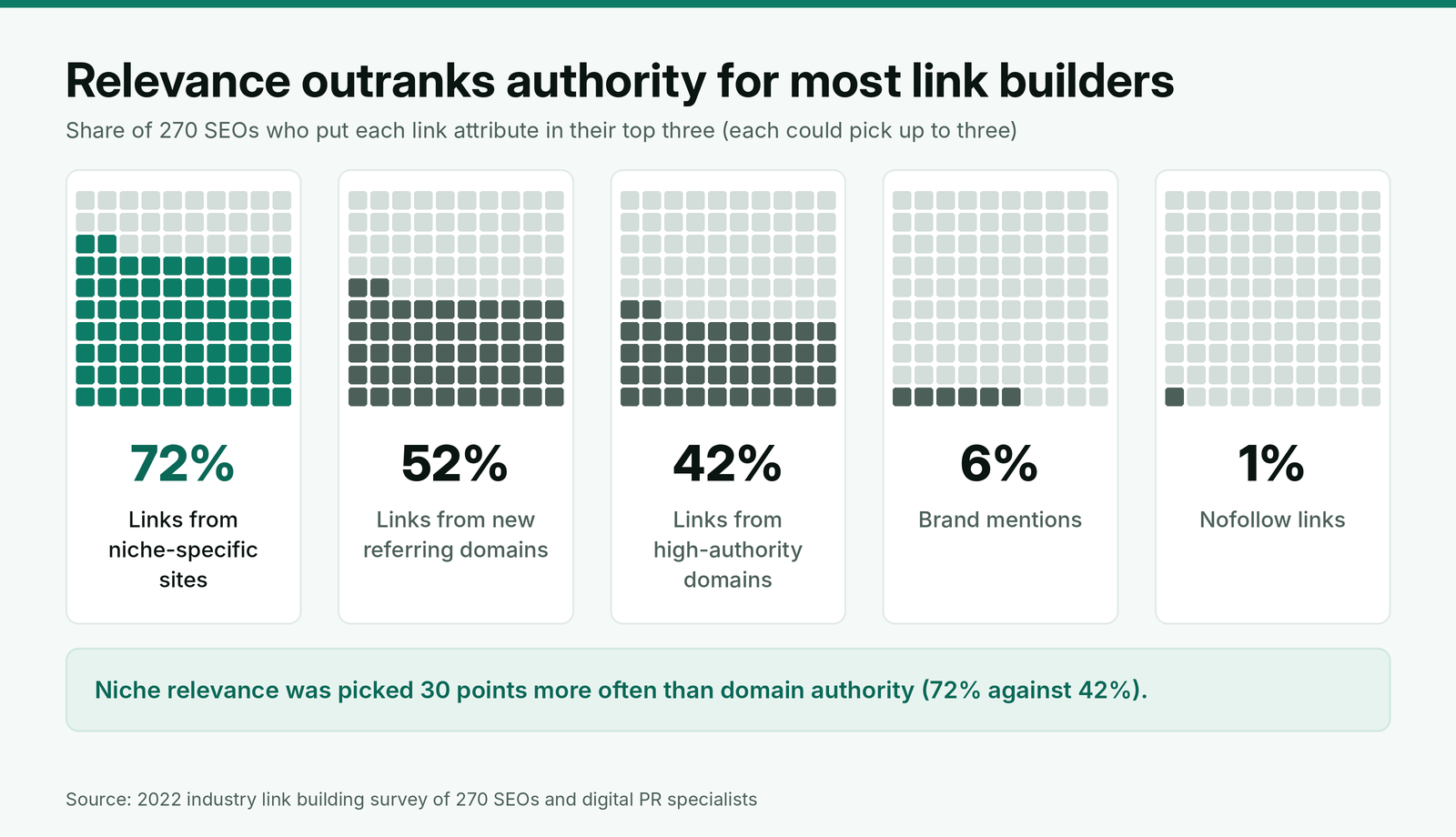
There are three practical reasons to follow them when money changes hands.
First, a link passes less than its domain metrics suggest when nobody on the page would click it. The reasonable surfer model weights a link by the chance a reader follows it, and an off-topic link in an off-topic article is the link readers ignore. DR is a site-wide number built from the links a site has earned; it says nothing about whether this page, on this topic, will send anything to your client. We cover the gap in more detail in why Domain Rating overstates what a site passes.
Second, irrelevance is what paid links look like. A general news site that suddenly links to a payroll tool, a casino and a mattress brand in the same week is the pattern Google's spam policies describe as link spam. A relevant placement on a site that covers your client's topic every week does not stand out in the same way.
Third, relevant links keep working after the ranking question. They send readers who might buy, they survive editorial clean-ups because they belong on the page, and the publisher is more likely to accept a second placement next quarter.
The five layers of relevance
Score each layer separately. A site can be a perfect topical match with a useless page, and a general site can host one page that is exactly right.
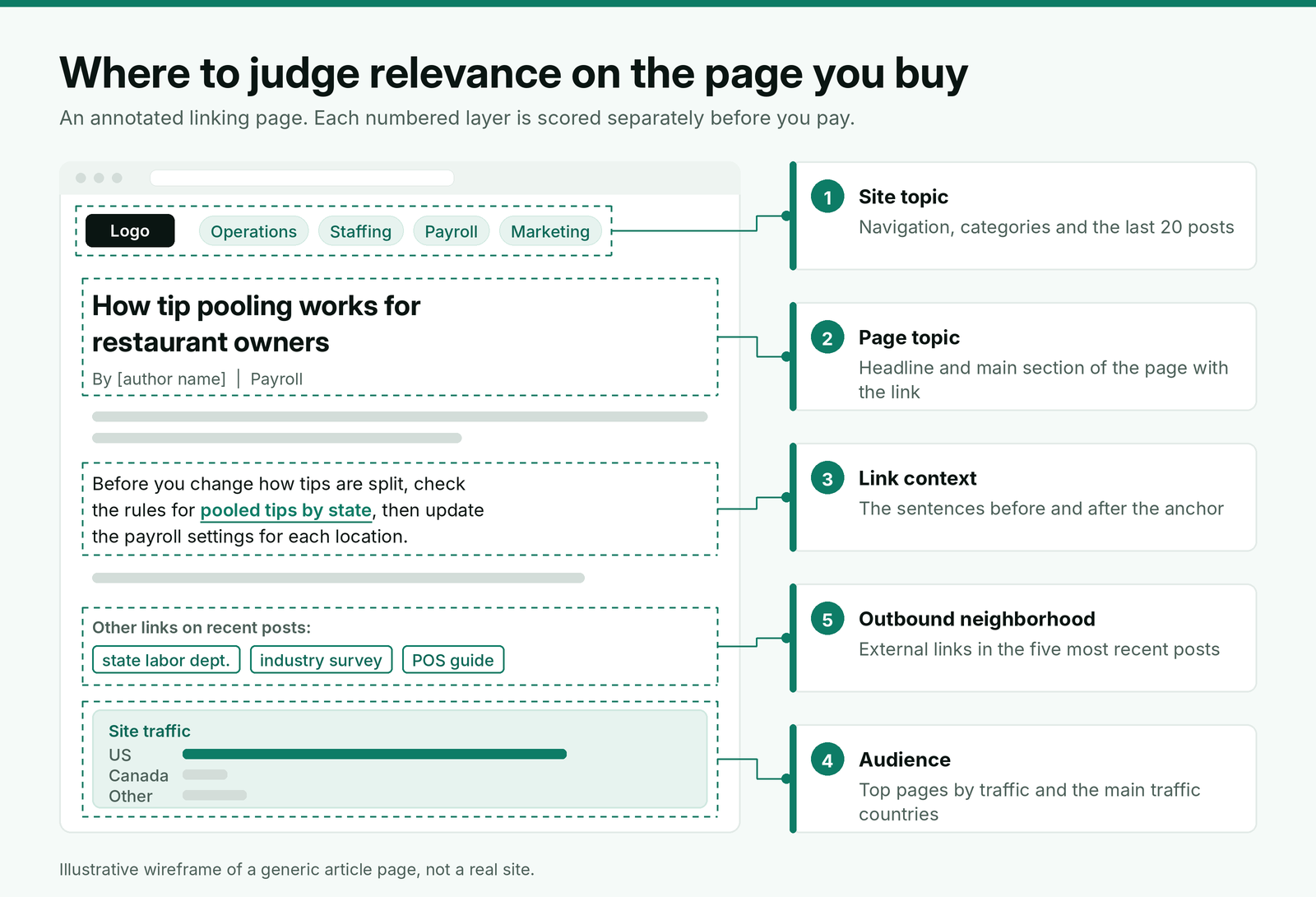
1. Site topic
Look at the navigation, the category pages and the last 20 posts. A site is a topical match when a clear share of its published content is about your client's subject or the problem your client solves. A useful house rule: if a site search for your client's core topic returns fewer than five indexed articles, the site does not cover that topic, whatever its "write for us" page says. Multi-niche sites with Finance, Health, Travel and Tech sections that all started in the same month score zero here.
2. Page topic
The page that carries the link matters more than the domain. For a guest post you choose the topic, so make it one where your client's page is the natural next read. For a niche edit the page already exists, so the question is whether its headline and main section are about your client's subject or only near it.
3. Link context
Google says the words before and after a link matter, and the reasonable surfer patent lists them as a feature. A link scores well when the sentence around it explains why the reader should click, and badly when it sits in an author bio, a footer, a list of "useful resources" or a sentence that was clearly written to carry it. If you cannot see the paragraph before you pay, you are scoring this layer blind, so ask for it.
4. Audience
Check who reads the site, not what it writes about. Pull its top pages by organic traffic and the main traffic countries. A restaurant blog whose traffic comes from recipe searches has a home-cook audience, which is a different audience from restaurant owners even though the topic sounds close. For a US client, a site with most of its traffic outside the US scores low here regardless of topic.
5. Outbound neighborhood
Open the five most recent posts and read the external links. If they point to casinos, CBD shops, essay mills and payday lenders, your client's link joins that list. This is also the layer practitioners treat as a dealbreaker: 89% of SEOs in a 2025 survey of 518, reported by Search Engine Land, avoid sites with spammy outbound links, and 86.3% treat low-quality content as a dealbreaker.
Relevance scorecard (copy this)
Score each layer 0, 1 or 2 and add them up. Record the score with the date and the URLs you checked, so the next person who quotes the domain for a similar client can reuse it.
| Layer | 2 points | 1 point | 0 points |
|---|---|---|---|
| Site topic | Covers the client's subject regularly | Covers an adjacent subject for the same buyers | Unrelated, or a multi-niche site that accepts any topic |
| Page topic | About the target page's subject | About the wider category | Unrelated to the target page |
| Link context | The sentence gives the reader a reason to click | Generic sentence in the main content | Bio, footer, resource list or a bolted-on sentence |
| Audience | Readers are the client's buyers, in the client's market | Partly the client's buyers, or the right buyers in another market | A different audience or mostly the wrong countries |
| Outbound neighborhood | External links are editorial and on topic | Mixed, with a few unrelated commercial links | Casino, CBD, essay, loan or other link-seller patterns |
How to read the total:
- 8 to 10: buy. This is the only band that justifies paying above your normal rate for the site's traffic.
- 6 or 7: buy at a standard price only. Push for a better page or a rewritten paragraph to lift it into the top band.
- 5 or below: skip, however good the DR looks.
- Hard stops: a 0 on outbound neighborhood, or a 0 on both site and page topic, ends the review whatever the total.
Worked example: three domains quoted for one client
The client, sites and quotes below are illustrative, not real domains. The client sells payroll software to US restaurants, and the target page is its guide to tip pooling rules. A vendor quotes three placements.
| Site A: restaurant operations blog | Site B: general business magazine | Site C: HR software blog | |
|---|---|---|---|
| DR | 31 | 68 | 44 |
| Monthly organic traffic (checked) | 7,500, mostly US | 120,000, 40% US | 3,200, mostly US |
| Placement | New guest post on front-of-house staff turnover | Guest post in any section | Niche edit in an existing article on tip credit rules by state |
| Quote | $280 | $450 | $190 |
| Site topic | 2 | 0 (accepts any niche) | 1 (HR, same buyer, broader topic) |
| Page topic | 1 (turnover is adjacent to tip pooling) | 1 | 2 |
| Link context | 2 (you write the paragraph) | 1 | 1 (inserted into an existing paragraph) |
| Audience | 2 | 1 | 1 (HR managers across industries) |
| Outbound neighborhood | 2 | 0 (casino and CBD links in recent posts) | 2 |
| Total | 9 | 3, hard stop | 7 |
| Quote per 1,000 monthly visits | $37.33 | $3.75 | $59.38 |
Site B is the cheapest per visitor by a wide margin and the highest DR on the sheet, and it fails twice: it accepts any niche, and its recent posts already link to casinos and CBD shops. It is the quote a DR filter would put at the top of the list.
Site A wins at 9. The page topic is the only weak point, and it is fixable: ask the editor to accept a post on tip pooling and front-of-house pay instead of general turnover, which moves the page score to 2 and the total to 10.
Site C scores 7, so it is a buy at a standard price only. At $59.38 per 1,000 visits it costs more per visitor than Site A, so the decision depends on your normal rate for a site of that size. If $190 is above what you pay for 3,000-visit sites elsewhere, negotiate or pass. If the publisher will rewrite the paragraph so the link sits in a sentence about pooled tips, context moves to 2 and the total to 8.
How far adjacent relevance stretches
Exact-topic sites run out fast in narrow niches, so most campaigns need adjacent placements. Use a one-hop rule: a site is adjacent if it shares either the client's buyer or the client's problem, but not if it shares neither.
For the restaurant payroll client, a restaurant marketing blog shares the buyer, and a small business accounting blog shares the problem (paying staff correctly). Both are one hop away and can score 1 on site topic. A general HR blog is one hop on the problem side. A food recipe site shares a word with the client but neither the buyer nor the problem, so it is two hops away and scores 0, even though a keyword filter would put it on the list.
Where the site is only adjacent, make the page do the work. A one-hop site with a page that is squarely about the target subject, a paragraph written for the link and the right audience can still reach 7 or 8.
Relevance in guest posts and niche edits
The two link types put relevance in different places. With a guest post you control the page topic and the paragraph, so the site topic, audience and neighborhood are what you are buying, and the page and context scores are your responsibility. With a niche edit the page already exists with its own topic, traffic and rankings, so page topic and context are fixed before you pay, and you should score them from the live page rather than the vendor's description. We set out the other trade-offs in how guest posts and niche edits differ in what you control.
Niche edits have one more relevance risk: the publisher keeps editing the page. Recheck that the paragraph around the link still exists on each scheduled link check, not only that the link is present.
Relevance and anchor text
A relevant placement does not need an exact-match anchor to work, because the page and the sentence already carry the topic. That matters, because Google's spam policies name "links with optimized anchor text in articles, guest posts, or press releases distributed on other sites" as link spam. On a highly relevant page, a branded or descriptive partial-match anchor in a well-written sentence gives you the topical signal without the pattern. Plan the mix per target URL before you order; this is how we set the anchor mix for each target page.
What relevance is worth in price
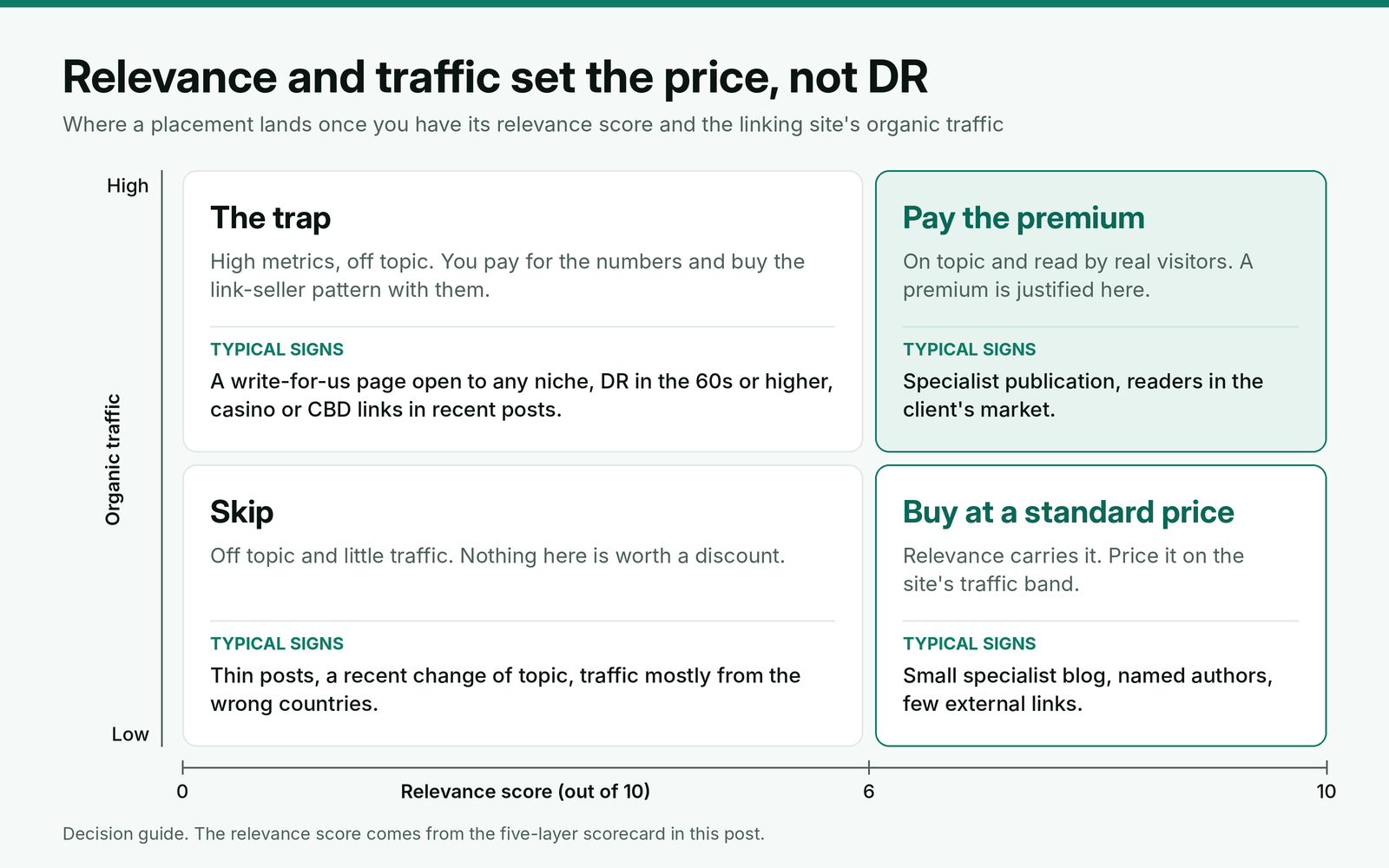
Relevance should change what you pay, but only in one direction. A score of 8 to 10 can justify a premium over the going rate for a site's traffic band. A score of 6 or 7 earns the going rate and no more. Nothing below 6 is worth a discount, because a cheap irrelevant link is still irrelevant.
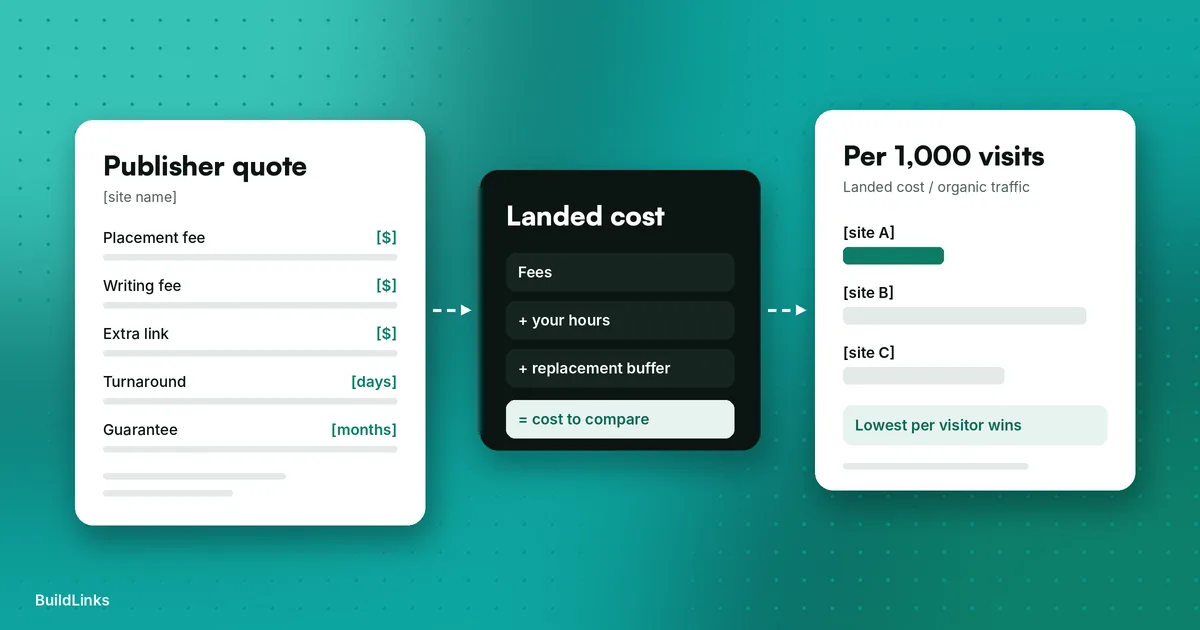
For a sense of scale, respondents to the same 2025 survey put the acceptable cost of one high-quality link at $508.95 on average, and 63.1% said they would consider sites that sell links if the quality is right. Before you pay that kind of money, compare quotes on landed cost per 1,000 visits, as in the example above, and check the going rate for the site's size against what guest posts cost at each traffic band.
Where software fits
A relevance score is only useful if the next person can find it. When scores live in one buyer's spreadsheet, the same domain gets re-checked for every client, or worse, gets quoted to a client it does not fit. In BuildLinks, a requirements page for each client holds what the client is after, the sites worth checking before pitching a domain, and the SOPs your team follows on their orders, so the client's topic, buyer and hard stops are written down before anyone quotes. The domain inventory filters by DR, traffic, service type, turnaround and country, a new domain has to be approved before anyone can quote it, and once a placement is made the target URL and anchor text are locked on the order. BuildLinks does not score relevance for you. It keeps the brief, the approval and the order in one place so the score you record is the one the order follows.
Conclusion
Judge relevance on five layers before you pay: site topic, page topic, the sentence around the link, the audience and the outbound neighborhood. Score each 0 to 2, buy at 8 or above, buy at a standard price at 6 or 7, and skip anything at 5 or below. Treat spammy outbound links, or a site and page that both miss the topic, as hard stops whatever the DR.
Use the one-hop rule to widen the pool in narrow niches, make the page and paragraph do the work on adjacent sites, and keep anchors branded or descriptive when the placement is already on topic. Then compare the survivors on landed cost per 1,000 visits and record every score so the next order starts from it.