An editorial link is a link that a site's editor chose to include because it helps their readers, with nothing given in return for the link itself. That definition matters more to link buyers than to anyone else, because "editorial links" is now also a product name: vendors sell placements by the unit under that label, and a link you paid for does not become editorial because the invoice says so.
This guide sets out a three-question test for what counts, what Google's spam policy says about paid links sold as editorial, how to check a live placement, the questions to send a vendor before you buy, and a worked audit of 20 placements from one vendor.
What counts as an editorial link
Run any link through three questions. If all three answers point the same way, the link is editorial.
- Who decided the link should be there? An editor or writer at the publication, using their own judgment, and free to say no.
- Did anything change hands for the link? No money, no free product, no service and no link back. Your time spent writing a pitch or an article does not count as payment; a fee to the publisher or the writer does.
- Would the link stay if the deal ended? An editorial link stays because it still serves the page. A link that would be removed when a subscription lapses or a renewal invoice goes unpaid was rented.
Most links fall between the two ends, and the useful question is where a given placement sits and what it needs to be safe there.
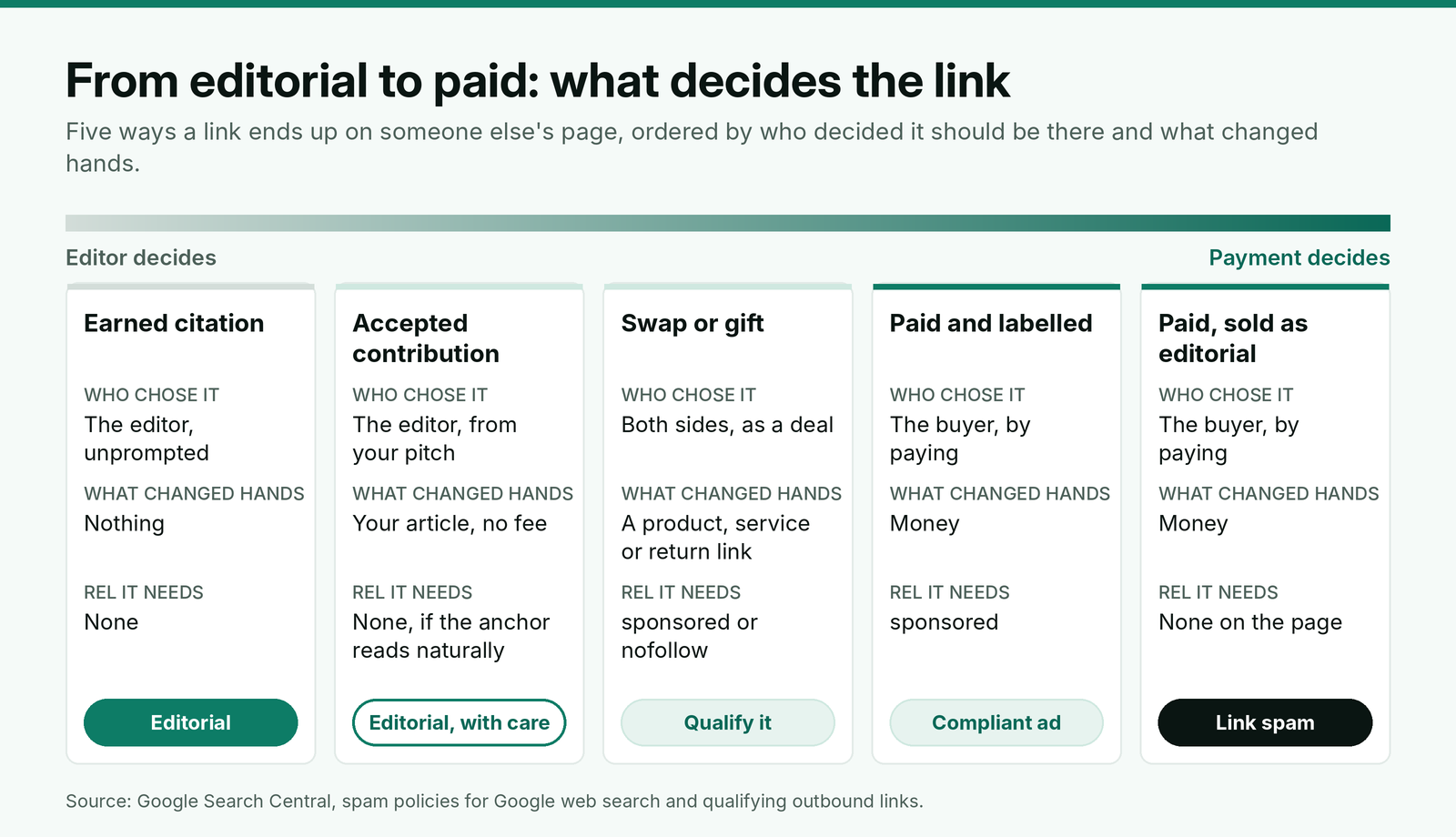
The middle of that spectrum is where most arguments happen. A guest article you pitched, wrote and got accepted without a fee is editorial in the sense that matters: the editor could have refused it. It moves right as soon as the anchor is written to rank rather than to read, or a fee appears somewhere in the chain. Our guide to when a new article beats an insertion into an old one covers how those two placement types differ on cost and risk once money is involved.
What Google's spam policy says about links sold as editorial
Google's spam policies for Google web search do not use the word "editorial" as a safe harbor. They list behaviors. Among the examples of link spam are "Exchanging money for links, or posts that contain links", "Exchanging goods or services for links" and "Advertorials or native advertising where payment is received for articles that include links that pass ranking credit". The same list names links with optimized anchor text in articles, guest posts or press releases distributed on other sites.
The policy also leaves room for paid links: "It's not a violation of our policies to have such links as long as they are qualified" with a nofollow or sponsored value. Google's guide to qualifying outbound links is explicit about which one: mark paid placements with sponsored, while nofollow "is still an acceptable way to flag them, though sponsored is preferred."
So a paid placement has two compliant forms. It can carry a sponsored or nofollow value and be an honest ad, or the buyer can stop paying for it. The form that breaks the policy is the one many "editorial link" offers are built to deliver: a paid link with no rel value, presented as an editor's choice. Our guide on how to pick and verify the rel value on paid links covers which value to use per client and how to check it on every live placement.
A second policy on the same page covers the sites these links sit on. Google's site reputation policy applies "where third-party content is published on a host site mainly because of that host's already-established ranking signals". A partner section filled with vendor posts that the host's editors never touch is close to what that sentence describes, whatever the vendor calls the links inside it.
The word "editorial" on a price list
One agency that sells "editorial backlinks" lists a single link at $375, $350 each in a pack of five and $300 each in a pack of 20. It says it pitches site owners directly and avoids sites that sell links, and nothing on that page says how publishers are compensated. That is the gap to close with any vendor: a fixed price per link tells you what you pay, not whether the publisher was paid, and only the second fact decides which side of Google's policy the link falls on.
Ask the question directly, get the answer in writing and keep it with the order. A vendor whose links pass the three-question test can tell you how each site was won. A vendor who cannot, or calls the question confidential, has told you which column the links belong in.
How often Google revisits spam, and why it matters for paid links
A paid link with no rel value only passes value until Google discounts it, and Google has given itself plenty of chances. Google's Search Status Dashboard lists 11 spam updates from October 2022 to September 2026, one of them named for links.
| Year | Spam updates listed | Updates | Longest rollout |
|---|---|---|---|
| 2022 | 2 | October spam update; December link spam update | 29 days (December link spam update) |
| 2023 | 1 | October spam update | 15 days, 12 hours |
| 2024 | 3 | March, June and December spam updates | 14 days, 21 hours (March) |
| 2025 | 1 | August spam update | 26 days, 15 hours |
| 2026 | 4 | March, June, August and September spam updates | 13 days, 16 hours (September) |
Two things follow for a buyer. First, the cadence has picked up: four spam updates in 2026 so far, against one in each of 2023 and 2025. Second, rollouts can run for weeks, so a ranking change during one is hard to pin on a single cause. The November 2026 core update began on November 10, which makes the weeks after that date a poor window for reading the effect of any new placement.
A link that passes the three-question test does not care when the next update lands. A paid link with no rel value is a bet that it will keep going unnoticed, and the client carries that bet, not the vendor.
How to check whether a placement is editorial
You cannot see a payment from outside, but paid placements leave marks on the page and the site around it. Check them on the live URL before you approve a site, and again on the placement itself once it goes live.
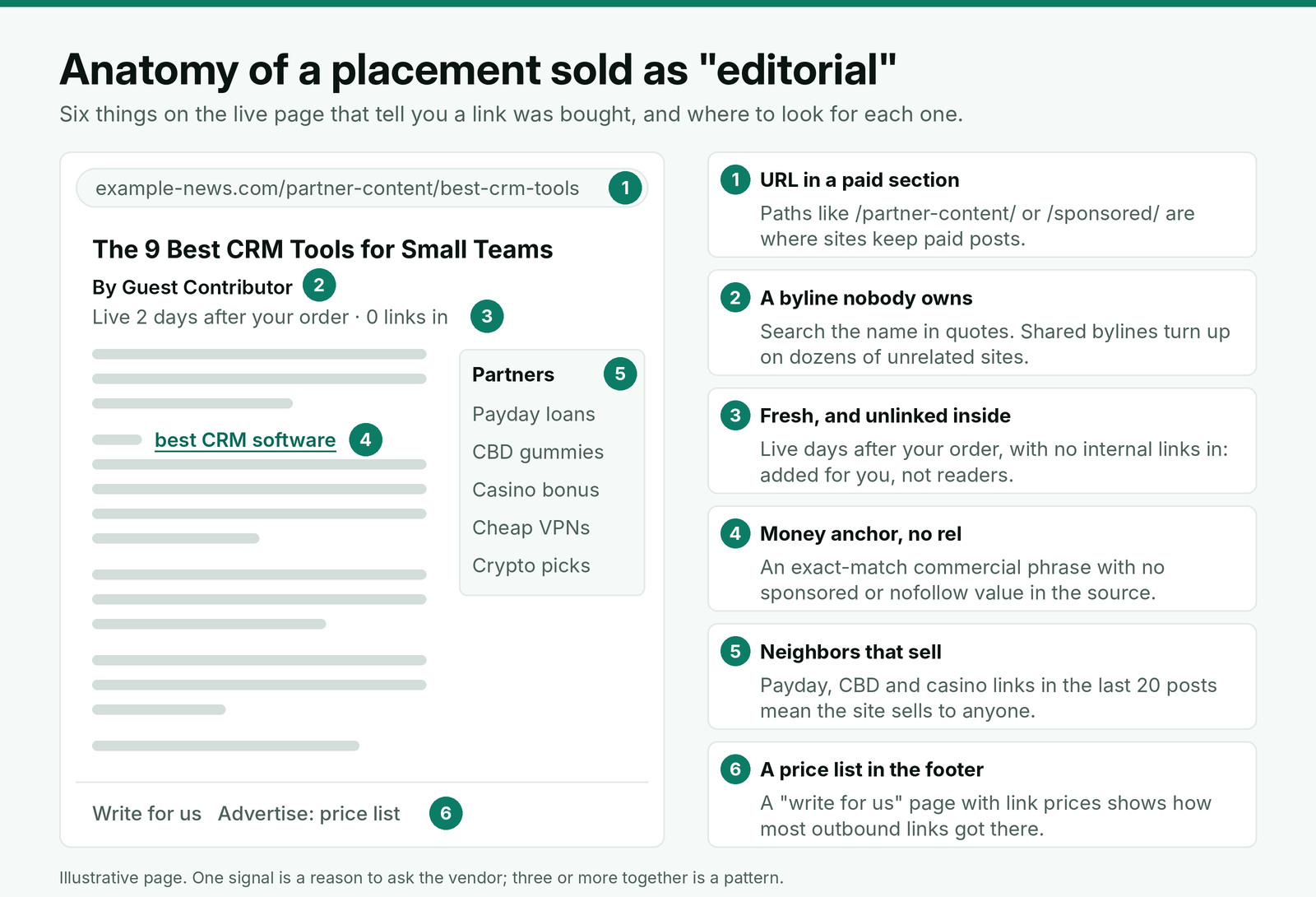
Work from the page source, not the rendered page. A sponsored label can live in a meta tag or a CSS class without showing on screen, and a rel value is invisible unless you look for it. Then widen the view to the site: open the 20 most recent posts in the same section and count the outbound commercial links that have nothing to do with the topic. On a site that sells to anyone, that count is usually higher than the number of posts.
Two checks take less than a minute and catch the most common footprints. Search the byline in quotes: a real contributor has a bio and a beat, while a shared name turns up across unrelated sites. Then search the domain for "write for us" and "sponsored post": a public price list does not make every link on the site paid, but it tells you how most of them got there. The same footprints show up on sites rebuilt from expired domains, which our guide to the footprints that give away a link network covers in detail.
None of this replaces the rest of a site review. Traffic, topic fit and how much strength the linking page itself carries still decide whether a placement is worth having at all. We run the editorial check as one step in the full checklist we run before buying on any site, after relevance and before price.
Questions to send a vendor that sells "editorial links"
Send these before the first order, and again whenever a vendor adds sites to its list. The answers go on the vendor's record, so a later claim does not depend on anyone's memory.
Subject: Questions before we order: [vendor name] editorial placements
Hi [first name],
Before we place orders for [client or project], we need written answers to the questions below for the sites on your list. Short answers are fine.
1. How is each publisher compensated: no payment, a flat fee per post, a revenue share, or something else?
2. Does any money or product go to the writer or editor who places the link?
3. Does the publisher's editor see and approve the article and the link before it goes live, and can they refuse it?
4. Will any placement sit in a section labelled sponsored, partner, brand or similar? If so, which sites?
5. Will the link carry a rel value? We need [no rel value on unpaid placements / rel="sponsored" on every paid placement].
6. How many of your other clients' links has each site published in the last 90 days?
7. What happens if a publisher later adds nofollow or sponsored, noindexes the page or removes the link, and for how long does that cover us?
We keep your answers with each order, and we will check live placements against them.
Thanks,
[Your name]
[Agency, URL]
Question 6 does the most work. A site that published dozens of client links in 90 days is selling inventory, whatever its editors do, and the honest answer to question 1 for that site is almost never "no payment".
Editorial, labelled or not at all: deciding per client
Once you know which column a placement belongs in, the decision is about the client, not the link. Three positions cover most accounts.
Earned editorial only. For clients in regulated markets, clients who have had a manual action, or clients whose legal team has a view on paid media, buy nothing that fails the three-question test. That means outreach, digital PR and assets worth citing, with slower delivery and less control over the anchor.
Paid and labelled. For clients who want placements on schedule, buy openly and require rel="sponsored" on every paid link. The link is not meant to pass ranking credit, but the placement can still send referral traffic and put the brand in front of the right readers, and it sits inside Google's policy. Price it as advertising, not as SEO.
Paid, unlabelled. This is the "editorial link" most vendors sell. If a client chooses it, record that decision in writing, with the risk stated, before the first order. The client should be the one who decides to take a risk with their site, and the record protects you when a spam update lands.
Whichever position the client takes, put it in the brief, the contract and every order. A placement that arrives labelled sponsored when the client paid for an unlabelled one is off brief, and so is the reverse.
Worked example: auditing 20 placements sold as editorial
Here is a made-up example. An agency bought 20 "editorial" placements from one vendor for a SaaS client at $350 each, $7,000 in all. The vendor's answers to the questions above said publishers were "partners" and placements were "editorially reviewed". The agency checked each live URL and its site.
| Group | Placements | What the check found | Decision |
|---|---|---|---|
| A | 5 | In the main editorial section, staff bylines, internal links in, no price list, normal outbound links | Keep; likely editorial or close to it |
| B | 6 | Site has a public price list, but the post sits in the main section with a real byline | Keep; ask the vendor to confirm compensation per site |
| C | 4 | In a /partner/ section, shared byline, no internal links, sponsored class in the source, no rel on the link | Ask for rel="sponsored" or a replacement under the brief |
| D | 3 | Last 20 posts link to payday, casino and CBD offers; same byline on 30+ sites | Replace; site fails vetting regardless of rel |
| E | 2 | Page noindexed within 30 days of going live | Replacement claim under the vendor's terms |
Eleven of 20 placements hold up, and only 5 look editorial without a follow-up. The 9 in groups C, D and E are $3,150 of spend that either needs a fix from the vendor or a replacement. Group C is the instructive one: the publisher already tagged the post as sponsored in its own markup but left the link unqualified, which is the exact form Google's policy describes.
The audit also changes the vendor's standing. A vendor whose "editorial" list is 25% clear editorial is a paid placement vendor with good sites mixed in, and the next order should go out with a brief that says so. Record the result against the vendor, alongside the on-brief rate we report to clients each month, so the next quarter's split between vendors uses numbers rather than impressions.
Earning editorial links instead of buying them
Links that pass all three questions come from giving an editor something worth citing: original data, a tool, a clear explanation of something their readers ask about, or a source for a story already in progress. Then someone has to put it in front of the right editors, one at a time. If your team runs that outreach in house, linkOreach is link building outreach software built for that job: its AI agent, Linkzy, finds prospects, writes personalized pitches, sends follow-ups and flags the replies worth your attention.
Earned links are slower and less predictable than bought ones, so most agencies run both. The rule is to keep them in separate lines on the plan and the report, so nobody mistakes a paid placement for an editor's endorsement.
Where BuildLinks fits
An editorial standard only holds if every order is checked against it, by whoever places the order. That is the job we built BuildLinks to do. In BuildLinks, the site list is one shared inventory, and new domains wait for approval before anyone can quote them, so a site with a public price list or a partner section stays out of quotes until someone has checked it against the client's standard. Each client's editorial position and your vendor questions go on the client's requirements page, next to the SOPs your team follows on their orders.
Once an order is placed, its target URL and anchor lock, and guest posts and niche edits are rechecked automatically the moment the link publishes, so you start from a link you know went live as ordered. BuildLinks does not know how a publisher was paid; the vendor's written answers and your own page checks are what tell you that.
Conclusion
Judge every link by who decided it should be there and what changed hands, not by what the vendor calls it. A link an editor chose freely, with no fee, product or swap behind it, is editorial. A paid link is compliant only with rel="sponsored" or nofollow on it, and a paid link without one is the form Google's policy names as link spam.
Before buying, send vendors the seven questions and keep the answers with each order. Check every live placement for a paid section, a shared byline, unrelated commercial neighbors and a missing rel value, and treat three signals as a pattern. Decide each client's position in writing, and score vendors on how much of their "editorial" list survives the audit.