Guest posting for SEO still works when the post would be worth publishing without the link: a real article, on a site with real readers in the client's topic, with one link placed where an editor would put it. What stopped working is guest posting as a volume tactic, where the article exists to carry a keyword anchor. Google names that pattern in its spam policies, and its systems now mostly ignore those links rather than penalize them, so the usual outcome is a full invoice for a link that does nothing.
This guide is for agencies and freelancers deciding how much of a client's link plan to put into guest posts. It covers what Google's policies say about them today, what a guest post that passes value looks like on the page, how to sort opportunities, the cost of earning a post against buying one, a brief you can send to any writer or vendor, and how to measure whether a post did anything.
Does guest posting still work for SEO?
Yes, with a narrower definition than most vendors use. A guest post link is worth what the page is worth: its topic, its audience, how the publisher treats it, and whether it reads as editorial. A post on a site the client's buyers read, linking to a useful page with a descriptive anchor, behaves like any other good link. Twenty posts a month on general blogs that publish anything for a fee behave like a pattern, and patterns are what Google's systems are built to find.
The industry has been told this for over a decade. In January 2014 Matt Cutts, then head of Google's webspam team, wrote that guest blogging for links had "gotten too spammy" and that anyone using it mainly to gain links should stop. In a reply under the same post he added that a high-quality guest post with nofollowed links "can still be a good way to get exposure to a new audience." That split still describes Google's position. Exposure is fine. Links placed to manipulate rankings are not.
What changed since then is enforcement. Most link spam is now neutralized by algorithm, so an untagged guest post on a weak site rarely triggers anything visible. It passes nothing. The client's report shows a live link, and the target page never moves.
What Google's policies say about guest posts
Two policies cover guest posting, and they apply to different sides of the order.
Link spam: the buyer's side
Google's spam policies list "links with optimized anchor text in articles, guest posts, or press releases distributed on other sites" as an example of link spam, next to advertorials "where payment is received for articles" that include links passing ranking credit. Read what the line targets: optimized anchors, distributed at scale. A guest post with a branded or descriptive anchor, on a site chosen for its readers, is not what it describes. A paid guest post whose link carries rel="sponsored" or rel="nofollow" is within the rules, and our guide to tagging paid guest posts shows how to confirm the tag on the live page.
Site reputation abuse: the publisher's side
The same page defines site reputation abuse as "third-party content is published on a host site mainly because of that host's already-established ranking signals." Its examples are an educational site hosting third-party payday loan reviews and a medical site hosting a casino page, while editorial columns and opinion pieces are named as fine. When Google clarified the policy in January 2025, it added that moving such content into a subdomain or subdirectory "may be viewed as an attempt to circumvent" it.
For a buyer, this policy is a vetting signal. A publisher with a partners or contributors section full of off-topic commercial posts is the kind of host the policy targets, and when Google acts on that section, every link in it goes with it.
What changed in October 2026
On October 5, 2026, Google added a paragraph to its guide on creating helpful content saying that fabricating creator profiles, "such as by using AI-generated headshots, made-up names, or false credentials," is a form of deception and "a signal of a low-quality page." That lands directly on guest posting, where invented contributor personas with stock photos are common, both in vendor-written articles and on the sites that host them. Put a real person's name on every guest post you place, and treat a site whose contributor pages are all invented as a site that fails vetting.
Manual actions may also be getting more frequent. Consultants reported a rise in manual action requests in early October 2026, mostly for thin, scaled and pure spam content, with site reputation and unnatural link actions among the types being discussed. The evidence is anecdotal, but large guest post sections on general blogs are the kind of content those actions hit.
What a guest post that counts looks like
Most of what decides a guest post's value is visible on the published page, and most of it can be agreed before you pay. The figure marks the seven places we check on every live post.
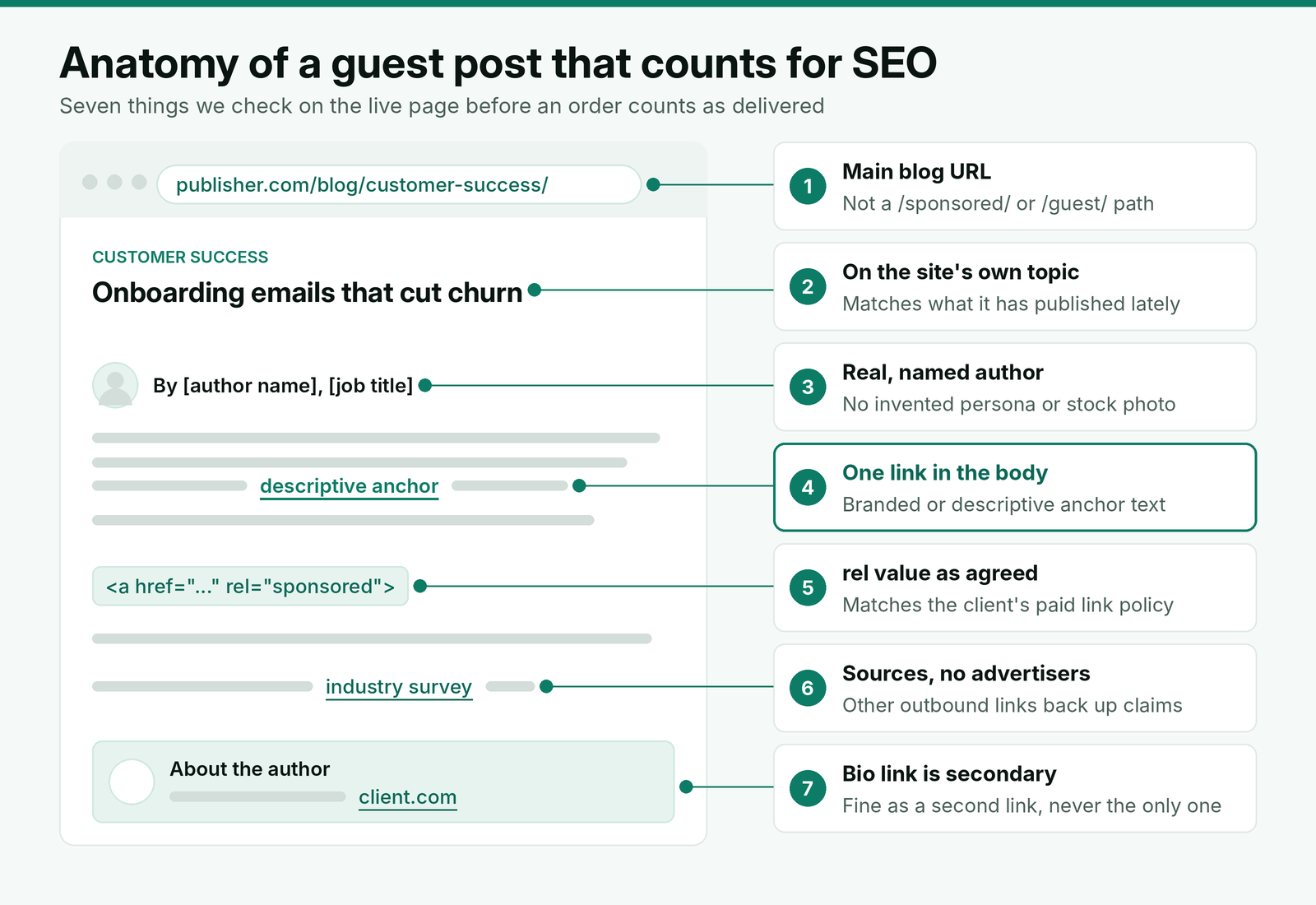
Two of these carry most of the weight. The first is where the post lives. A guest post in the publisher's main blog, linked from its category pages and listed in its sitemap, is treated like the rest of the site's content. One filed under a separate sponsored or guest path that nothing links to is often thin, sometimes noindexed, and exactly the setup the site reputation policy warns about. Ask for the URL path before you buy.
The second is the link itself. One link to the client in the body, inside a paragraph about the same subject, with a branded or descriptive anchor, is the placement to ask for. An author bio link is fine as a second link, but it is the first thing a template change removes, and it reads as self-promotion. Keep exact-match anchors out of guest posts entirely: the spam policy names them, and pages you control are the safer place for them.
The rest of the figure is a vetting question rather than a placement one. Our full vetting routine covers traffic, topic and outbound links, and the checks for network sites rebuilt on expired domains catch the cheap high-DR blogs that sell guest posts to anyone.
Which guest post opportunities are worth taking
Two questions sort almost every opportunity: whether the site covers the client's topic, and whether it has readers. Together they decide whether to take the post and how to report the link.
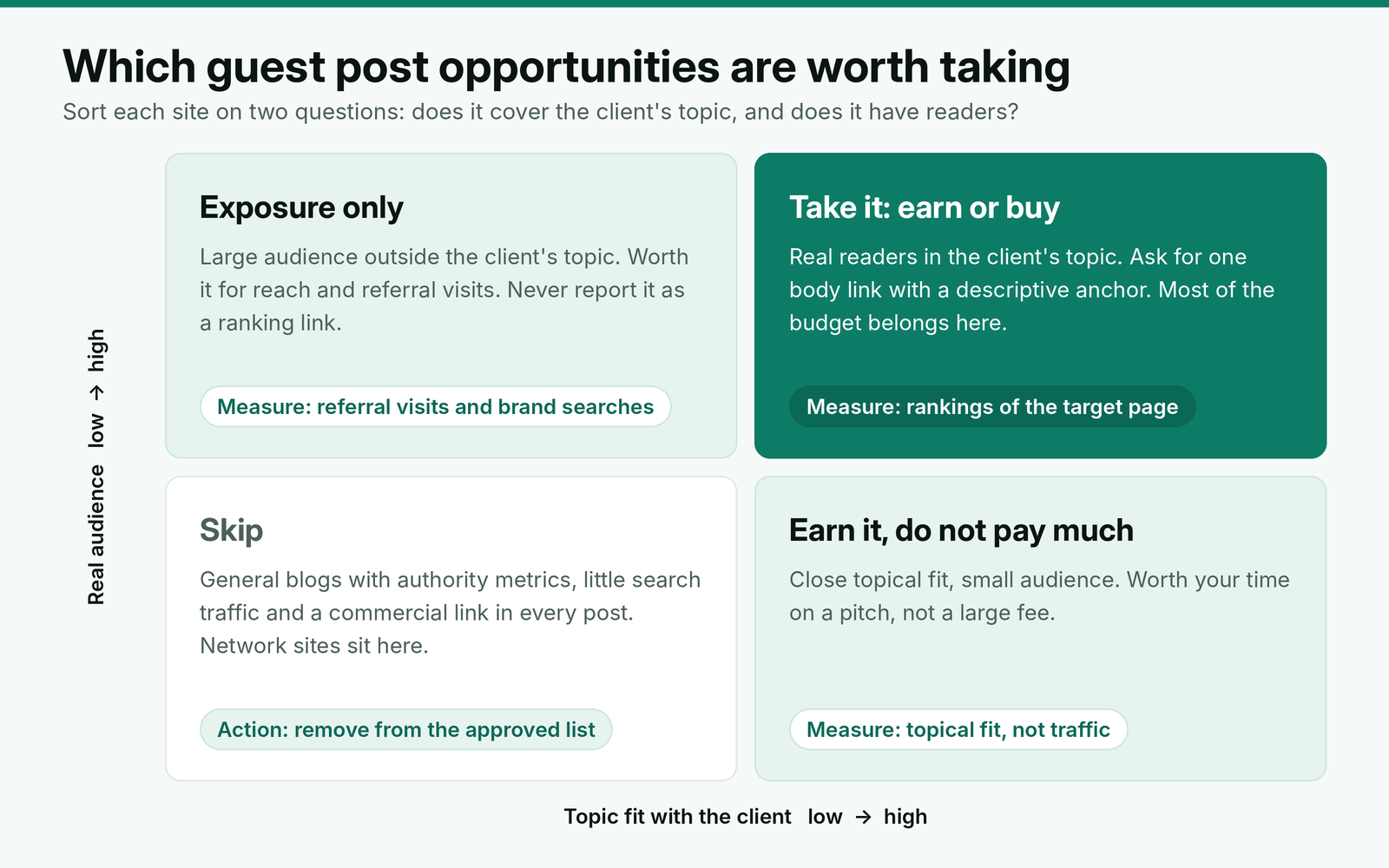
The top right is where a guest post works as an SEO link in the full sense, and it is where most of the budget should go. The bottom left is where low-priced guest posts usually sit: general blogs with authority metrics, little search traffic and a commercial link in every post. Skip them even when they are cheap.
The other two quadrants are judgment calls. A relevant site with a small audience is worth an earned post, because the cost is time and the topical fit is real; a niche newsletter's blog or a trade association's resource section often sits here. A large site outside the client's topic can be worth it for reach, as long as nobody reports it to the client as a ranking link.
Earn or buy: what each guest post costs
An earned guest post is one the publisher accepts on merit after a pitch, with no fee. A bought one is a placement you pay for, direct or through a vendor. Earned posts look free and are not: someone finds the site, pitches, writes, revises and checks the link. Bought posts cost more up front, but the cost is known before you start.
A survey of 518 SEO professionals, reported by Search Engine Land, gives a sense of where buyers sit. It was run by a company that sells link building services, which may tilt it toward people who buy links.
| Figure | Result | What it means for guest posts |
|---|---|---|
| Average acceptable price for one high-quality link | $508.95 | A sensible ceiling for a strong, relevant guest post. A "high DR" quote far below it needs the full checks. |
| Outsource at least part of their link building | 56% | Buying placements is normal. The question is which sites, not whether to buy. |
| Open to sites that sell links if the quality is right | 63.1% | Most buyers judge the site rather than whether money changed hands. |
| Avoid sites with spammy outbound links | 89% | Outbound links in recent posts are the first filter, for buyers and for Google. |
| Treat low-quality content as a dealbreaker | 86.3% | The host's own articles matter as much as the one you place. |
| Say measuring link building ROI is hard | 52.9% | Decide how a guest post will be measured before you order it. |
On the earned side, the cost is labor. The median pay for writers and authors in the US is $36.98 an hour, from the Bureau of Labor Statistics' May 2025 data. Our worked example assumes five hours to write and revise a post for a real publication, half an hour per pitch including finding and checking the site, and one hour of brief and QA on a bought post.
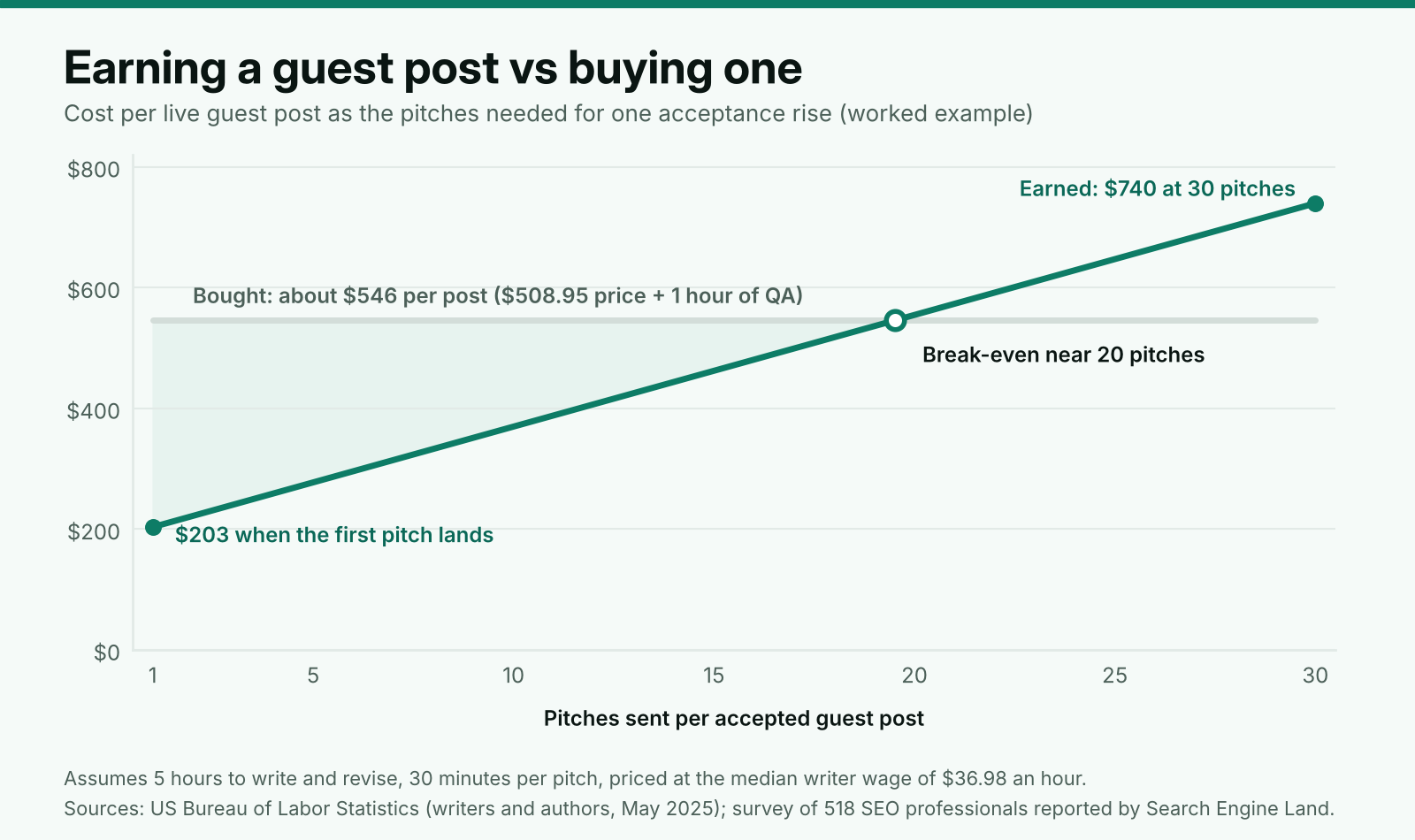
At the median writer wage, an earned post costs about $203 when the first pitch lands and about $555 when it takes twenty. A bought post sits flat at about $546: the $508.95 price plus an hour of your time. The break-even is just under 20 pitches per accepted post.
Two things move that line. Your real hourly cost is higher than a median wage once overhead is added, which pulls the break-even lower. And in a narrow B2B niche with a few dozen relevant publications, you can run out of sites before you reach twenty pitches. Most agencies end up with a mix: earned posts on the best-fit publications, where an editor's acceptance is part of the value, and bought placements to hit monthly volume. When you resell bought posts, the markup goes on top of these costs; we set it from what to charge clients for a placement, and the current market rates are in what guest posts cost by route.
For the pitching itself, linkOreach is link building outreach software. Its AI agent, Linkzy, builds prospect lists with authority and traffic data, writes a pitch for each site, sends from your own domain and runs follow-ups that stop as soon as someone replies.
Guest posts or niche edits
A guest post gives you control of the article, the context around the link and the publish date. A niche edit puts the link into an existing page that already has age, links and sometimes traffic, usually for less money. Use guest posts when the client needs a subject covered a specific way, or when the target page needs a focused article to justify the link. Use niche edits when an existing article already ranks for the subject and the publisher will add a sentence that fits. We compare both in more detail, including when a niche edit beats a new article.
A guest post brief you can send to any writer or vendor
Most guest post problems start with a missing line in the brief. This is the one we send for every placement, earned or bought, so the writer and the publisher know the rules before the article exists.
Guest post brief: [client name], [target URL]
Publication: [site], main blog section only. Please confirm the URL path before writing. Posts in sponsored, partner or contributor sections that the main blog does not link to do not meet this brief.
Topic: [working title]. The article must be useful to [audience] without the link, and must match subjects the site has covered in the last six months.
Length and author: [1,200 to 1,800] words, published under the real name of [author], with a short bio and an author page. No invented personas or stock headshots.
Link: one link to [target URL] in the body, inside a paragraph about [subject], with the anchor [branded or descriptive anchor]. No exact-match keyword anchors. An author bio link to [client home page] is optional.
Tag: [rel="sponsored" or rel="nofollow" on the client link / no qualifier], as set in the client's written paid link policy.
Other links: at least two links to non-commercial sources that support claims in the article. No links to other advertisers.
Delivery: send the live URL within [n] days. We check the link, anchor, tag and indexing when it goes live and again after 90 days.
The URL path and author lines are the ones vendors push back on most. A vendor who cannot say which section a post will appear in, or who publishes every article under the same invented contributor, is selling the kind of placement that both the site reputation policy and the October 2026 authorship guidance describe.
How to measure a guest post's SEO effect
Measure each post on three things, in this order. First, indexing: if Google has not indexed the page within four weeks of going live, the link is not doing anything yet, so ask the publisher to fix crawl or noindex problems on their side. Second, the target page: track the queries it ranks for in Search Console from the live date, and compare against similar pages that got no new links in the same period, so a site-wide update does not get credited to the post. Third, referral visits from the post, which matter most for posts in the exposure quadrant.
A single link rarely moves a page on its own, so judge guest posts in batches by target page rather than one at a time. Record every post with its live date, anchor, tag and index status, and recheck at 90 days, when tags lost in redesigns and deleted bio links show up.
Where BuildLinks fits
Guest posting at agency scale is mostly record keeping: which site, which brief, which anchor, which tag, which client, and whether the link is still there. That is the job we built BuildLinks to do. In BuildLinks, the brief above lives on a per-client requirements page alongside your SOPs, so whoever places the next order works from the same rules. Each guest post is an order with a status, the target URL and anchor lock once the order is placed, guest posts are rechecked automatically when the link publishes, and the invoice is generated when the order completes.
Sites you approve go into a domain inventory with your prices, and a new domain cannot be quoted until it is approved, so a general blog that failed your checks does not come back through a different vendor. In the setup we built for agencies, clients log in to a portal on your domain and see their price, while the vendor cost behind each placement stays visible only to you. BuildLinks does not find publishers or send pitches, so keep your outreach tool alongside it.
Conclusion
Treat guest posting for SEO as a placement decision, not a volume target. Put the budget into sites that cover the client's topic and have readers, and ask for one body link with a branded or descriptive anchor, in the main blog, under a real author. Keep exact-match anchors out, and skip cheap general blogs with authority metrics and no traffic whatever the price.
Earn posts on the best-fit publications while they take fewer than about 20 pitches to land, and buy the rest against a ceiling near $500 for a strong site. Send the same brief every time, check indexing within four weeks, and judge results by target page after 90 days.