Spam Score is Moz's estimate, from 1 to 100%, of how many sites with features like the one you are checking it has found penalized or banned by Google. It describes what a site looks like, not what it does, and for anyone buying links that gap is where the score misleads: a link seller can look clean and a harmless niche blog can look risky.
This guide is for agencies and freelancers who see a spam score on a vendor list, a marketplace listing or a client's backlink report. It covers what the score measures, which of its 27 signals matter to a link buyer, why Google ignores it, the thresholds we use when vetting a site, a worked example and a note you can copy onto every order.
What spam score measures
Moz built Spam Score with a machine learning model trained on sites that Google had penalized or banned. The model found 27 features those sites tend to share, and a site's score is the share of sites with a similar mix of features that turned out to be penalized. A 40% score does not mean 40% of the site is spam. It means four in ten sites that look like it in those 27 respects were penalized.
Moz's help documentation sorts the score into three bands: 1 to 30% is Low, 31 to 60% is Medium and 61 to 100% is High. The same page stresses that the score rests on correlation with penalties, not causation, and recommends treating a high score as a reason to look closer rather than a reason to reject a site or disavow its links.
A few details matter before you read a score on a listing:
- It scores the site, not its backlinks. A site's own Spam Score is not an average of the sites linking to it. The tool shows the scores of linking domains separately.
- It changes slowly. The score is refreshed quarterly, and only moves when the crawler sees a change in one of the 27 features. There is no history view, so you cannot see when a score last moved.
- "--" means not scored. The site has not been evaluated yet. Treat it as unknown, never as zero.
- It is a different number from DA. Domain Authority estimates ranking strength from links. Spam Score estimates penalty risk from site features. If you need the difference between the authority scores themselves, see how DA and DR disagree, and what DR4 changes.
The 27 spam score signals, grouped by what they look at
The list of signals tells you more than the number does. Grouped by what each one looks at, most of the 27 check how a site is built and set up. Very few look at what a link seller does for a living: link out to paying customers with commercial anchors.
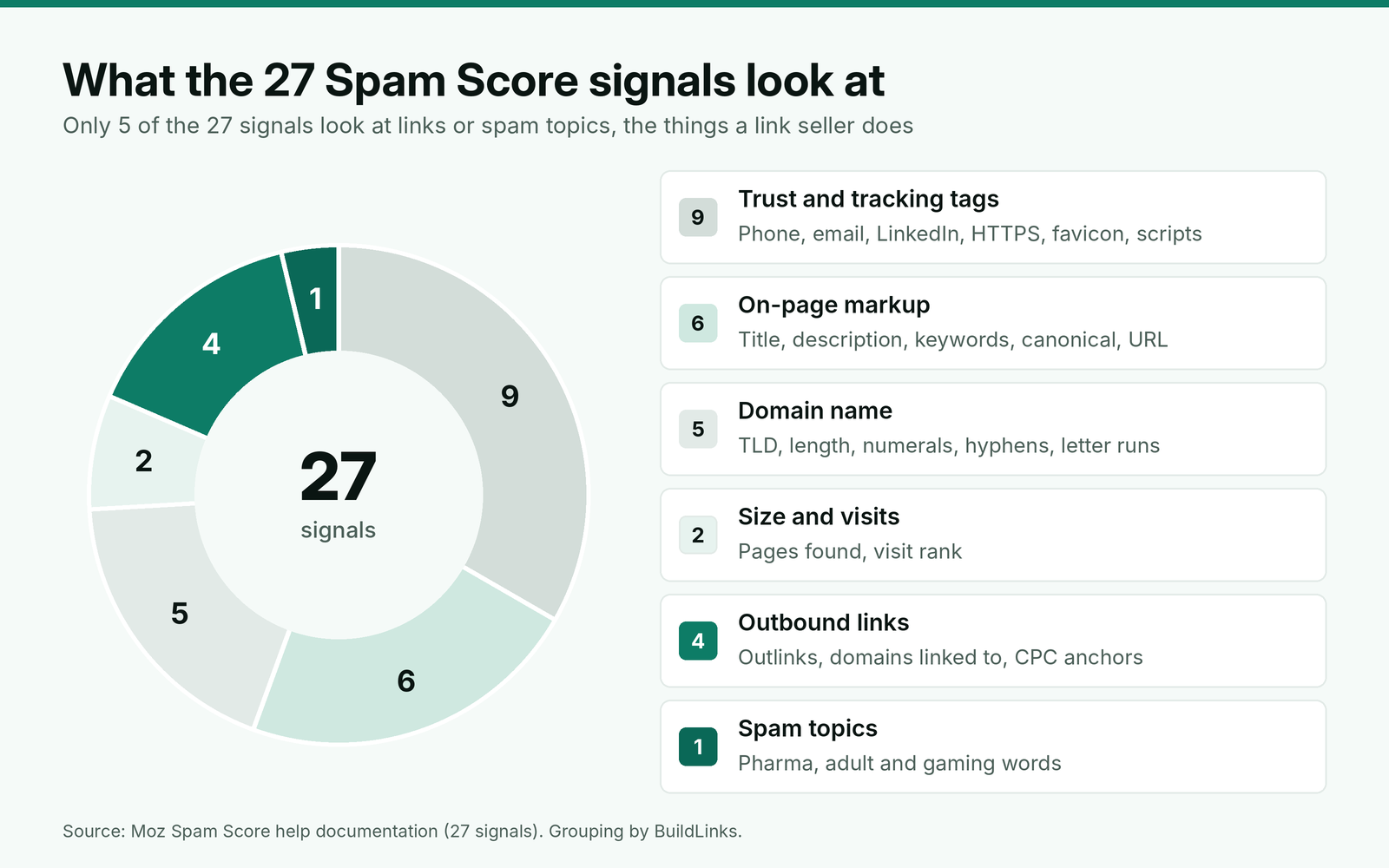
Nine signals check whether a site has things real businesses usually have: a phone number, an email address, a link to a LinkedIn page, HTTPS, a favicon, Google Tag Manager, the Facebook pixel, the DoubleClick ad tag and Google Fonts. Six look at markup such as title and meta description length, meta keywords and canonical tags. Five read the domain name itself. Two look at size and visits.
Signals a site owner can change in an afternoon
Fifteen of the 27, the trust tags and the markup, can be fixed by anyone with access to the theme. A publisher who sells guest posts has every reason to add a phone number, a contact email, a LinkedIn link, a tag manager container and a pixel, and none of that changes who they sell links to. Once those boxes are ticked, a link selling site can show a low score while doing exactly what Google's spam policies describe as link spam.
Signals that are hard to fake
The four outbound link signals are the ones to read closely: the number of external links, the number of domains linked to, the ratio of links to content, and anchor text that uses high CPC words from gray niches. The single topic signal, "poison words" tied to pharma, adult content and gambling, belongs with them. A site that sells links to anyone cannot hide these without selling fewer links, which is why they carry most of the weight when we vet a site.
Does Google use spam score?
No. When asked in 2020, Google's John Mueller said the Moz spam score doesn't affect your backlinks and is not used by Google. Google runs its own spam detection, including SpamBrain, its AI-based system, and it changes that system far more often than a quarterly third-party score can follow.
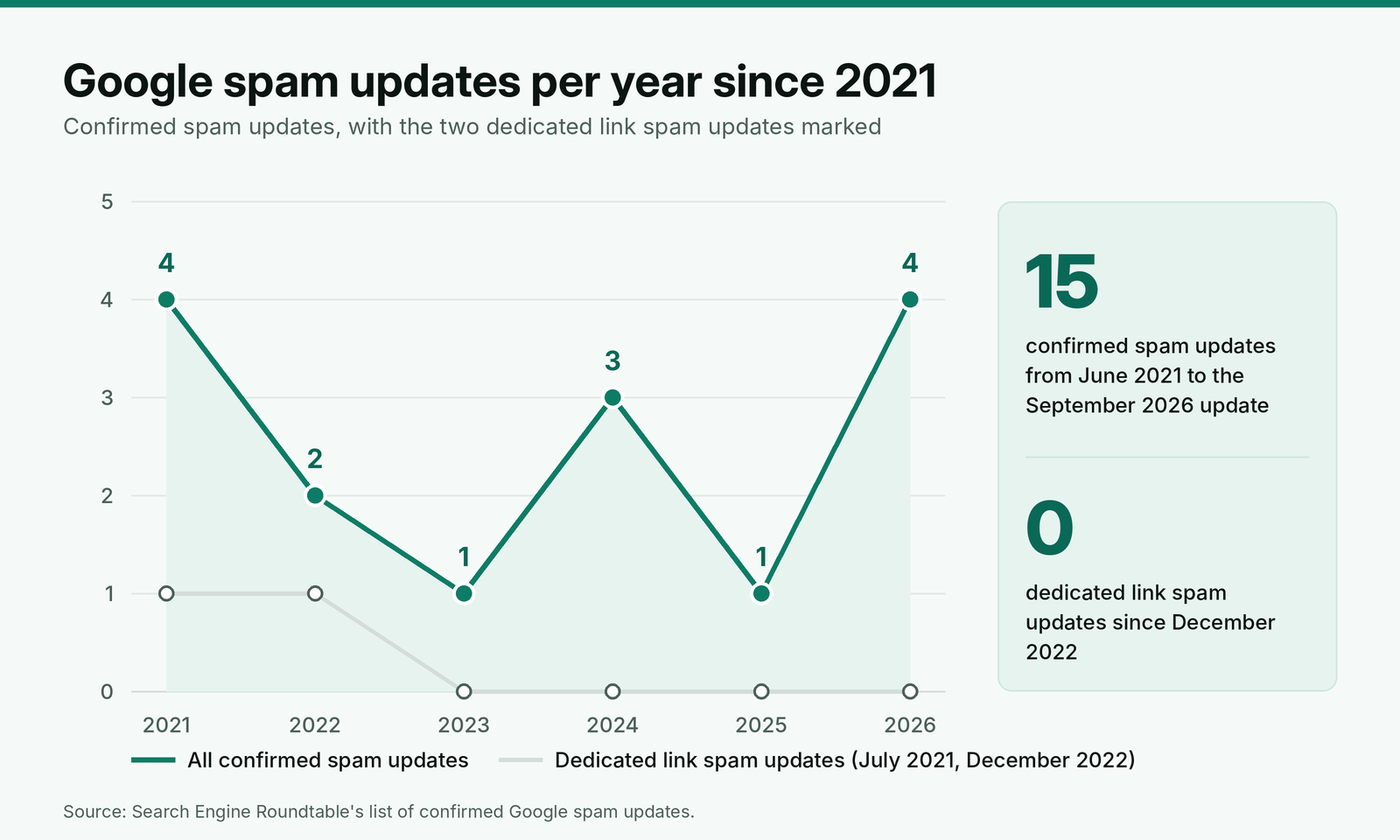
The most recent, the September 2026 spam update, finished rolling out on October 8 after two weeks and did not target link spam. Google's position on bad links has been steady since the December 2022 link spam update: its systems neutralize them, so any ranking benefit a paid link was passing is simply lost rather than turned into a penalty. That changes what spam score is useful for. It is a rough screen for sites you might buy on, not a measure of the risk sitting in a client's backlink profile.
Google's view of third-party "spammy link" reports is just as plain. Asked about spammy links that a tool reported and Search Console did not, Mueller replied that if they are random spammy links on the web, he would just ignore them. A spam score attached to those links does not change that answer.
Why a low spam score proves little and a high one proves less
The two failures run in opposite directions, and both cost money.
A low score on a link seller tells you its theme is tidy. Sites built to sell placements are often more polished than real blogs, because the owner treats them as storefronts. The checks that catch them, such as who the site links to, what its last five posts are about and whether anyone reads it, are the ones the score barely touches. What separates a link farm from a real blog is mostly outbound behavior, and a farm with a contact page and analytics tags can sit comfortably in the Low band.
A high score on a small, honest site usually reflects size. A two-year-old hobby blog with 40 posts, no ads and no business phone number trips several signals at once: few pages found, a low visit rank, and no tag manager, pixel or ad tag. None of those say anything about links.
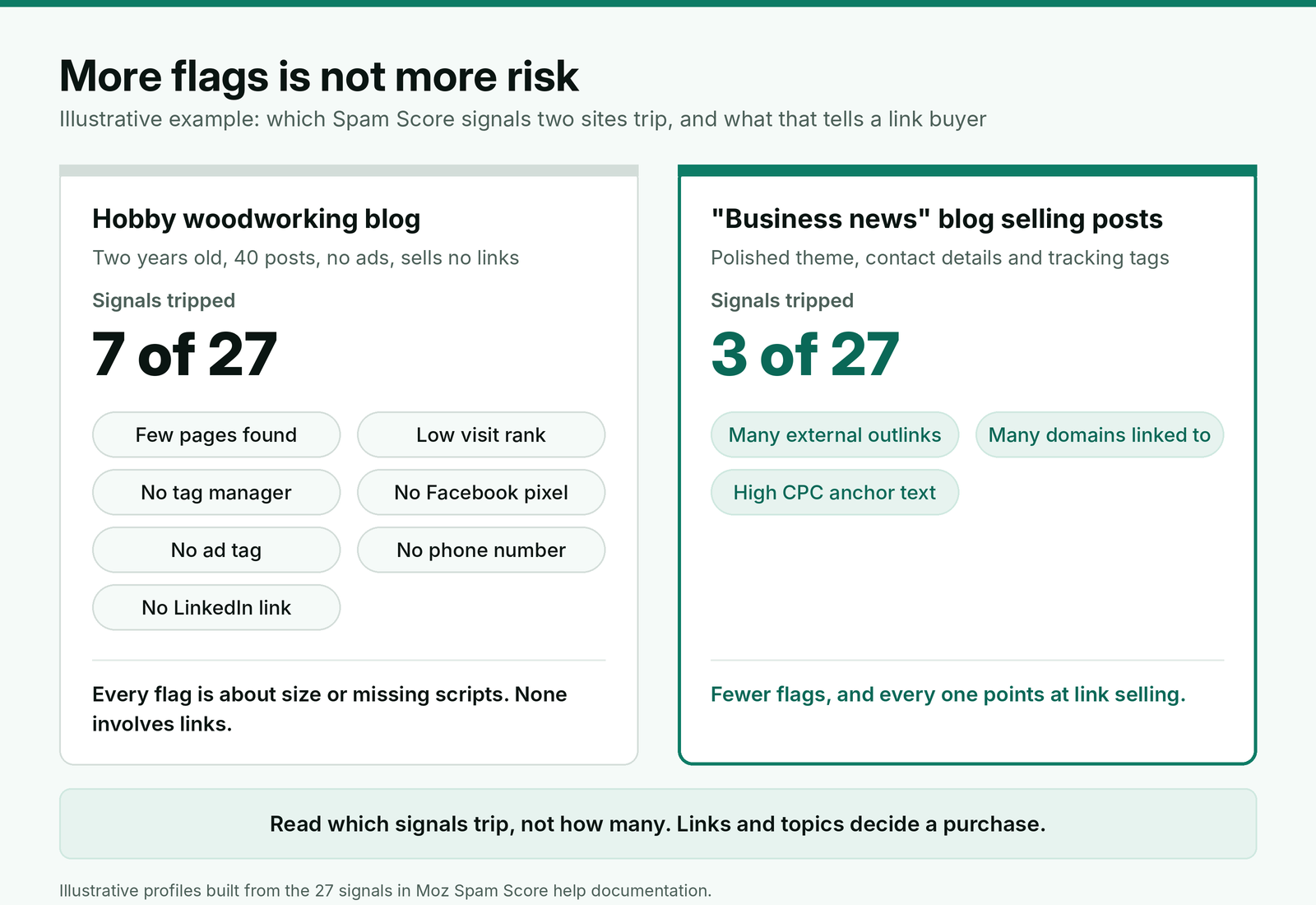
The tool does not show which features a site triggered, so you cannot read the flags off the score. You can check the five that matter yourself in a few minutes, which is the point of the next section.
Spam score thresholds we use when vetting a site
We use spam score to decide how much checking a site gets, never to approve one. Every site still goes through the five checks we run on any site before an order: traffic trend, outbound links, whether the content would exist without the links, the page the link will sit on, and the red flags that end the conversation. The score only adds steps.
| Spam score | Band | What we do |
|---|---|---|
| "--" (not scored) | Unknown | Run the standard checks and record "no score" on the order. Do not read it as zero. |
| 1 to 30% | Low | Standard checks only. A low score earns the site nothing extra, and the outbound link check still runs in full. |
| 31 to 60% | Medium | Standard checks plus an outbound link review: count external links in the five newest posts and list any gray niche anchors. |
| 61 to 100% | High | A second reviewer signs off. Approve only if organic traffic is steady, the five newest posts are on topic and no post links out with pharma, gambling, adult or loan anchors. |
Two habits make the score more useful. Read it yourself rather than trusting the number on a listing, since a seller's screenshot can be a quarter or more out of date. And write the reading on the order with the date, so a later change shows up when you recheck the site.
The outbound link review, in numbers
Open the five newest posts and count external links that are not citations of a source the reader would want. Our working limits: more than 3 commercial outbound links per post on average, or any gray niche anchor in the last five posts, is a reject whatever the score says. A site with zero sponsored posts in its last five and steady traffic can be approved at a Medium or High score, because the flags it trips are almost certainly the size and setup ones.
Worked example: three sites from one vendor list
A vendor sends a list for a home services client. Three of the sites, with made-up figures, show how the score and the checks interact.
| Site | Spam score | Organic visits a month, 12-month trend | Commercial outbound links per post (5 newest) | Gray niche anchors | Decision |
|---|---|---|---|---|---|
| A: "home and lifestyle" blog | 4% (Low) | 600, down 60% | 6 | 2 (casino, payday loan) | Reject |
| B: regional plumbing and DIY blog | 41% (Medium) | 3,800, steady | 0.4 | 0 | Approve after review |
| C: general "tech and business" site | 68% (High) | 900, down 25% | 5 | 1 (CBD) | Reject |
Filtering the list on "spam score under 30%" would have kept A, the worst site on it, and dropped B, the only one worth buying. Site A has done everything right on setup and everything wrong on behavior. Site B trips size signals because it has 60 posts and no tracking scripts. Site C is the rare case where the score and the checks agree, and the checks would have rejected it anyway.
The vendor's list as a whole also tells you something. When most of a list sits in the Low band with falling traffic and the same advertisers across sites, run the checks for a private blog network across a whole vendor list rather than vetting site by site.
Spam score in a client's backlink profile
Agencies see spam score most often in a new client's backlink export, sorted with the highest scores on top. That view invites a disavow file, and it is almost always the wrong move.
Google's disavow help page says to disavow only when two things are both true: you have a considerable number of spammy, artificial or low-quality links, and those links have caused, or are likely to cause, a manual action. A list of linking domains with high spam scores meets neither test on its own. Most of those links are scraper sites and auto-generated directories that Google already ignores.
The links worth acting on are the ones someone built: paid placements without a sponsored or nofollow tag, network links, and exact match anchors bought in volume. Find those by source, not by score, using a referring domain triage in a full link audit, and decide what to do about each one with our guide to when a toxic link is worth acting on.
A vetting note to copy onto every order
Record the score next to the checks that matter, so anyone reviewing the order later can see why the site was approved. Keep it short enough that the team fills it in every time:
Site: [domain]
Spam score: [x]% ([Low / Medium / High / not scored]), read on [date]
Organic traffic: [visits a month], 12-month trend [up / steady / down x%]
Five newest posts: [on topic / mixed / off topic], [x] commercial outbound links per post on average
Gray niche anchors in the last five posts: [none / list them]
Second reviewer (High band only): [name]
Decision: [approve / reject], because [one line]
The "because" line is the part people skip and the part that saves the most time. When the same site comes back on another vendor's list six months later, the reason it was rejected is already on file.
Where BuildLinks fits
Spam score is one reading among several, and the readings only help if they stay with the site. That is the job we built BuildLinks to do. In BuildLinks, every site you buy on sits in an inventory you can filter by DA, DR, traffic and turnaround, with your price on each one, and a new domain is held for approval before anyone on the team can quote it. That approval step is where the vetting note belongs, so a site with a 4% score and a falling traffic line does not reach a client just because it passed a filter.
Thresholds like the ones above vary by client. A client in finance may want a second reviewer on every Medium score, while a local services client may not. In BuildLinks you can write those rules into the client's own brief, alongside its SOPs, so whoever picks up the account applies the same rule without asking.
Conclusion
Treat spam score as a measure of how a site is set up, not of whether it sells links. Only 5 of its 27 signals look at outbound links or spam topics, Google does not use it, and the score refreshes quarterly at best. Use it to decide how much checking a site gets: standard checks below 31%, an outbound link review from 31 to 60%, and a second reviewer above 60%.
Whatever the band, the decision rests on traffic trend and the five newest posts. Reject any site averaging more than 3 commercial outbound links per post or carrying a gray niche anchor, even at a 4% score, and do not disavow a client's links on score alone.