DA vs DR is a comparison of two companies' estimates of the same thing: how strong a site's backlink profile is. Domain Authority (DA) is Moz's score and Domain Rating (DR) is Ahrefs' score; they use different link indexes and different math, so one site can sit at DA 24 and DR 53 at the same time, and Google uses neither.
For link buyers the comparison matters more this month than usual. Ahrefs replaces its current model with a new one, DR4, on December 1, 2026, and about half the sites that have a DR today will not get a DR4 score. This guide covers what each metric measures, why they disagree, what DR4 changes, how to use both when vetting and pricing, and a worked example of re-tiering a vendor list after the switch.
DA vs DR at a glance
Both scores top out at 100, and both are built from links. That is where the similarity ends.
| Domain Authority (DA) | Domain Rating (DR) | |
|---|---|---|
| Made by | Moz | Ahrefs |
| Scale | 1 to 100 | 0 to 100 |
| What goes in | Linking root domains, total links, a spam score and other proprietary inputs | Followed links from other domains; each linking domain splits its own rating equally among every domain it links to |
| How it is combined | A neural network trained to predict ranking, since the DA 2.0 rebuild in 2019 | A link graph calculation, scaled into the 0 to 100 range |
| Model now | DA 2.0 | DR3 until November 30, 2026; DR4 from December 1, 2026 |
| Used by Google | No | No |
The DA inputs and the move to a neural network come from Moz's own explanation of DA 2.0, given to Search Engine Land, which also said the rebuilt model drew on more than 35 trillion links and would lower scores by about 7% across the board when it launched. The DR mechanics come from Ahrefs' help documentation, which gives a useful example: a DR 26 site that links to five domains passes more than a DR 73 site that links to 5,000. We cover that split in more depth in how Domain Rating is built from linking domains.
The practical difference is this. DR answers "how strong is this link profile, as a pure link graph". DA answers "how likely is a site with this link profile to rank, by Moz's model". Neither is a measure of traffic, topic fit or whether the site sells links to anyone who asks.
Google uses neither score
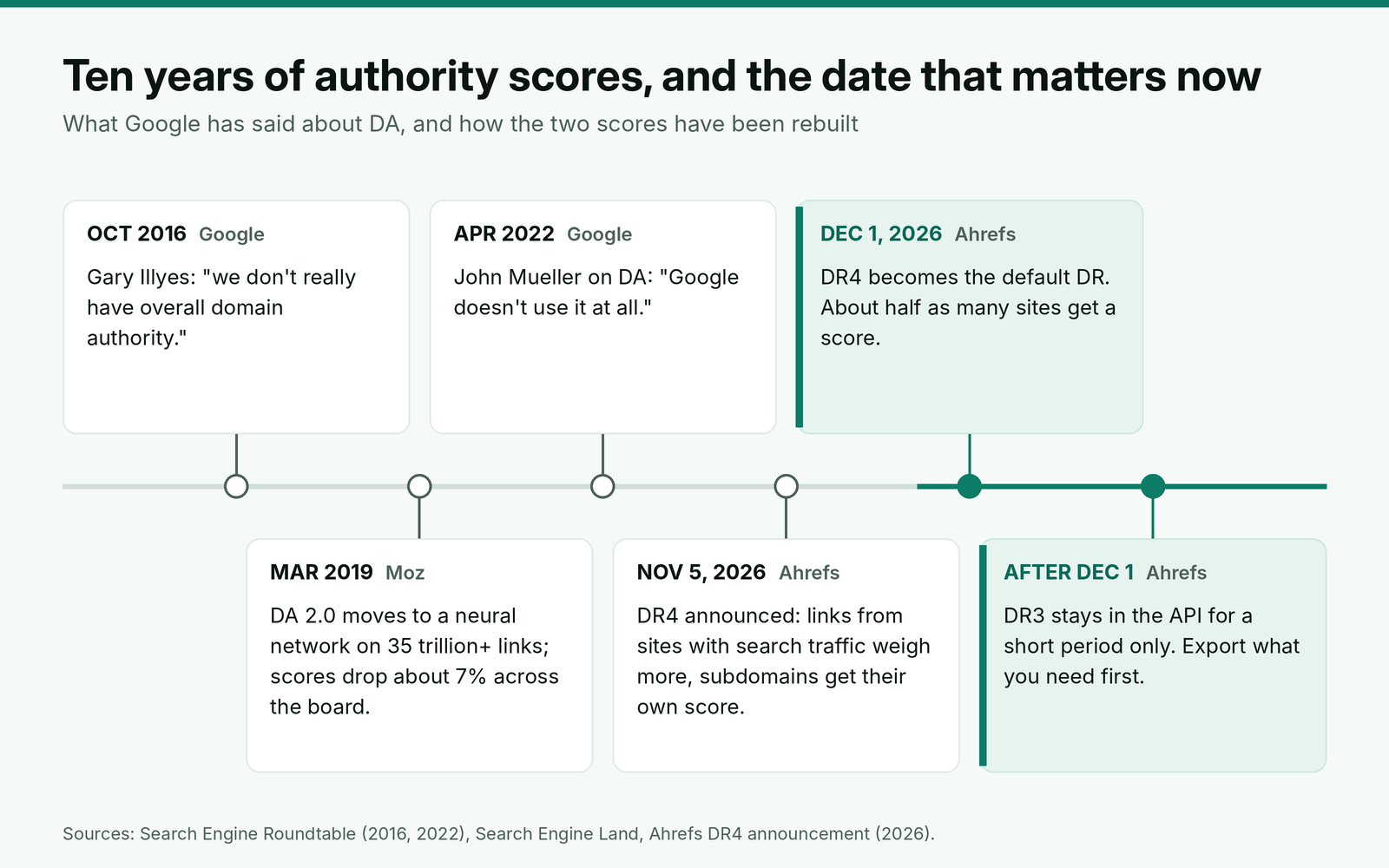
Google has said so more than once. In 2016, Gary Illyes said Google doesn't really have overall domain authority. In 2022, John Mueller answered a question about raising DA by saying Google doesn't use it at all and that you do not need DA for Google Search. The same goes for DR. Both are third-party estimates that never enter Google's systems.
That does not make them useless. They are cheap, fast filters for a list of 500 sites, and the price of a placement tracks them because buyers filter by them. The mistake is treating either one as proof of quality. A news explainer on how domain authority is used in practice collected two examples of the gap: ClickUp's blog lost 97.6% of its organic traffic between January 2025 and April 2026 while its DR rose from 87 to 90, and a link marketplace's study of more than 40,000 sites put the correlation between DA and traffic at 0.238. A score that can climb while traffic collapses cannot be the last check before you pay.
Why DA and DR disagree on the same site
Some gap between the two scores is normal, because the tools crawl different parts of the web, weigh links differently and scale differently. A big gap usually has a reason worth knowing before you quote the site. Our working rule: when DA and DR on one site are more than 20 points apart, look at why before trusting either.
| What you see | Common reason | What to check |
|---|---|---|
| DR far above DA | Many followed links from sites that link out widely, which DR counts and DA's spam inputs discount | The linking domains: are they real publishers or sites that sell to everyone? |
| DA far above DR | Older links DR no longer sees, or a profile Moz's model scores well for ranking potential | Lost links over the last 12 months and the organic traffic trend |
| High DR on a subdomain | The subdomain inherited the platform's rating under DR3 | The subdomain's own traffic and links; DR4 scores it separately |
| Both high, traffic flat or falling | A strong old profile on a site Google no longer sends visitors to | The 12-month traffic trend and what replaced the site in search results |
| Both jumped in one quarter | A burst of new links, often bought to lift the score before selling placements | When the links arrived and whether traffic moved with them |
The first row is the one that costs agencies money. A site can push its DR up with cheap links from sites that sell to any buyer, which are the same link farms with high scores and no readers that a vendor list fills up with. DA's spam inputs tend to blunt that, so a wide DR over DA gap is a reason to open the backlink report before quoting the site.
What DR4 changes on December 1
Ahrefs announced DR4 on November 5, 2026 as its fourth Domain Rating model. It is still built from links, not from domain age or content quality, but it changes which links count and who gets a score. These figures all come from Ahrefs' DR4 announcement:
| Change | Figure | What it means for a buyer |
|---|---|---|
| Sites with a score | About half as many as under DR3 | Domains on your list may show no DR at all from December 1 |
| Whose links count | A smaller pool of domains, with links from sites estimated to get organic search traffic weighted more heavily | Links from sites nobody visits stop propping up a seller's score |
| Subdomains | Scored on their own instead of sharing the root domain's DR | Hosted blogs and platform subdomains lose borrowed ratings |
| Top 1,000 domains by organic traffic | 64.3% rose, 15.8% unchanged, 19.9% fell; fallers lost 7.3 points on average (median 4) | Large, visited sites mostly hold or gain |
| Domains labeled as spam, DR3 between 30 and 70 | Median drop of around 15 to 20 points | The mid-DR sites that fill cheap vendor lists take the biggest cuts |
| DR3 after the switch | Available through the API for a short period only | Save your DR3 readings before you lose access to them |
The announcement also published how well each model correlates with top 10 Google positions, and the result is more mixed than the headline suggests.
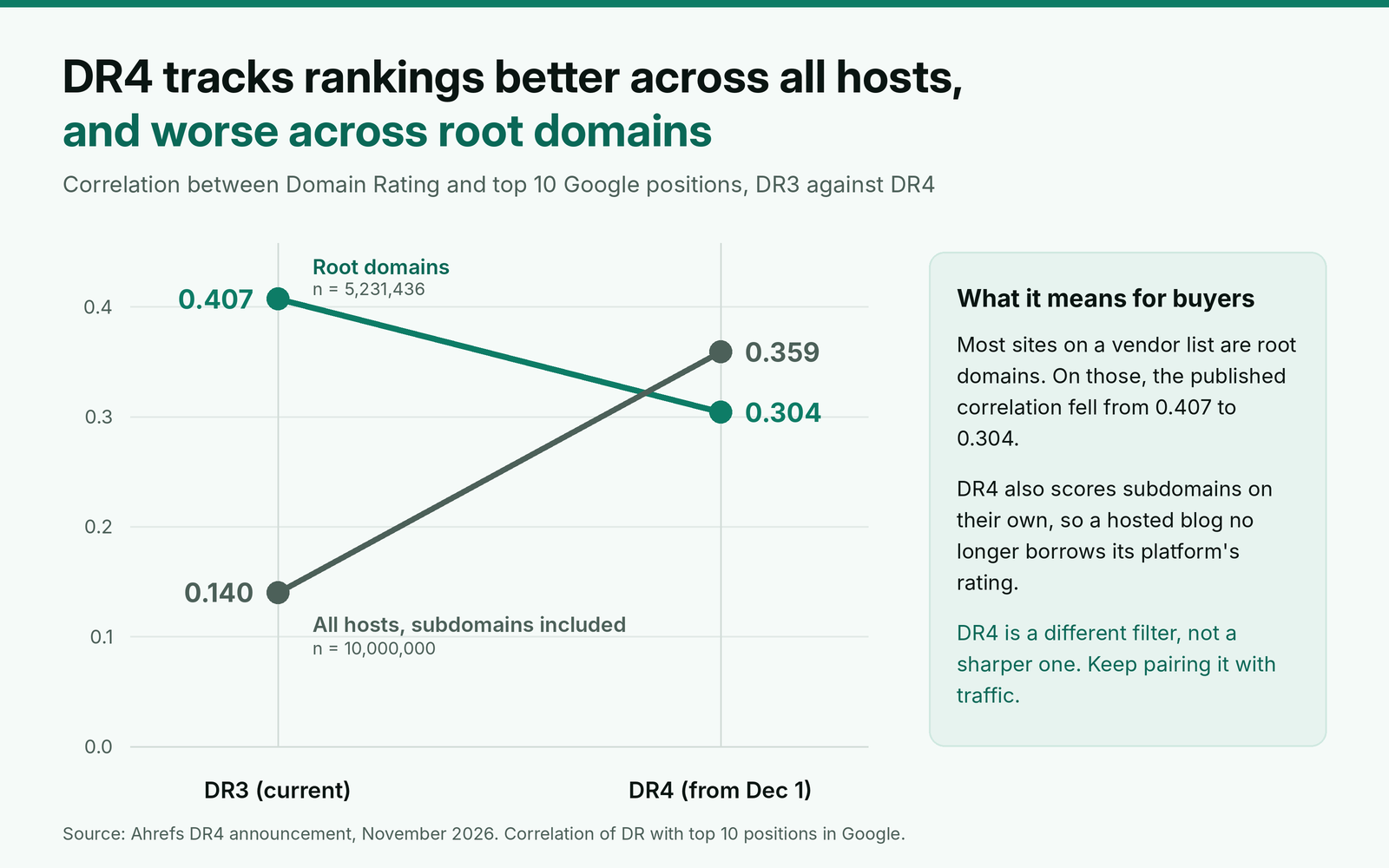
Read that as a reason to keep DR in its place, not to drop it. DR4 fixes a real problem with subdomains and with sites propped up by links from dead sites, and those are exactly the sites that hurt buyers. It does not turn DR into a ranking predictor for the typical root-domain blog you buy a guest post on.
At the top of the scale, DR4 bunches big publishers together. A PR agency scored 222 outlets that PR teams commonly pitch on the DR4 preview, and the results reported by Everything PR show the share at DR 90 or higher rising from about 48% to about 63%.
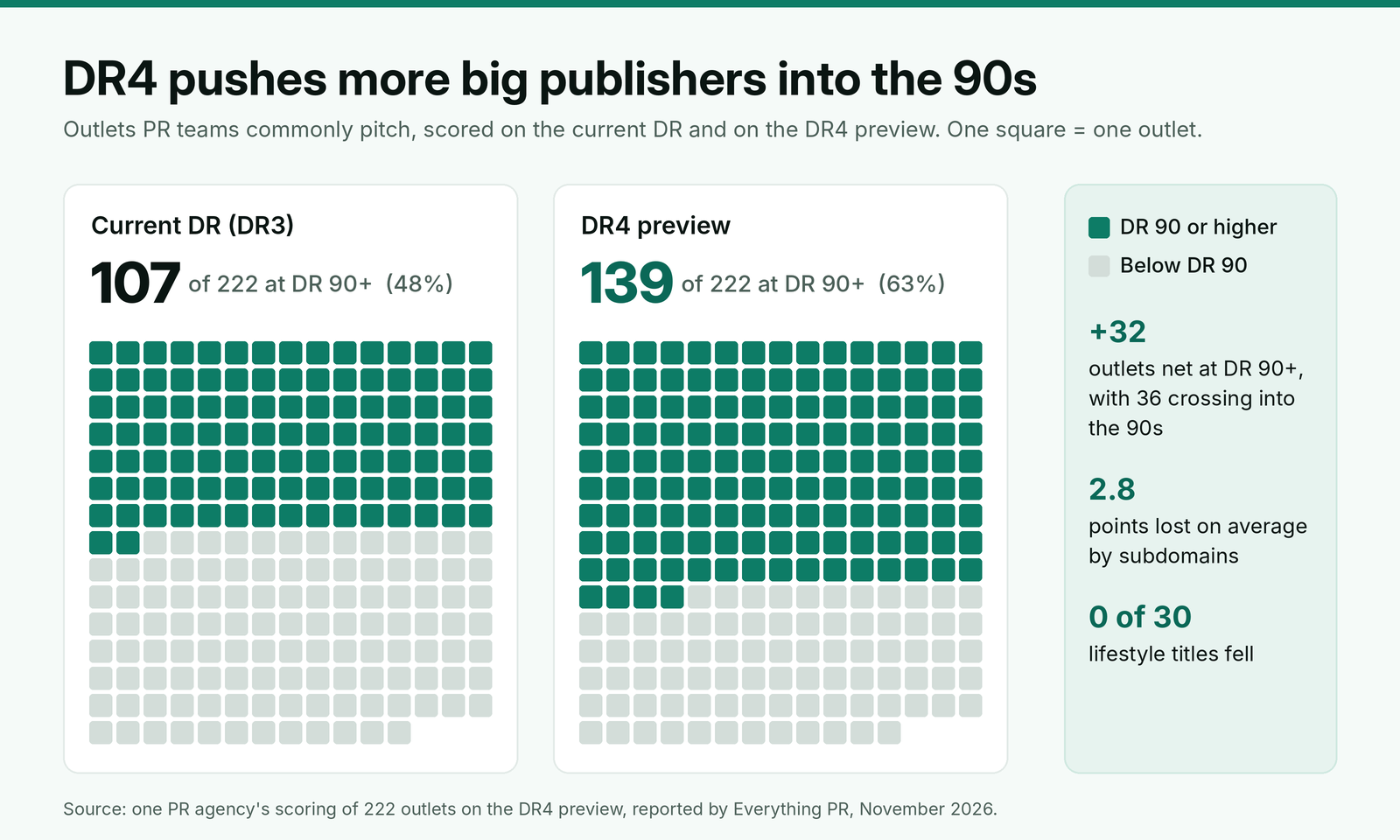
For digital PR clients that means DR stops being a useful way to rank one coverage win against another at the top end. Report the outlet, its audience and the page's traffic instead.
How to use DA and DR when vetting a site
Use one score as your filter and the other as a cross-check, and never let either make the decision alone. The rules we work to:
- Pick one primary score for the agency. Rate cards, proposals and client reports should all use the same metric, or a client will compare a DA from your proposal with a DR in a competitor's and conclude one of you is inflating numbers.
- Set thresholds against the client's competitors, not a fixed number. A DR 30 filter is strict for a local plumber and loose for a fintech brand. Take the median score of the sites that rank for the client's main terms and filter at or above it.
- Check the gap. More than 20 points between DA and DR on one site sends it to a manual look before it can be quoted.
- Pair the score with traffic. In our vetting, a site with a 12-month organic traffic decline of more than 50% fails, whatever either score says.
- Judge the page, not just the domain. For a niche edit, the existing page's links matter more than the site's score, so read page-level scores for the exact page you buy on.
Both scores are first filters. Topic fit, outbound links, sales pages and indexing all come after them, in the vetting checks that come after the metric filter.
Where the score is written down: rate cards, proposals and contracts
Agencies commonly price placements in DR tiers, and proposals often promise "DR 50+ links". On December 1 those promises start meaning something different. A site bought as DR 53 in November may read DR 34 in January without anything about the site changing, and a client checking its own report will see a placement that no longer meets the contract.
Fix it in the wording. Every rate card, proposal and contract that names a DR threshold should say which model and when: "DR as recorded on the order at the order date". Record the score, the model and the date on each order. Then a later model change is a reporting note, not a dispute. If you price by tier, compare your bands with guest post price bands by DR tier after the switch, because sellers will reprice their lists too.
Worked example: re-tiering a vendor list after DR4
Here is a made-up example. An agency prices placements in three tiers: tier A needs DR 50 or higher and at least 3,000 monthly organic visits, tier B needs DR 30 to 49 and at least 1,000 visits, and everything else is tier C, quoted case by case. On November 28 it saves DR3 for every domain in its inventory. On December 1 it pulls DR4 for the same domains. Six of them:
| Site | DA | DR3 | DR4 | Visits a month | Tier before | Tier after | Action |
|---|---|---|---|---|---|---|---|
| Home improvement blog | 41 | 54 | 57 | 8,400 | A | A | None |
| General business blog | 24 | 53 | 34 | 3,600 | A | B | Reprice new quotes; recheck linking domains |
| SaaS review site | 38 | 44 | 49 | 2,100 | B | B | None; one point and 900 visits short of A |
| Blog on a platform subdomain | 31 | 71 | 22 | 1,500 | B | C | Remove from standard quotes |
| Directory-style site | 35 | 47 | No score | 600 | C | Hold | Re-vet before any quote |
| Niche publisher | 29 | 33 | 36 | 1,800 | B | B | None |
Three of the six did not change. Of the three that did, two had a gap of more than 20 points between DA and DR3 before the switch: 29 points on the business blog and 40 on the subdomain blog. The gap rule would have sent both to a manual look a month earlier. That is an illustration, not a study, but it shows why the cross-check is worth the minute it takes.
The open orders do not change. The business blog was quoted as tier A in November, recorded as DR3 53 on the order, and delivered as promised. Only new quotes use the new tier.
Before and after December 1: what to do
Before the switch:
- Export DR for every domain in the inventory, every client domain and every competitor you report on, labeled DR3 with the date.
- Find every rate card, proposal, contract and statement of work that names a DR threshold, and add the model and date wording above.
- Tell clients before their December report arrives, not after they notice a drop.
After the switch:
- Pull DR4 for the same domains and calculate the change for each.
- Hold any domain with no DR4 score until it has been vetted again.
- Re-tier domains that crossed a tier line, and reprice new quotes only.
- Start a new DR series in client reports from December 1. Do not draw one line across both models.
The third step before the switch is the easiest to put off. A short note now costs less than explaining a 15-point drop in January. Adapt this one:
Subject: A change to the Domain Rating figures in your report
Hi [first name],
From December 1, Ahrefs switches Domain Rating to a new model called DR4. It weighs links from sites that get search traffic more heavily and scores subdomains separately, so many sites' DR will move, and some will not get a score at all. Nothing about your site or your links changes on that date.
Your December report will show DR on the new model from December 1, with your November figure on the old model kept alongside for reference. [Client domain] was DR [number] on November [date]. For the links we placed this year, we keep the DR recorded on each order at the time we bought it, so you can see what was promised and what was delivered.
The numbers we judge the work on stay the same: new referring domains, organic traffic and rankings for your target pages. Happy to walk through it on our next call.
[Your name]
[Agency, URL]
The DR line then sits beside the numbers that matter in the client report where these numbers sit, with a note on the model change for the month it happened.
Where BuildLinks fits
A model change is a bulk data problem: hundreds of domains, two sets of scores and a set of tier rules to apply to them. That is part of the job we built BuildLinks to do. In BuildLinks, every domain sits in one inventory you can filter by DA, DR and traffic, along with service type, turnaround and country, with your own prices on each listing. Bulk changes go through CSV import and export, so after December 1 the new scores from your own Ahrefs export go in as one import rather than a day of editing rows.
New domains are held for approval before anyone can quote them, which is where a domain that lost its score can wait until it has been vetted again. Each order keeps its full history with the site attached, so the DR3 export you saved before the switch can be matched to every link bought on the old model.
Conclusion
Treat DA and DR as two filters built from different link data, not as two versions of the truth, and pick one as the agency's standard for rate cards, proposals and reports. Use the other as a cross-check: a gap of more than 20 points sends a site to a manual look, and a falling traffic trend fails it whatever either score says.
Before December 1, save DR3 for every domain you sell or report on and add the model and order date to anything that promises a DR threshold. After it, hold domains with no DR4 score, re-tier the ones that crossed a line, reprice only new quotes, and start a fresh DR series in client reports.